• Skip to main content
  • Home
  • Sign Up
  • Blog & Search
  • Privacy Policy
  • Affiliate Disclosure

WORK FROM YOUR LAPTOP

  • Start Here
    • Watch the Video Tutorial
    • FAQs
    • Start Your FREE TRAINING!
  • Blog
  • Meet Eric

Blogroll

Apr 19 2026

What It’s Actually Like to Learn on Skool (A Student’s Perspective)

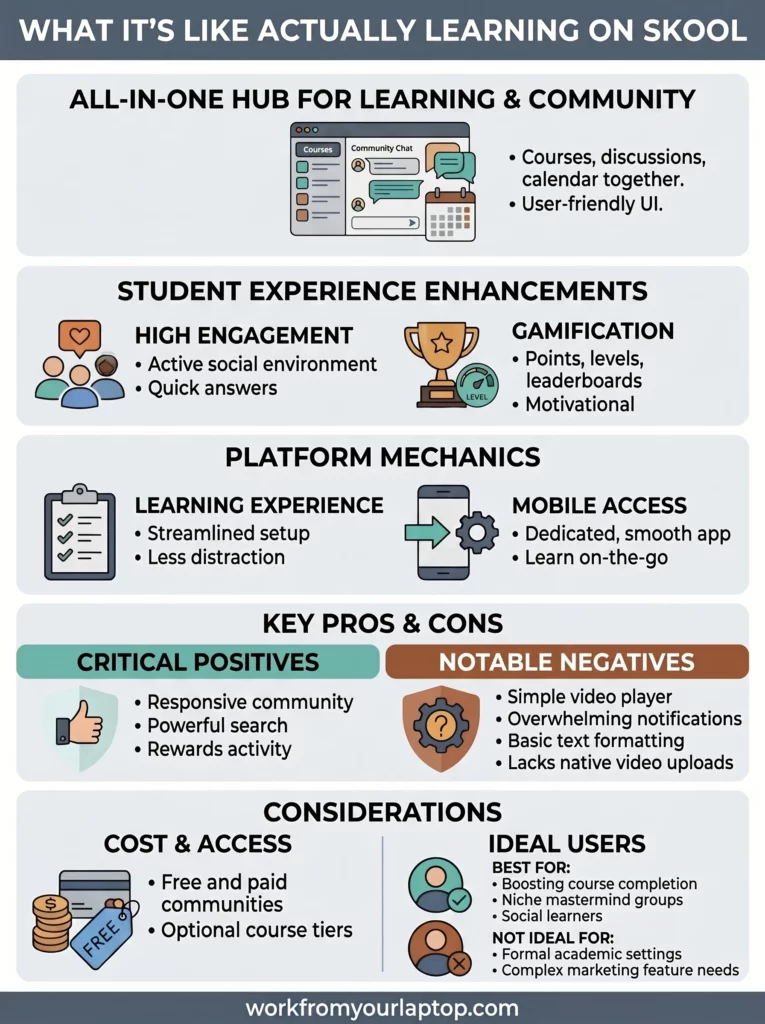
What its actually like to learn on Skool

If you’ve spent any time in the world of online business or digital creators, you’ve probably seen the clean, gamified interface of Skool. I recently did a full Skool review for content creators who are looking to get their course content out to their community. But what’s it actually like to learn on Skool from the student’s perspective?

Is Skool Worth It for Students?

Skool is a legitimate, high-quality social learning platform that combines courses, community, and gamification. For students, it offers a streamlined, “distraction-free” environment that significantly boosts course completion rates compared to traditional platforms.

  • Clean Interface: The minimalist design removes the “noise” of Facebook groups or complex LMS dashboards.
  • Built-in Gamification: Points, levels, and leaderboards make the learning process feel like a game.
  • All-in-One Hub: Courses, community discussions, and event calendars are all in one single location.
  • High Engagement: The “social-first” approach encourages students to actually talk to each other and the creator.
  • Mobile App: A dedicated app allows you to learn and participate in the community on the go.
🔍 Have ChatGPT Summarize This Article

What’s In This Article (Quick Jumps)

  • What Is Skool?
  • How Much Does Skool Cost For Students?
  • Skool Features and Functionality For Students
  • My Student Experience With Skool
  • Skool Student Testimonials
  • Final Thoughts
  • Frequently Asked Questions

What Is Skool?

Website: skool.com
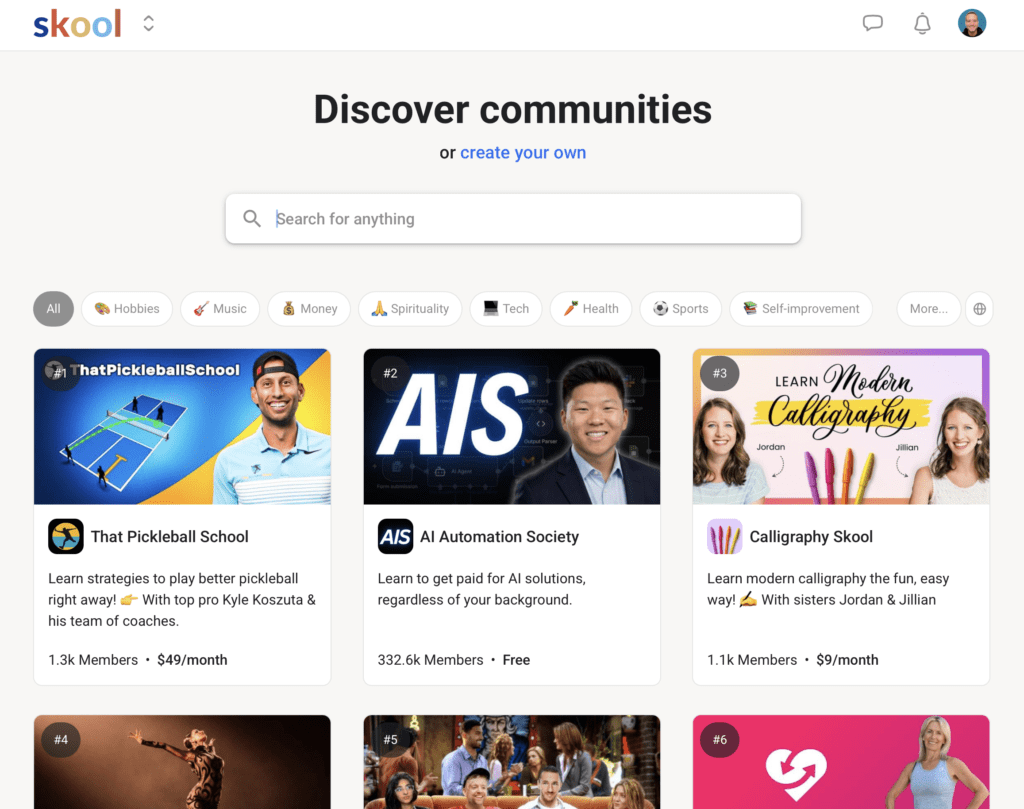
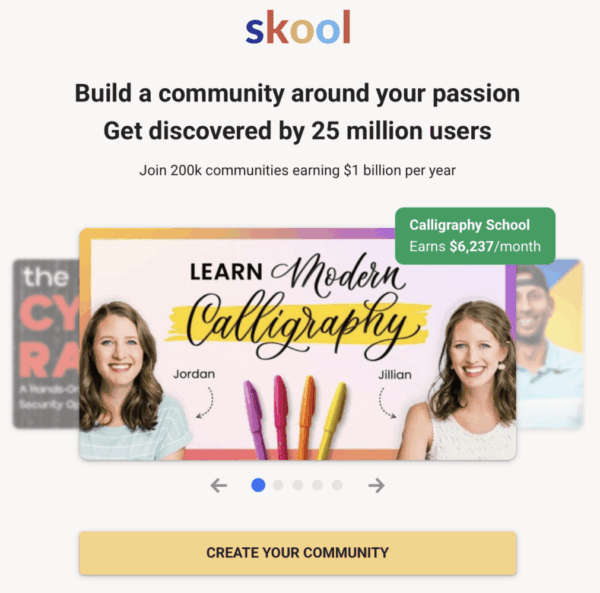
Skool Review

Skool is a community-based platform designed for creators to host their courses and build an engaged audience in one centralized spot. It was founded in 2019 by Sam Ovens who wanted to solve what he called a “fragmentation” problem where students had to go to one site for videos and another (like Facebook) for the community.

In my experience you’d see this all the time. You’d go to teachable for the full course and as part of the package you’d get access to a separate “private Facebook group”. But this always seemed like a hassle. I’m not active on Facebook, so I always ignored the Facebook group.

Now with Skool, the class and the community are all under one roof.

Other options that are similar to Skool are platforms like Kajabi, Mighty Networks, and Circle. However, while Kajabi focuses on being a “Swiss Army Knife” for marketing, Skool’s main focus seems to be on the student experience and community engagement.

Who this is for: It’s perfect for students who struggle with “course abandonment” and want a social, interactive way to learn. It’s also great for hobbyists and professionals looking for niche “mastermind” groups.

Who it isn’t for: If you prefer a formal, academic setting or need complex features like built-in email marketing and advanced sales funnels, Skool might feel too simplified for you.


How Much Does Skool Cost For Students?

From a student’s perspective, the “cost” is usually determined by the creator whose community you’re joining.

  • Free Communities: Many creators offer free “entry-level” groups to get you into their ecosystem.
  • Paid Memberships: These typically range from $20/month to $200+/month, depending on the level of access and coaching provided.
  • Course-Based Access: Some creators charge a one-time fee for a course (e.g., $497 or $997) which then gives you lifetime access to their Skool group.

Any Upsells?

While Skool itself doesn’t have many “hidden” fees for students, you should be aware of Community Tiers. What this means is that a creator will have a basic community and then an optional “Elite” or “Mastermind” tier that is much more expensive. Not to worry though. From what I’ve seen, they’re usually not “essential”, they just offer more features and usually offer more direct access to the founder of the class.


Skool Features and Functionality For Students

The Skool user interface is intentionally thin to keep things fast and easy to use. I think it’s a plus.

  • The Classroom: This is where the video lessons live. It’s a very simple list of modules and lessons.
  • The Community Tab: This looks like a cleaner version of a Reddit feed. You can post questions, share your wins, and comment on others’ posts.
  • Leaderboards & Levels: They’ve managed to gamify the UI which keeps things feeling alive. You earn “points” when people like your posts. Higher points unlock new “levels,” and creators can even set it up so that reaching a certain level unlocks a bonus course.
  • Calendar: A built-in view of all upcoming live Zoom calls, workshops, or community events so you never miss a beat.
  • Universal Search: You can search a keyword and it will find every post, comment, and lesson related to that topic.

My Student Experience With Skool

Just arriving inside Skool it looks like a professional and established spot that is here to stay. I like the simplicity. There’s no confusion as to what it is. Whether you’re a student or a creator you fully understand exactly how to navigate the platform.

The setup process is the fastest I’ve ever experienced with joining an online course. I didn’t have to wait for a “welcome email” with a dozen links; I just logged in and everything was right there, from the videos, the people, the schedule. Done and done.

The daily rhythm of using it is what I surprisingly enjoyed the most. I found myself “checking in” on the community like I would check a social media app. And because you get notifications when people “like” your input, it creates this positive feedback loop that actually kept me coming back to finish the lessons. You’re incentivized to be active, and to be honest, it was fun.

Balanced Take:

  • Specific Positive: I once posted a pretty technical question about a WordPress detail at around 10 PM my time. Because the community was so active, I had three different students and a moderator jump in to answer it inside 15 minutes. That’s really responsive and a huge plus.
  • Specific Negative: If I have to find a negative (and it’s not a big one), it’s that the Classroom player is very basic. If you are used to the advanced playback features of something like YouTube or Vimeo (like specific speed adjustments or advanced captioning), Skool’s native player can feel a bit no-frills, but, honestly, I think it’s meant to be that way on purpose.
Work From Your Laptop YouTube Subscribe

Skool Student Testimonials

As always, don’t just take my word for it. Here are positive and negative reviews I was able to gather from online forums such as Reddit, Quora, and others.

✅ Skool Positive Student Reviews

  • “The first course I actually finished because the leaderboard made me want to ‘win’ the levels.” – Reddit
  • “No ads, no distractions, just learning. It’s so much better than Facebook Groups.” – Trustpilot
  • “The mobile app is surprisingly smooth. I watch lessons while on the treadmill easily.” – G2
  • “I love that I can see everyone else who is online; it makes the course feel ‘alive’.” – Quora
  • “Search actually works. I found an answer to a niche problem in a post from two years ago.” – Reddit
  • “The UI is so clean my grandma could use it without getting lost.” – Trustpilot
  • “I like that the creator can reward active members with secret content.” – YouTube Comment
  • “It feels like a private club rather than just a digital file folder of videos.” – Quora
  • “The ‘Daily Activity’ chart keeps me accountable to my own habits.” – Reddit
  • “Simple billing. I can see exactly what I’m paying for in my settings.” – Trustpilot

❌ Skool Student Complaints

  • “It’s almost too simple. I wish I could format my posts more like a blog.” – Reddit
  • “The ‘Gamification’ can feel a bit childish if you are in a very serious professional niche.” – G2
  • “No native way to host ‘live’ videos; creators still have to link out to Zoom or YouTube.” – Quora
  • “The notification system can get overwhelming if you are in a very large group.” – Reddit
  • “I wish there were more options for ‘Dark Mode’ across the whole platform.” – Trustpilot
  • “As a student, I can’t easily message people unless they message me first in some groups.” – Quora
  • “Sometimes the ‘Classroom’ videos take a second to load on slower connections.” – Reddit
  • “Not enough ‘sub-group’ options. Everything happens in one big feed.” – G2
  • “The mobile app lacks some of the administrative settings of the desktop version.” – Trustpilot
  • “It’s hard to find ‘small’ groups; the platform seems to favor the giant, noisy ones.” – Reddit

Final Thoughts

Skool is a game-changer for students who want everything under one roof with a focus on community and simplicity. While it doesn’t have the “bells and whistles” of older platforms, its focus on engagement makes learning much more fun.

What Do You Think? Have you tried learning on Skool yet, or do you prefer the traditional “video-only” course platforms? Do the leaderboards actually motivate you, or do they feel like a distraction? Let me know your experience in the comments below! I love hearing your perspectives and I always reply!

Check out my Skool review for content creators and see how this platform works from the other side!

What its actually like to learn on Skool
Try SKOOL FREE AND TRY IT OUT!

Trying to make money online and still not seeing results? Create your FREE STARTER ACCOUNT with the same straightforward training I’ve used to create full time revenue online. No matter your experience, this step by step training delivers! Click here and get started NOW!


Frequently Asked Questions

Is Skool better than a Facebook Group for learning?
Yes, Skool is generally superior for learning because it is a dedicated environment without the distractions of personal notifications, ads, and unrelated newsfeed content. It also organizes the actual “lessons” right next to the conversation, which Facebook cannot do effectively.

Do I need a credit card to join a Skool group? It depends on the group.
If the creator has made their community “Free,” you can join with just an email address. If the community is “Paid,” you will need to provide payment details through Skool’s secure checkout (powered by Stripe).

Can I use Skool on my phone?
Yes, Skool has a highly-rated mobile app available for both iOS and Android. It allows you to watch all classroom videos, post in the community, and receive push notifications for mentions or likes.


Want More Honest Reviews?

Don’t slow your roll! We’re just getting started! Check out my experience-first reviews on some of these platforms below! Don’t fall for the online hype machines looking to make a quick buck!

  • Wordform AI review
    Wordform AI Review: What They Don’t Tell You About the $67 Price

  • Cash Tracking System Scam Review
    7 Red Flags That Prove Cash Tracking System Is a Scam

  • Keala Kanae Power Code Masterclass review scam
    Keala Kanae’s Power Code Masterclass Review: The Free Bait Before the $29K Hook
  • Genesis by Inspirean Keala Kanae Scam or Legit Review
    7 Reasons Why Keala Kanae’s Genesis by Inspirean Is a Bad Idea – Honest Review
  • 7 figure accelerator review
    7 Figure Accelerator Review
  • Mastermind.com Review
    Mastermind.com Review: Scam or the Ultimate Knowledge Business Tool?

Written by Eric Cantu · Categorized: Reviews & Comparisons

Apr 17 2026

Skool Review for Creators – $99 Monthly Worth the Hype?

Skool Review

Out of nowhere I started seeing Skool ads everywhere. When I checked it out it looks like a centralized area for content creators and students alike to find communities to teach and learn just about anything. But how good is this for creators? Is it a legitimate game-changer or just another hype machine money-grab? If you want to see my Skool review for students, click here.

TL;DR: Is Skool a Good Deal for Creators?

Skool is a website that helps creators build online communities and sell online courses. At $99/month it can be a good fit if you already have an audience to monetize, but maybe not so much if you’re a brand new creator or need more technical features.

  • It’s Easy to Use: The design is very clean. It doesn’t have too many buttons or confusing menus, so your members can focus on what matters: the conversation.
  • Fun to Participate: Skool has a “game-like” system where members earn points and reach new levels by commenting and being helpful. This keeps people interested and coming back.
  • Everything in One Place: You can host your videos directly on the site, manage payments, and host live events without needing a bunch of other expensive tools.
  • Pricey for Beginners: At $99/month for the Pro plan, it’s a steep investment as a creator if you don’t already have an audience to monetize.
🔍 Have ChatGPT Summarize This Article

What’s In This Article? (Quick Jumps)

  • What is Skool?
  • What Type of Creator is Skool For?
  • What Type of Creator is Skool Not For?
  • How Much Does Skool Cost for Creators?
  • Skool Features and Functionality
  • My Experience: How Skool Compares to Teachable
  • Skool Testimonials
  • Final Thoughts
  • Frequently Asked Questions

What Is Skool?

Website: https://www.skool.com

Skool Review

Skool was started in 2019 by Sam Ovens. He wanted to create a centralized spot where teachers and students alike could find their “community” and exchange ideas and learn..

In early 2024, the platform got a big boost when Alex Hormozi invested in it and added some gamification which breathed new life into it. This helped start the “Skool Games,” where creators compete to see who can build the best, most active groups.

Today, Skool is a mix of an online school and a private social network. It’s built to keep your members coming back every day to talk, learn, and grow. It’s taken off really well and creators are making money from it.

So is Skool the right fit for you as a creator?

Related article: Check out my full review for a similar platform Mastermind.com. Which one provides the best tools and resources for you as an online marketer?

What Type of Creator is Skool For?

  • Coaches and Mentors: If you run group coaching calls or want to mentor people, Skool is perfect. It’s easy to organize your lessons and host live calls all in one spot.
  • Course Creators: If you have a course and want your students to be able to ask questions, share their progress, and help each other, Skool is much better than a static website.
  • Community Builders: If you want to create a space for people with a common interest (like painting, fitness, or coding) to hang out and learn together, this is the best place to do it.
  • People Tired of Social Media: If you want to move your audience away from the “noise” of Facebook or Instagram, Skool gives you a private, distraction-free “club” where you control the rules.

What Type of Creator is Skool Not For?

As a creator, Skool may not be the best fit if:

  • You’re Just Starting Out (Without an Audience): If you’re building your very first course and have no followers, no email list, and no customers, then paying $99/month for a “ghost town” community is a fast way to lose money. You’re better off starting on free platforms to prove people actually want what you are selling before you commit to a monthly bill.
  • You Need “White-Label” Branding: If it’s very important that your community looks exactly like your own custom website with your own colors and fonts, Skool might frustrate you. It always looks a bit like “Skool.”
  • You Need Complex Sales Funnels: If you need a site that automatically sends complex email series, tracks people across different pages, or creates “order bumps” and “upsells” at checkout, Skool isn’t the right tool. You will need a separate sales software for that.
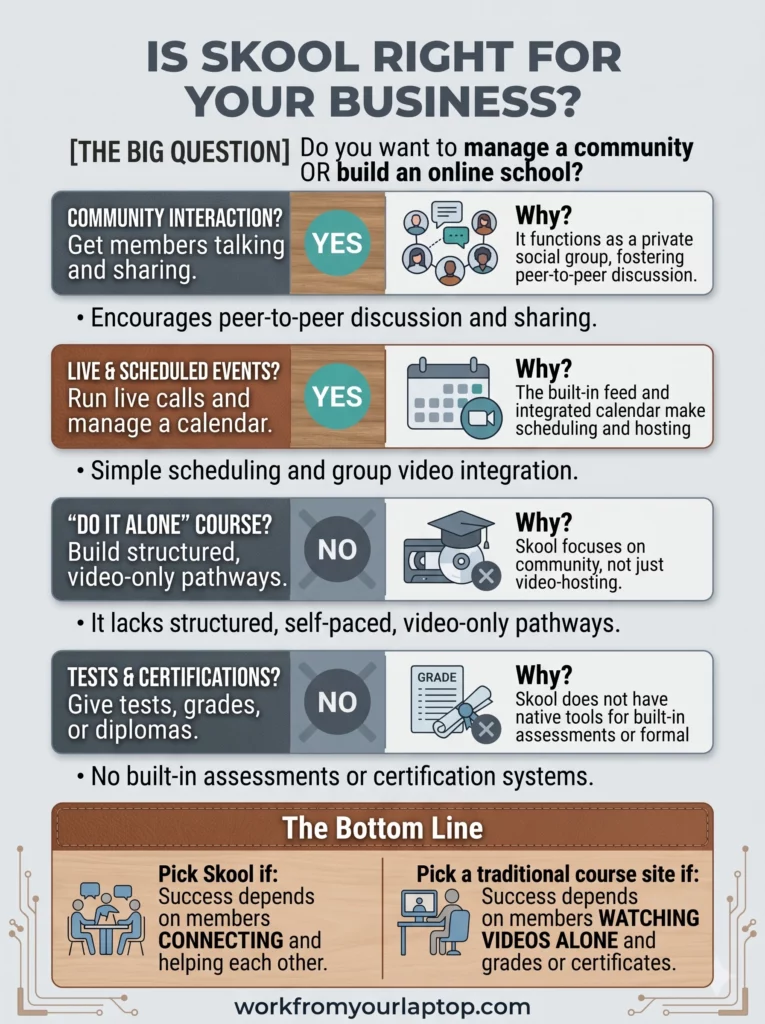
  • You Need Deep Learning Tools: If you’re building a formal school that needs strict grading, fancy certificates, or complex quizzes to test students, Skool is probably too simple for you.
  • You Sell Physical Products: If your main business is shipping boxes of physical products to customers, Skool is not built for that. It is designed for digital knowledge, not store inventory.

How Much Does Skool Cost For Creators?

Skool has simplified its pricing model to keep things more straightforward. They previously had a Hobby Plan at $9/month, but that has been removed. Now you’re either on the sidelines watching or you’re all in.

  • The Plan: It is a flat $99/month.
  • What’s Included: This gives access to all community features, course hosting, events, payments, and analytics.
  • Transaction Fees: There is a processing fee of 2.9% + $0.30 per successful charge.

The “Multiple Community” Catch: It’s important to note that the $99/month price covers one community. If you want to start a second group for a different topic, or if you want a separate “VIP” group that is totally disconnected from your main one, you have to pay another $99/month for each new community you create.

There is no “unlimited” plan for power users.


Skool Features and Functionality

Skool’s design is simple on purpose. They want you to spend time with your members, not fiddling with tech.

  • Community Feed: This is your private forum. There are no ads, no fake news, and no annoying algorithms. You choose what people see, and your members can talk to each other without distractions.
  • Classroom: This is where your lessons live. You can upload your videos directly to Skool, so you don’t have to pay for other video hosting services anymore. This native hosting wasn’t available at first, so it’s a big win for creators.
  • Gamification: This is the secret sauce that has leveled up Skool’s user experience. Members earn points by posting and helping others. You can set it up so that when they reach a certain “level,” they unlock new lessons or special rewards. This means your own community is incentivized to help answer questions so you don’t have to.
  • Events Calendar: If you host live coaching calls, this feature is a lifesaver. It automatically tells your members what time the call is in their local time zone.
  • Freemium Model: This is a big one. You can now create multiple tiers within a single community, offering a “free” tier for entry-level engagement while locking specific courses or chat areas behind a “paid” tier.
  • No Complex Sales Pages: Skool doesn’t include a funnel builder. You don’t need to build custom sales pages, opt-in forms, or complex “order bumps.” Instead, it uses a simple, standard “Membership Page” where users see your community description and pricing, and then click to join.

My Experience: How Skool Compares to Teachable

Most creators start on Teachable because it’s the “traditional” way to sell a course. You build a library, focus on a structured lesson plan, and create a professional, “school-like” experience. Teachable has comment sections under each lesson, and many creators use these to answer student questions.

The difference, though, is these comments are “lesson-bound.” If a student has a question, they post it under that specific video. You answer, and that’s often the end of the conversation.

With Skool, the entire platform is built around the “feed.” Instead of the lesson being the center of the world, I feel like it’s the community discussion that takes center stage. If a student has a question, they post it to the main feed. And because of Skool’s gamification with leaderboards and levels, members aren’t just waiting for me to answer. They’re motivated to jump in, answer each other’s questions, and share their own tips to earn points. 

Skool’s workflow is what saved lots of time:

  • The Teachable Workflow: On Teachable, you’re managing a storefront. For every course you publish, you have to build a dedicated sales page, manage specific checkout settings, etc., to structure your school
  • The Skool Workflow: Skool is “community-first.” You set the price once for the entire group, not for every individual course. When you add a new module or a “Set” of training videos to the Classroom, your existing members automatically gain access to it. You don’t have to build a new sales page or worry about checkout links for each new course.
Work From Your Laptop YouTube Subscribe

Skool Testimonials

Don’t take my word for it. Here are positive and negative reviews creators working with Skool. I was able to gather from online forums such as Reddit, YouTube, and others:

✅ Skool Positive Reviews from Creators

  • “I found Skool to be the ultimate tech-stack killer; dumping my Vimeo, Circle, and scheduling subscriptions saved me $150+ monthly.” — Reddit
  • “Churn finally plummeted after moving here—the community feed gives members a social reason to stay subscribed.” — YouTube
  • “The gamification engine is my secret moderator; members fight to earn points helping each other, so I don’t have to be in the feed 24/7.” — Reddit
  • “Launching is lightning fast; I just dump modules into the Classroom and skip the funnel-builder headache entirely.” — YouTube
  • “The community directory is an underrated growth hack; it’s pulling in warm leads who are already hunting for my specific niche.” — Reddit
  • “The freemium model is a genius entry point; it’s so much easier to upsell people who are already active in the free community.” — Reddit
  • “No more ‘what time is the call?’ emails; the automatic time-zone conversion on the events calendar was worth the price alone.” — YouTube
  • “The Daily Digest is a total set-and-forget engagement tool; it drags members back to my content without me touching a newsletter.” — Reddit
  • “Converting is way smoother now; the unified checkout within the community feels way less jarring than external payment links.” — YouTube
  • “The app is actually fast; my members are checking in daily on mobile, which they never did on my old clunky platform.” — YouTube

❌ Skool Complaints from Creators

  • “It’s annoying that I still need a separate funnel tool; Skool can’t handle my custom upsells or order bumps.” — Reddit
  • “I’m genuinely concerned about being locked in; there’s no easy way to export my community’s full discussion history if I ever want to leave.” — Reddit
  • “The $99 monthly fee is a brutal barrier; it’s a lot of overhead to swallow when you’re still pre-revenue.” — Reddit
  • “It’s a non-starter for my coaching business; without proctored quizzes or certificates, it’s not professional enough for my certification program.” — YouTube
  • “The pricing is too rigid; I’m stuck paying $99 for every single sub-group instead of having one main account with cheaper private areas.” — Reddit
  • “The analytics are too basic; I’m flying blind because I can’t track student drop-off points in my videos.” — YouTube
  • “Evergreen training gets buried instantly; the feed-first design makes it impossible to keep important content visible for new members.” — Reddit
  • “I hate being forced into their payment processor; the transaction fees add up, and I’d rather use my own Stripe integration.” — Reddit
  • “It’s way too cookie-cutter; the lack of custom CSS makes my brand look identical to every other group on the platform.” — Reddit
  • “The signal-to-noise ratio is terrible at scale; my high-paying members are annoyed that the feed is flooded with basic questions from free-tier users.” — YouTube

Final Thoughts

Skool is the best choice for creators who want a “set it and forget it” community without paying for extra tools, but it isn’t for those who need complex features or have yet to find their audience.

What Do You Think? The second you arrive inside Skool is seems like it’s an established platform with staying power. I’ve seen dozens of these platforms come and go, but the gamification factor seems like the “game-changer” that keeps the community interested. As a creator, would you pay the $99/month?

Answer these 2 questions in the comments section for me:

  • If you’re using Skool, has it actually helped your course completion rates?
  • Are you someone who’s always wanted to create your own course, and now you see this as a much easier path than the traditional one using Teachable?
  • Are there any features lacking that make joining as a creator a no-go for your business?

Drop your comment below and let’s talk about it! I love hearing your perspective and I always reply! Want to check out the student experience and what it’s like to actually learn on Skool? Click here!


Skool review is Skool right for your business
join skool free and try it out!

Trying to make money online and still not seeing results? Create your FREE STARTER ACCOUNT with the same straightforward training I’ve used to create full time revenue online. No matter your experience, this step by step training delivers! Click here and get started NOW!


Frequently Asked Questions

Is Skool better than a Facebook Group?
For business, absolutely. Skool removes the distractions of social media, provides a structured Classroom for your content, and uses gamification to keep members active, which Facebook simply cannot match.

Is Skool worth the $99 monthly fee?
If you already have paying members, the price is a bargain because you can cancel other tools like video hosting and scheduling software. If you are just starting and have no income, it is a high cost to pay every month while you build your audience.

Is it good for formal online schools or certifications?
No. If your business needs to issue official certificates, grade quizzes, or track exactly how much of a video a student watched, Skool will not work for you because it lacks these specific professional academic features.


Want More Honest Reviews?

I search far and wide doing the research so you don’t have to! Check out these other honest reviews and see if they stack up!

  • Wordform AI review
    Wordform AI Review: What They Don’t Tell You About the $67 Price
  • Cash Tracking System Scam Review
    7 Red Flags That Prove Cash Tracking System Is a Scam
  • Keala Kanae Power Code Masterclass review scam
    Keala Kanae’s Power Code Masterclass Review: The Free Bait Before the $29K Hook
  • Genesis by Inspirean Keala Kanae Scam or Legit Review
    7 Reasons Why Keala Kanae’s Genesis by Inspirean Is a Bad Idea – Honest Review
  • 7 figure accelerator review
    7 Figure Accelerator Review
  • Mastermind.com Review
    Mastermind.com Review: Scam or the Ultimate Knowledge Business Tool?

Written by Eric Cantu · Categorized: Reviews & Comparisons

Apr 14 2026

Repurpose Your Blog Content: A 3-Step Guide to Turning Articles into Social Posts

Repurposing Your Blog Content Into Social Media Posts

Your audience, no matter your niche, is on the socials. Instead of spamming the link to your latest article all over Facebook, Twitter, Instagram, LinkedIn, Pinterest, Threads, TikTok. (…jeez are there really this many?), how about repurposing that article into a perfectly fitting social media post? Let me show you how I do it.

TL;DR: How to repurpose blog content for social media?

Repurposing involves breaking your long-form blog post into platform-specific assets like short-form video scripts, carousel slides, and threaded tweets. By “atomizing” your core message, you increase reach, maximize content lifespan, and drive consistent traffic back to your primary website.

  • Audit: Identify your highest-performing, evergreen blog posts.
  • Atomize: Extract the core argument into 3-5 distinct sub-topics.
  • Adapt: Reformat those points for the native features of your chosen social platforms.
🔍 Have ChatGPT Summarize This Article

What’s In This Article? (Quick Jumps)

  • Why Repurposing Your Blog Content Matters
  • My Experience Turning Blog Posts Into Social Media Posts That Convert
  • Step by Step Breakdown: The Core Strategy
  • Common Pitfalls & What to Avoid
  • Your Next Step
  • Final Thoughts
  • Frequently Asked Questions

Why Repurposing Your Blog Content Matters

Content repurposing is the practice of systematically deconstructing long-form articles into micro-content for social distribution. This strategy maximizes audience reach, reinforces your authority across multiple channels, and solves the creator’s burnout problem by ensuring high-value information is seen by your target audience in their preferred format.

Trust me when I say that in the current era of blogging, the “post and pray” method is officially dead. Social media platforms massively prioritize high-engagement content over spammy link-dropping. Your link will not only get ignored but it’ll probably get you shadow banned.

If you ignore this opportunity, you’re leaving about 80% of your audience’s attention on the table. Never leave meat on the bone! Mastering social media marketing is all about owning your niche by appearing everywhere your audience already hangs out.

Do it right and it won’t take up all your time either.


My Experience Turning Blog Posts Into Social Media Posts That Convert

When I first started my online business, I thought that to grow, I’d have to come up with never ending brand new ideas. It was intimidating. I didn’t realize that the most successful people online aren’t the ones making the most content, it’s the ones who are best at reusing what they already have.

The “a-ha” moment for me happened when I looked back at an article I had written months before that was doing well. I realized that one long piece of writing actually had five or six smaller, ideas hidden inside it that were perfect nuggets I could use for social media.

This lightbulb moment really did take the pressure off. It made my work much easier and more organized. One article could provide content for a Facebook post, a post on Threads, an Instagram reel, and more. I had an actual plan.

In blogging, you don’t need to build a brand-new toy every time you want to play. Just take your existing bricks and rearrange them into something new. A great business gets more done without getting stressed out.

And that’s exactly what repurposing your blog posts can do for you and your business. Let me show you my method that’s worked for me.

Related article: Repurposing for Pinterest can be really fun! Check out my guide on how to turn your Pinterest traffic into traffic for your website!


Step-by-Step Breakdown: The Core Strategy

A successful repurposing workflow requires a structured transformation process: identifying the primary value hook, distilling the content into platform-specific modules, and scheduling the rollout. This approach ensures consistent messaging while catering to the unique consumption habits of users on various social media platforms.

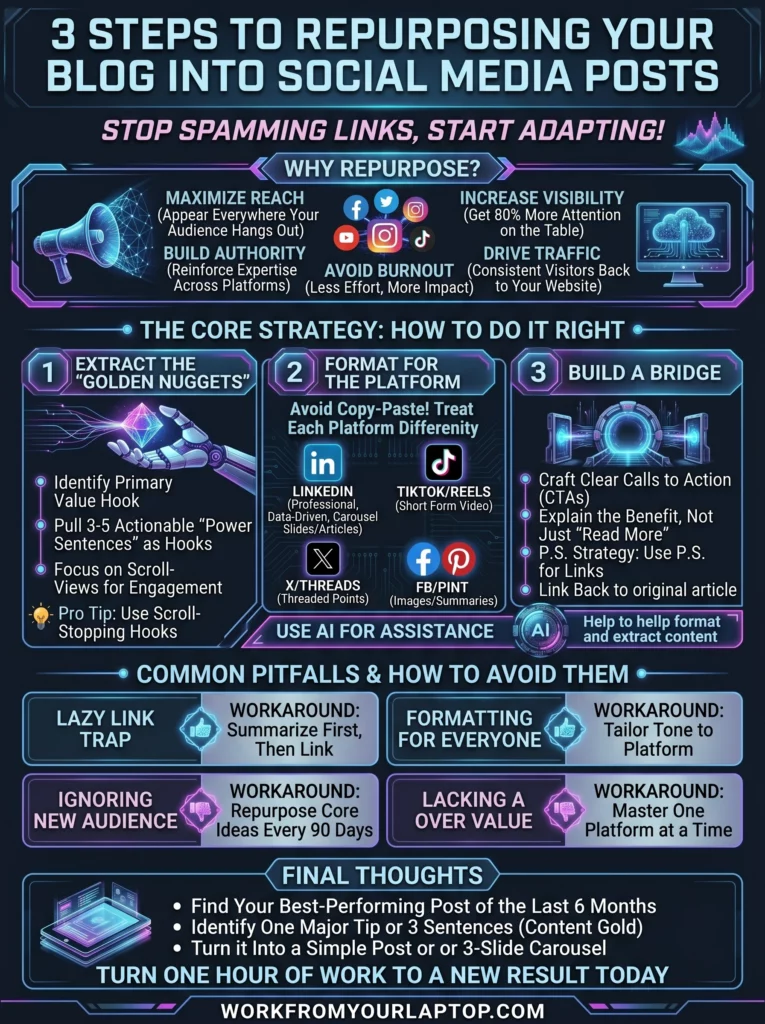
1. Extract the “Golden Nuggets”

Don’t try to condense your whole article. There’s way too many pieces. Focus on the most actionable takeaway or the one point that goes against the grain. (Those are great for social media). Pull out 3-5 “power sentences” from your post. These are gonna be your hooks.

Pro Tip: If a sentence makes you pause while reading it, it’ll do the same for your reader. And when they pause they stop their scroll. Use these too hook them in.

2. Format for the Platform

Each social media platform has its vibe and its style. Don’t just copy and paste the same thing into all your platforms. Play to each platform’s wheelhouse; AI is great for this.

Pro Tip: Ask you AI tool of choice to transform a short blurb form your blog post into “a perfect video for TikTok”, or “a great reel for Instagram”, or “a tweet that will demand retweets” and watch it give you the perfect direction on how to do exactly that.

Related article: Not sure whether to post on X or Threads? Check out my comparison guide “Threads vs X vs Bluesky”.

3. Build a “Bridge”

Every piece of repurposed content needs a clear “Call to Action” that links back to the original blog post. Don’t just say “read more”; explain the benefit of clicking through.

Pro Tip: Use a “P.S.” at the bottom of your post to link to the article, rather than putting the link in the main body.


Common Pitfalls & What to Avoid

Common errors in content repurposing include direct link-spamming, failing to adjust tone for platform-specific audiences, and ignoring the visual requirements of social algorithms. Avoiding these pitfalls requires a mindset shift from “promoting a link” to “delivering value” through native social media formats.

  1. The “Lazy Link” Trap: Just posting a link to your blog is the fastest way to get shadow banned. Workaround: Summarize and give some context in the caption first, then link to the full read.
  2. Formatting for Everyone: LinkedIn isn’t TikTok. Workaround: Tailor your tone. Be professional and data-driven on LinkedIn; be personal and raw on short-form video.. Remember, AI is great at doing this for you.
  3. Ignoring the “New” Audience: Thinking that because you already posted it, everyone saw it. Workaround: You can actually repurpose the same core idea every 90 days. Your audience changes, and reminders help.
  4. Lacking a System: Waiting for inspiration. Workaround: Spend just one hour on Sunday “content mining” your existing blog posts for the week ahead. Just feed a post into your AI tool of choice and ask it to pull the best nuggets
  5. Focusing on Volume over Value: Trying to post everywhere at once. Workaround: Master one platform before moving to the next. I like to focus on two max. Don’t spread yourself so thin.
Work From Your Laptop YouTube Subscribe

Your Next Step

Your next move is to stop staring at that blank cursor and start looking backward. What do I mean? Go find your best-performing blog post from the last six months. Look for the one that got the most comments or shares. Pull out three key sentences or one major tip from that article. Remember, you can use AI for this. This is your “content gold” that you’re going to use for your social media posts

Now, take those three points and turn them into a simple, three-slide carousel for LinkedIn or a quick, punchy list for a social post. I know I sound like a broken record by now, but helloooooo, use AI for this! This process takes a high-value idea that you’ve already proven works and giving it a second life in front of a whole new group of people.

You’ll be surprised at how much easier it is to “create” when you’re just using AI to rearrange gems you’ve already polished.

Once you hit publish on that repurposed post, you’ll feel the same “a-ha” moment I did.. You just turned one hour of past work into a brand-new result today. This is how you win the long game without burning out.

Start small today, and watch how this simple habit turns your “old” writing into your most powerful new growth engine.


Final Thoughts

Content repurposing is about efficiency, not laziness. Take one “Golden Nugget” from a past article today and turn it into a short-form post. That’s your only goal for the next 24 hours.

What do you think? Don’t get shy on my now. I love hearing your perspective on things. Answer the two questions below in the comments section and be honest. This is going to help you improve your results.

  • Which of the platforms you use do you find the hardest to adapt your blog content for?
  • Do you prefer “summarizing” an article or “expanding” from one specific point for social media?
Repurposing Your Blog Content Into Social Media Posts infographic

Trying to make money online and still not seeing results? Create your FREE STARTER ACCOUNT with the same straightforward training I’ve used to create full time revenue online. No matter your experience, this step by step training delivers! Click here and get started NOW!


Frequently Asked Questions

Is it okay to post the exact same text across all social media platforms? No. Each platform has a different “language” and user intent. Adapt your tone and format to fit the native style of the platform (e.g., LinkedIn vs. X/Twitter) to ensure the algorithm favors your content.

How often should I repurpose old blog content? You should aim to refresh and repurpose evergreen content at least once every 3–6 months. This allows you to introduce the same high-value information to new followers who missed it the first time around.

Does repurposing content hurt my SEO? No. Distributing summaries of your content to social media helps drive traffic, which acts as a positive signal to search engines. Just ensure the social post links back to your original, canonical article on your own website.


Want More Social Media Strategies?

No matter your niche, your audience is hanging out on social media! Learn how to find and connect with them and get those conversions your content deserves!

  • Pinterest SEO for Bloggers: Turning Pins into Website Traffic
    Pinterest SEO for Bloggers: Turning Pins into Website Traffic
  • Repurposing Your Blog Content Into Social Media Posts
    Repurpose Your Blog Content: A 3-Step Guide to Turning Articles into Social Posts
  • Threads vs X vs Bluesky Review
    Threads vs. BlueSky vs. X: Which Platform is Best for Affiliate Marketing?
  • Affiliate Marketing Strategies for Social Media
    Affiliate Marketing Strategies For Social Media in 2025

Written by Eric Cantu · Categorized: Social Media for Affiliates

Apr 13 2026

Wealthy Affiliate Review 2026 – Why Their AI Tech Stack Is a Must Have for Content Creators

Wealthy Affiliate Review 2026

If you’ve followed me for a while, then you know that I’m one of the expert trainers inside Wealthy Affiliate. This is the exact training I found on my own back in 2017 when I had no idea how online business worked.

This is not a “done for you” system, and it’s not some “set it and forget it” platform where you don’t have to do any work. But if you want to build a real online business around your actual interests, let me show you why you’ve found what you’re looking for.

TL;DR: Is Wealthy Affiliate Legit?

Wealthy Affiliate is a comprehensive ecosystem designed to help you build, host, and grow an affiliate marketing business. With built-in AI tools for content, design, and SEO, it provides everything a beginner needs to start from scratch..

  • Comprehensive Ecosystem: Provides high-speed hosting, AI writing and design tools, keyword research tools, & step-by-step course lessons in one dashboard.
  • No-Cost Entry: The free starter membership allows you to build a website and start the first 10 lessons without adding any payment information.
  • AI-Powered Updates: Recent updates include Business Hubs, AI Article Designer to speed up content creation, DsgnPop logo designer, and a true stand out feature Image Studio.
  • Community Support: Features a 24/7 live chat and a community of over 2 million members for troubleshooting, asking questions, and more.
  • Long-Term Strategy: This is a marathon, not a sprint; those looking for “push-button” riches or first month revenue will likely be disappointed.
🔍 Have ChatGPT Summarize This Article

What’s In This Article? (Quick Jumps)

  • What is Wealthy Affiliate?
  • How Much Does Wealthy Affiliate Cost?
  • Wealthy Affiliate Features and Training
  • My 9 Years With Wealthy Affiliate
  • Wealthy Affiliate Testimonials
  • Feature Spotlight: Wealthy Affiliate Image Studio (Watch This Video!)
  • Final Thoughts
  • Frequently Asked Questions


What Is Wealthy Affiliate?

Website: wealthyaffliate.com

Wealthy Affiliate is an online training hub and community founded in 2005 by Kyle Loudon and Carson Lim. In my almost 10 years experience with Wealthy Affiliate, what makes it stand out is its straightforward, “non-guru”, “no flash” approach to its training.

WA is built for beginners. I was an absolute beginner when I started, and I appreciated the step by step training for a total newbie. I had never built a website before and knew zero about online business. I made a commitment to follow the training like a robot and I started seeing results.

The approach is a simplified, direct one. Let me break it down for you.

Wealthy Affiliate’s core philosophy is “Niche, Website, Content, Revenue.” 

  • Choose your niche around a passion or interest.
  • Build your niche website in seconds using the Business Hub website builder.
  • Create content with the AI Article Designer and Image Studio to drive targeted traffic to your site
  • Use affiliate programs and monetized traffic to turn those visitors into revenue.

You’re walked step by step through this process via

  • Step by step course lessons and 4 phases of Core Training
  • Weekly expert classes
  • Daily expert training vlogs
  • One-on-one training and mentorship

What you get with Wealthy Affiliate is full freedom of direction to build a real, profitable business based on your own interests. I’ve done a ton of reviews on “guru-led” competitors that charge $1,000+ to have you simply buy and then resell their product. Wealthy Affiliate teaches actual affiliate marketing. You never have to promote Wealthy Affiliate or take part in their affiliate program if it doesn’t fit your niche.


How Much Does Wealthy Affiliate Cost?

Wealthy Affiliate has 3 tiers of membership:

  • Free Starter Membership ($0): The purpose of the free starter account is to test drive the platform to see if it’s a good fit. It includes 1 website, Phase I of the Core Training (see below in “Features” section), 1500 AI credits and limited use of Business Hubs.
  • Premium Plus+ ($49 first month, $99/month thereafter, or $588/year): This is the “Pro” tier you upgrade to from your free starter account. It includes:
    • 100% of all the training and tools available inside Wealthy Affiliate
    • 10 websites with included hosting, 10 email accounts per site, Included SSL, 24/7 Site Support
    • 1 free .com domain
    • 60k AI credits per month for creating content with the AI Article Designer and creating images/graphics with DsgnPop and Image Studio
    • Bonus 100k AI Credits for upgrading to yearly membership
  • Premium ($49/month, $497/year): While you can’t upgrade directly to this Premium tier from the free starter membership, this tier is available if you want to downgrade from Premium Plus. It includes 3 websites and 10k monthly credits.

Additional costs:

  • Domain Registration: While your first .com is included with Premium Plus+ membership, additional domains cost anywhere from $20-$25/year

Wealthy Affiliate Features and Training

This is where I feel Wealthy Affiliate has made major strides over the last couple of years. When I got started with Wealthy Affiliate back in 2017, we didn’t have ANY of this.

This is what I call their “Tech Stack”. In my opinion, every content creator should get their hands on Wealthy Affiliate’s AI image creation tool called Image Studio. It’s worth the price of admission all by itself.

The “Tech Stack”

  • Business Hubs: This is your main “hub” for working on your site. It manages your niche research, website and branding, keyword research, affiliate programs, and content writing. You can create up to 10 business hubs.
  • AI Article Designer: This is your main writing tool to help you outline and draft posts. You can choose to write everything yourself, but using AI for the heavy lifting is a massive benefit in my opinion. Pro tip: Always make AI written content your own by adding your voice.
  • DsgnPop: Great AI tool for creating branded, professional logos.
  • Image Studio: I use Image Studio for everything. Click the link to my full YouTube video walkthrough in the Image Studio section further below to see it in action.
  • Jaaxy Keyword Tool: Helps you find “low-hanging fruit” keywords with low competition.
  • SiteRubix Builder: Built into Business Hubs, this will build your website in seconds.

Wealthy Affiliate’s Core Training

This is where you learn the basics and make your way to intermediate level principles of affiliate marketing and online business. Even if you have some experience, don’t sleep on these course lessons.

What I took away personally from these course lessons is the focus on delivering value to your audience if you want to rank and build traffic.

  • Phase I: Getting Started
    • Lesson 1: Welcome to Wealthy Affiliate
    • Lesson 2: How the Make Money Online Process works
    • Lesson 3: Setting Money Goals & Accessing Live Chat
    • Lesson 4: Creating a Hub for your Business (and Choosing Your Niche)
    • Lesson 5: Crafting Your First Niche Post Using Our Designer
    • Lesson 6: Choosing a Brand for Your Business
  • Phase II: Your Brand and Content
    • Lesson 1: Getting Your Branded Domain (and Moving Your Website To It)
    • Lesson 2: Creating a Professional Logo
    • Lesson 3: Keyword Research with Jaaxy
    • Lesson 4: Creating Helpful Content that Ranks
    • Lesson 5: Creating Images with AI
    • Lesson 6: Optimizing Your Design and User Experience
  • Phase III: Growth and Momentum
    • Lesson 1: Getting Your Website Set Up for SEO
    • Lesson 2: The Rules of SEO: Making Search Engines Love Your Site
    • Lesson 3: Harnessing Website Speed for Better User Engagement
    • Lesson 4: Integrating AI and ChatGPT In Your Business
    • Lesson 5: Perfecting On-Page SEO Elements
  • Phase IV: Making Money and Scaling
    • Lesson 1: Introduction to Affiliate Marketing
    • Lesson 2: Utilizing Affiliate Links and Disclaimers
    • Lesson 3: Introduction to the World of Social Media
    • Lesson 4: Setting Up Business Profiles on Social Media
    • Lesson 5: Generating Buzz with Shareable Content
    • Lesson 6: Understanding the Affiliate Marketing Financials
    • Lesson 7: Scaling and Building Out Your Thriving Business
    • Lesson 8: Leveraging Wealthy Affiliate’s Training Models

When you’ve mastered these 4 phases of training, you will have a business in your lap that delivers value, is profitable, and is finding its target audience. Period.

Now, to reach the expert level affiliate marketer, you have to learn from the experts who have walked the path before you. This is where we get into the expert classes. In my expert opinion, this is the secret sauce to Wealthy Affiliate.

Wealthy Affiliate’s Weekly Expert Classes

Wealthy Affiliate Review Expert Classes Jay Neill

These are weekly live hour-long classes taught by Wealthy Affiliate’s head trainer Jay Neill every Friday. They deep-dive into all aspects of affiliate marketing, from design and aesthetics, to Youtube, email marketing, social media specific marketing, Pay-Per-Click marketing, etc.

Jay is an absolute master affiliate marketer. Every year, Wealthy Affiliate sends its top earners to an all-expenses-paid, week-long Super Affiliate Conference in Las Vegas. I met him back in 2018 when I qualified for it after my first year. He is my friend and I trust 100% of the training and advice he teaches.

Jay and Eric WA Super Affiliate Vegas
Eric Cantu Headshot

If You’re Serious About Online Business

I coach my WA students personally through Jay’s GENIUS “0-10K Traffic Blueprint” training. It’s a 90 day, focused, algorithmic training that forces consistency and massive growth. Niche by niche, site by site, it delivers every time. Let’s do this!

Get Started Today!

Shortly after any live class has aired, the on-demand replay is available. I have learned so much from these classes that I still put in practice today. They are invaluable.

As an expert trainer myself, I’ve hosted countless expert class series on a wide variety of topics from YouTube growth, SEO, social media marketing, AI tools, and more.

Wealthy Affiliate’s Daily Expert Vlogs

Wealthy Affiliate Review Expert Vlogs Eric Cantu

These are bite-sized, short-form daily vlogs by experienced, expert members of the WA community. These 5-10 minute vlogs touch on training tips across all aspects of affiliate marketing. I post expert training vlogs almost daily.

Wealthy Affiliate Communities

WA communities started in 2025 and are like mini hubs so you don’t have to go looking all over for specifics about a certain element of affiliate marketing. WA communities currently include:

  • WordPress & Web Hosting
  • Artificial Intelligence
  • Social Media Marketing
  • YouTube
  • User Generated Content (UGC)
  • Search Engine Optimization
  • Pay Per Click Marketing (PPC)
  • Affiliate Marketing
  • Email Marketing
  • Facebook
  • Instagram
  • Pinterest

So, if you want to see training, questions, and posts about YouTube, you jump into the YouTube community. Want to learn more about PPC? Jump into the PPC community.

Wealthy Affiliate Activity Commissions

Wealthy Affiliate Activity Commissions

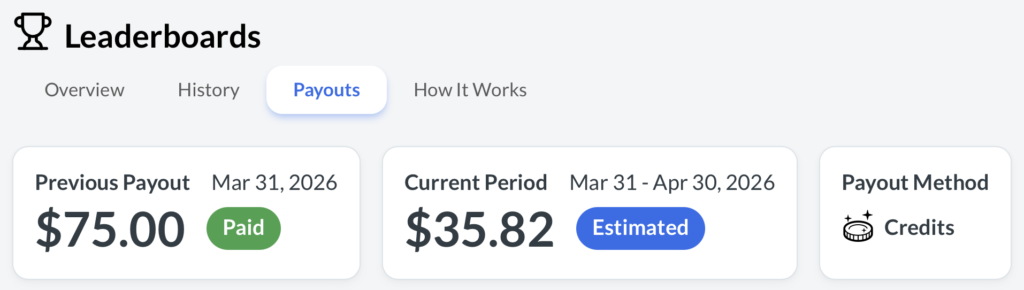
Starting last year in 2025, activity commissions are paid out on the first of the month based on your activity within the platform. They’re deposited either into your PayPal account or your WA credits account.

I consistently earn enough through activity commissions alone to pay for WA’s membership.


My 9 Years With Wealthy Affiliate

I’ve been with Wealthy Affiliate since 2017. As I said at the top, I had never built a website before, didn’t know how affiliate marketing worked, and I didn’t understand why bloggers blogged.

Now I feel like an expert at it.

The key metric to measure with any training platform is how much you learn and how quickly you learn it. This training just clicked. I got slightly addicted to it at the start and was spending every waking moment in the lessons for the first couple of weeks.

I think what helped me personally is that I didn’t focus on making money at the start. I knew I had to learn first. I gave myself 6 months to work at this like a robot to see how much I could pick up. My website looked super basic, my YouTube videos were cringe. But I was learning.

6 weeks in I had my first commission. Some random person from across the world had seen my content and clicked through on one of my affiliate links. I remember sitting at my kitchen counter and saying “It’s working” over and over again.

I had a huge month at my 12 month mark and it continued to grow. I grew my YouTube channel, exploded an Instagram following where I started sharing my solo travels, and now I’m happy to say that I’ve helped people from all over the world earn their first commissions from their own online business.

But my success means nothing to you though if this training isn’t a good fit for you. And you’re the only one who can decide that. I highly recommend creating a free starter account through any of my links on this page or on this website and giving it a try. You’ll get me as your support coach and I’ll be happy to help you reach your goals just like I have for so many people now from all over this world.

Hope to see you on the inside!

Eric Cantu Headshot

Hey, I’ll Be Your Support Coach!

Sign up for your FREE WA starter account and I’ll guide you one-on-one with daily messaging and support. You have an expert in your corner, and I can’t wait to see what we build together!

Get Started Now!

Wealthy Affiliate Testimonials

Don’t just take my word for it though. In all my reviews I scour the online forums like Reddit, Quora, YouTube, TrustPilot, and more to give you both positive and negative reviews left by real people online.

✅ Wealthy Affiliate Positive Reviews

  • “The hosting is top-tier; my site loads in under a second.” – Trustpilot
  • “Step-by-step videos make it impossible to get lost as a beginner.” – Quora
  • “The community is active 24/7; I never feel alone.” – Reddit
  • “I’m honestly PROUD of my website and that is something this mom of 4 never dreamed I’d say!.” – Reddit
  • “The AI tools have saved me hours on research and writing.” – G2
  • “No credit card needed to start is a huge plus for skeptics.” – YouTube Review
  • “Weekly live webinars are actually fun!” – Trustpilot
  • “The training teaches you how to build a real business, not a gimmick.” – Quora
  • “I’ve been a member for over a decade and the platform keeps evolving.” – G2

❌ Wealthy Affiliate Complaints

  • “The $99/month Premium Plus tier is too expensive for most beginners.” – Reddit
  • “Some of the older training videos feel a bit dated despite updates.” – Quora
  • “The community can be overwhelming with too many notifications.” – Trustpilot
  • “It takes a long time to see money; it’s definitely not for those in a rush.” – Reddit
  • “There is a lack of advanced training on paid ads (PPC).” – G2
  • “The free version is very limited; you have to upgrade to do anything real.” – YouTube Comment
  • “Site Support used to get back to you in minutes, now it’s usually 24 hours.” – Reddit

Feature Spotlight: Wealthy Affiliate Image Studio (Watch This Video!)

Wealthy Affiliate’s Image Studio is one of those things you just need to get your hands on and see to believe. From YouTube thumbnails to infographics to comparison tables to featured images for product reviews, this things is off the charts good.


WA Image Studio Review Thumb

Click here or the image above to watch my full Wealthy Affiliate Image Studio walkthrough video on YouTube. It’s well worth it and I promise your jaw is going to drop.

I. Love. Image. Studio.


Eric Cantu Headshot

This is How I Built Full-Time Income!

With training that has a real focus on you learning and me in your corner you can’t lose. Take the FREE test drive to see if this is a good fit. I look forward to helping you every step of the way!

Get Started FREE!

Final Thoughts

Wealthy Affiliate leveled up its game with its AI tech stack. With a focus on learning, a global community, and daily trainings with a straightforward focus to deliver value to your audience, you have a platform that can turn your passion into real monthly revenue.

What do you think? What questions do you have for me? Have you tried other platforms and been sold snake oil? Is there a question about a feature you don’t quite understand. Drop your comments down below! I look forward to hearing from you!

The truth of the matter is that I’ve made life-long friends from this platform. I found it as a newbie and now I’m an expert trainer inside it. My success means nothing to you if it’s not a good fit for you, so let’s give this a real effort to see what we can build together!

If you’re ready, let’s get started! I look forward to seeing you on the inside!


Kyle, Eric, Carson Super Affiliate Conference Vegas

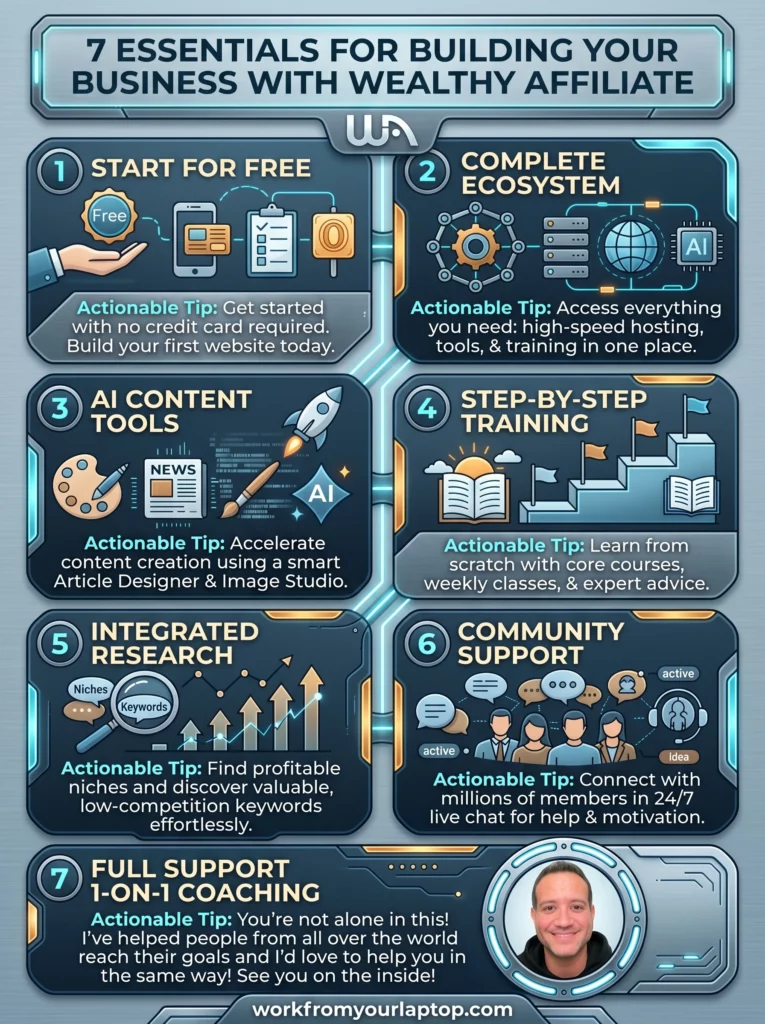
Wealthy Affiliate Review 2026 Infographic

Frequently Asked Questions

Is Wealthy Affiliate good for beginners?
Yes, it is specifically designed for beginners. The training modules start with the absolute basics, like how to choose a profitable niche and how to install a WordPress theme.

Can you really make money with Wealthy Affiliate?
Yes, but it is not a “money-making machine.” It is a training platform. You make money by applying the SEO and affiliate marketing techniques they teach to your own niche website.

How long does it take to see results?
Most users start seeing organic traffic within 3–6 months and consistent revenue within 6–12 months, provided they publish content regularly and follow the keyword research guidelines.

Written by Eric Cantu · Categorized: Featured, Essential Reads, Reviews & Comparisons

Apr 11 2026

SEO for Bloggers: How To Get to the Top of Search Rankings Consistently

How To Get to the Top of Search Rankings Consistently

So you just spent your entire weekend (or week) perfecting you latest post. You smash that “publish” button and then… crickets.. How frustrating is that?! All that hard work and you’re buried on page ten of the search results? Not on my watch. Let’s pull back the curtain on how search actually works so you can stop guessing and start ranking.


TL;DR: How Can I Rank My Blog Posts at the Top of Google Consistently?

To rank consistently, align your content with user intent, build topical authority through topic clusters, and optimize for both human readers and AI-driven search engines. Focus on providing unique, experience-based insights that deliver value.

Golden Rules of Ranking:

  • Target Search Intent: Write to solve the user’s specific problem, not just to rank for a keyword.
  • Prioritize Topical Authority: Build clusters of related articles to prove your expertise to search algorithms.
  • Optimize for AI & Humans: Use clear headings, direct answers, and structured lists for both search crawlers and readers.
  • E-E-A-T is Everything: Infuse your content with personal experience, credentials, and transparent, factual accuracy.
🔍 Have ChatGPT Summarize This Article

What’s In This Article? (Quick Jumps)

  • Why SEO Still Matters Right Now
  • My Experience With Ever-Changing SEO
  • Step-by-Step Breakdown: The Core Strategy
  • Common Pitfalls & What To Avoid
  • Your Next Step
  • Final Thoughts
  • Frequently Asked Questions

Why SEO Still Matters Right Now

SEO has evolved from simple keyword optimization into a holistic system of signals. Google’s algorithms now evaluate your site’s overall quality and trustworthiness. Ignoring SEO means your best content remains invisible, while mastering it ensures a steady stream of targeted traffic that compounds over time.

I’ve heard plenty of bloggers argue that SEO is dead. In my opinion, this is a really, really bad take. I believe now more than ever it’s hyper essential for driving organic traffic and building your brand.

One of the more common misconceptions about SEO is that it’s a one-time effort. For SEO to even begin to work there needs to be consistent effort and a long-term strategy in place. With the rise of new technologies SEO is as important as ever.

We’re living in a time where AI-powered search engines can summarize the internet in seconds. So don’t kid yourself into thinking you’re only competing with other bloggers. You are 100% competing with AI for the “featured” slot in AI overviews.

Let me make this crystal clear from personal experience: SEO is not dead. It’s simply time to adapt. Results don’t come overnight. We’re playing the long game here.


My Personal Experience with Ever-Changing SEO

Just like in the fire department, you have to apply a logical, step-by-step system that you’re consistent with to get the results you’re looking for with SEO.

Back in 2017 you could arrange the words in your title in a certain way and suddenly shoot to the top of the SERPS. That’s not even close to a thing now.

The focus now is entirely on overall intent. When I write, I prioritize what I feel is my reader’s actual goal. I focus on the pain point they’re searching for answers to. I write so that the article is the most direct and accurate answer they can find online.

I want my article to be talking to the reader directly. That’s how you snag the “Rank Zero” position: by being the best source for the information that the reader has “a-ha” moments for.

You can’t rely on guessing or hacks or shortcuts. There’s no such thing. I try to build pages that are simultaneously easy to follow but also structured and easy for AI engines to scan and extract from. You can’t focus on one and not the other.

When you make your focus being the most reliable, accurate source for your topic, your results start being way more consistent. And don’t worry, I’m about to lay down the straightforward approach I use so you can to.

Let’s break this down.

Related article: Try broadening your search traffic strategy and using a visual search engine like Pinterest to drive targeted traffic back to your blog!


Step-by-Step Breakdown: The Core Strategy

A consistent ranking strategy requires a shift from keyword volume to topical depth. Start by selecting one primary niche, identifying the specific questions your target audience asks, and creating comprehensive, interconnected content that satisfies their intent better than anything else currently available in search results.

Step 1: The Niche “Deep Dive”

You don’t have to rank for every single aspect of every single pain point your audience has. Choose one specific problem you solve for a specific person. Choose something you have actual experience with. Remember, you’ve picked your niche based on passion, right? Use tools like Google Search Console or just do like I do and dive into Google itself to find low-competition, long-tail questions.

Pro Tip: Most people target broad terms. Instead, target specific long-tail questions that address the precise “how-to” questions your audience is asking.

Step 2: Content That Answers Better

When you write, look at the top 3 results for your target topic. Ask yourself: “What’s missing here?” If they have a text-heavy guide, add a comparison table, a checklist, or a personal case study. (Image Studio by Wealthy Affiliate is spectacular for this.) Your goal is to provide a “one-stop shop” answer so the reader doesn’t even think about going anywhere else.

It’s a complete myth that your audience is only interested in the “quick” answer. Understand this: Google and YouTube have a stranglehold on search. Yes, AI is here and people will go to ChatGPT or Gemini for quick answers, but then they go right into Google and YouTube to find the “whole” answer.

Pro Tip: AI is your friend. Use it to brainstorm structures, but always rewrite the content in your own voice. Google’s algorithm is incredibly good at identifying generic, AI-written filler. Be honest, when you read this article, can’t you hear me talking? Do the same for yours.

Related article: Think that PPC kills SEO? Check out my full guide on SEO vs PPC and see why PPC has it’s place, but you can never quit SEO!

Step 3: Link Your Content Like a Web

Search engines want your site to be this interlocking, connected entity. If you write an article, make sure it links to at least two other relevant posts on your site, and have at least two existing posts link back to it. This creates a “cluster” that signals to Google you are an expert on that topic. It’s also great for the user experience of your reader.

Pro Tip: Do your best to avoid “orphan pages.” Never publish an article without at least one internal link pointing to it from your high-traffic pages. If it doesn’t connect to your other content, then it’s probably not a good fit for your site.


Common Pitfalls & What to Avoid

Beginners often fail by chasing “vanity metrics” or outdated tactics. To succeed, prioritize E-E-A-T signals: Experience, Expertise, Authoritativeness, and Trustworthiness. Do this by demonstrating real-world knowledge and maintaining technical hygiene on your site.

  1. Keyword Cannibalization: Stop targeting the same intent on multiple pages. Workaround: Audit your site and consolidate those pages into one “pillar” page.
  2. Ignoring Mobile Users: Remember that over 50% of your traffic is on mobile. Workaround: Use a mobile-responsive theme and test your site layout on your phone regularly.
  3. Thin Content: Stop posting less than 300 word articles that offer no value. Workaround: Aim for comprehensive guides that solve the reader’s intent completely.
  4. Buying Backlinks: Never do this. This is a quick way to get penalized and dropped to the bottom of Google. Workaround: Earn real backlinks by creating genuinely helpful resources, original research, or data-backed insights.
  5. Neglecting Site Speed: A slow site kills your rankings. Workaround: Use a fast host, compress your images before uploading, and don’t stuff your content with noise or overdo plugins.
  6. Obsessing over optimization: Before you dive into optimizing, make sure you’re not falling into the analytics obsession trap first.
Work From Your Laptop YouTube Subscribe

Your Next Step

Stop thinking about your blog as a collection of random posts and start seeing it as a library of assets. Whether you’re just starting or you’ve been grinding away for years, the work doesn’t stop when you hit “publish.”

To actually rank, you need to apply what we’ve covered to your existing practices:

  • For the New Blogger: Stop hunting for “perfect” keywords. Pick one core problem you’re going to solve, outline the five most common questions your audience asks about it, and write the answer to each one. Focus on getting these first five pieces live and linked together. This is your foundation for building early topical authority.
  • For the Seasoned Veteran: Stop churning out new content just to stay “active.” Audit your existing articles and find your top-performing pieces (AI is great for this kind of stuff). Now look for “intent gaps” and places where you haven’t fully answered the user’s follow-up questions. Update these posts and snag that Rank Zero position away from the competition who hasn’t updated their content in years.

Take a look at your Google Search Console data to see what queries you’re already getting impressions for, even if you aren’t ranking well. That’s your low-hanging fruit. Take the highest-potential post, strip out the noise, sharpen the answer, and create a cluster around it.

Getting to the top of the search results page is the first step. Traffic to your content (and more importantly to your affiliate links) is how you get to full time revenue!

Need some tips on the visuals of your blog to make it easy on the eyes while still delivering value? Check out my guide on building a visually perfect blog post and get that leg up on the competition.


Final Thoughts

SEO isn’t a “get rich quick” scheme; it’s a long-term asset-building strategy. Do the work today by answering one user question perfectly, and you’ll reap the traffic rewards for years to come.

What do you think?

  • What’s the biggest roadblock you face when trying to rank your blog posts?
  • Have you ever tried to update an old post with better information, and did you see a traffic shift?

What other questions do you have for me? I absolutely love hearing your perspective so don’t be shy! Drop your comments and questions down below!

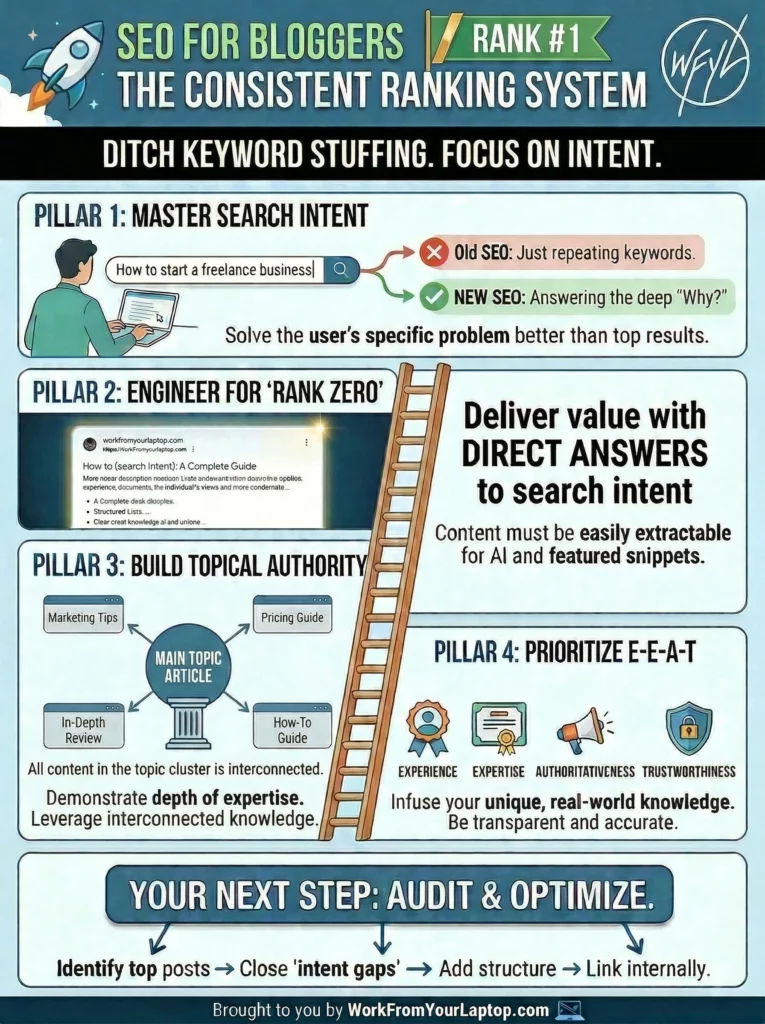
How To Get to the Top of Search Rankings Consistently infographic

Trying to make money online and still not seeing results? Create your FREE STARTER ACCOUNT with the same straightforward training I’ve used to create full time revenue online. No matter your experience, this step by step training delivers! Click here and get started NOW!


Frequently Asked Questions

Does AI-generated content hurt my SEO rankings?
Not necessarily. Google focuses on the “helpfulness” of content, not the tool used to write it. If your content provides unique value, experience, and accuracy, it will perform well. If it’s generic, repetitive, or inaccurate, it will fail regardless of whether a human or AI wrote it.

How often should I update my old blog posts?
You should review and update your content whenever the information becomes stale, or at least every 6–12 months. Updating old posts with fresh data, new insights, and broken link fixes is often faster than writing new content and signals to Google that your site remains current.

What is the fastest way to build topical authority?
Focus on “content clusters.” Choose a core pillar topic and create a comprehensive main page for it. Then, write 5–10 supporting articles that answer specific sub-questions and link them all back to the pillar page. This structure tells search engines exactly what your site specializes in.


Want More Search Engine Optimization Strategies?

SEO is the key to building traffic! Don’t stop your momentum now! Dive into these guides and turn that traffic into revenue!

  • How To Get to the Top of Search Rankings Consistently
    SEO for Bloggers: How To Get to the Top of Search Rankings Consistently
  • What is Generative Engine Optimization GEO
    Generative Engine Optimization (GEO): How to Optimize for AI‑Driven Search
  • SEO vs PPC which is more effective in 2024
    SEO vs PPC: Which is More Effective in 2024? Numbers Don’t Lie!
  • How the 2024 HCU Update has Affected SEO
    How the 2024 Google HCU Has Impacted SEO – Strategies for Recovery
  • Why is my bounce rate over 100
    Why is my bounce rate over 100?

Written by Eric Cantu · Categorized: Essential Reads, SEO (Search Engine Optimization)

  • « Go to Previous Page
  • Page 1
  • Page 2
  • Page 3
  • Page 4
  • Page 5
  • Page 6
  • Interim pages omitted …
  • Page 29
  • Go to Next Page »
  • Home
  • Sign Up
  • Blog & Search
  • Privacy Policy
  • Affiliate Disclosure

Copyright © 2026 · Work From Your Laptop · Eric J. Cantu · All Rights Reserved