Last updated on May 28, 2026 · Comprehensive breakdown, <10 min read

You’re building your new online business, and you want to see if your hard work is paying off. But if the very first thing you’re doing every single morning is spending an hour checking your traffic stats, we need to have a serious talk.
TL;DR: How Do I Stop Obsessing Over Website Analytics and Grow My Traffic?
To stop obsessing over analytics, shift your focus from tracking data to executing high-impact tasks like consistent content creation, updating old posts, and expanding targeted keyword research to build sustainable search traffic.
- Ditch the Hourly Checks: Limit your analytics viewing to once a week or even once a month.
- Feed the Engine: Spend 80% of your time writing fresh, valuable content for your audience.
- Build the Guardrails: Stick to a strict publishing schedule so idle time doesn’t turn into stat-staring time.
- Fix What You Have: Double down on internal links and content updates to score easy traffic wins.
What’s In This Article (Quick Jumps)
- Why Over-Analyzing Your Traffic Matters Right Now
- My Experience with the Analytics Addiction Trap
- The 4-Pillar Core Strategy to Replace Stat-Staring
- Common Pitfalls & What to Avoid
- Your Next Step
- Final Thoughts
- Frequently Asked Questions
Why Over-Analyzing Your Traffic Hurts Your Business
Constantly checking analytics slows business growth because it wastes valuable time that should be spent on content production, schedule consistency, and search optimization. These are the only activities that actually drive new traffic.
We happen to find ourselves living in a time where we have more online business tools than ever before. But because of that, more than ever before, new online marketers find them checking the score every 5 minutes instead of playing the game.
If you can master your focus starting now, your upside will be massive. While everyone else is panicking over daily fluctuations, you’ll be building your library of content. Shift your focus away from the numbers and put it back into content creation.
That’s what the search engines love. Don’t get lost in paralysis by analysis!
Related article: The first step to successful content creation is choosing your niche. Check out my full guide on how to choose your niche as a micro influncer and start building on a strong foundation!
My Experience with the Analytics Addiction
Thankfully, I’m not an analytics guy. Never have been. But as an expert trainer at Wealthy Affiliate, I see the analytics addiction firsthand almost every single day. I feel like I’m constantly coaching my students, “Stop. Checking. Your Analytics!”
Look, I get it. It’s totally natural when you’re starting out to want to see results. But if you’re planting a garden and digging up the seeds every single morning to see if they’re growing roots yet, you’re gonna kill that plant. You have to water it, trust the process, and give it time to grow in the dark.
Having a relationship with Google Analytics is important. But as a new online marketer, you have to tell yourself that this new tool will be a huge asset later down the road. The time you’re spending watching the real-time tracker for your site would be much better spent creating content!
Remember:
- Analysis comes from data.
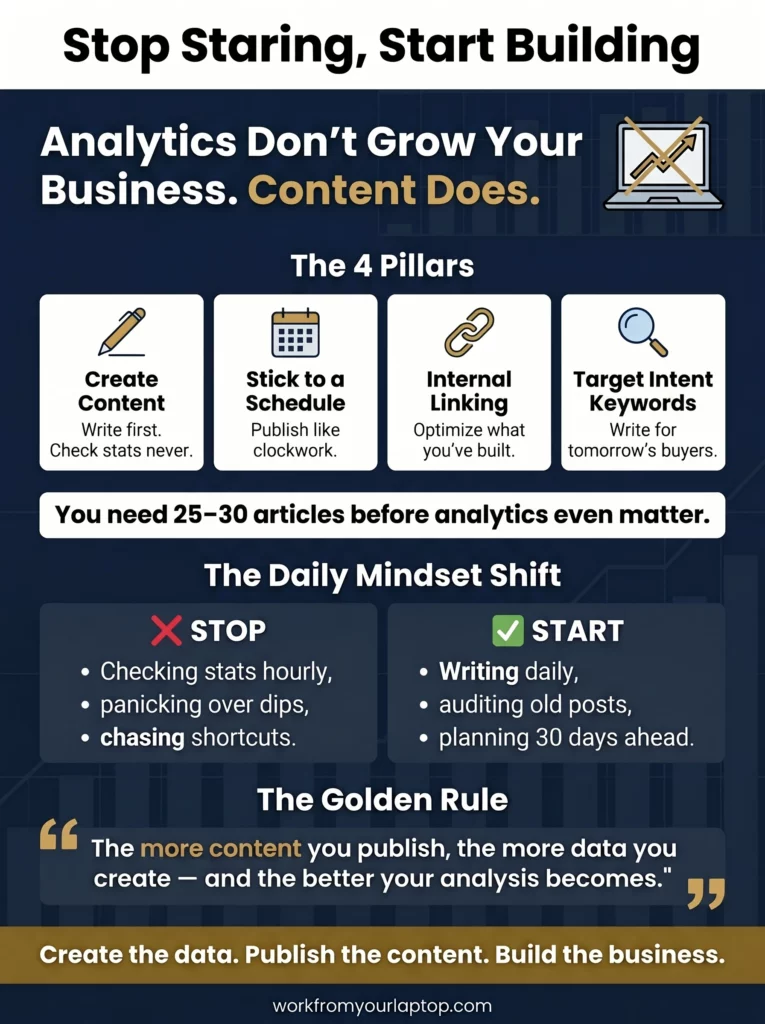
- The more data you provide via publishing great, new content, the better the analysis.
- Checking your stats fifteen times a day doesn’t bring a single new person to your website. It steals the creative energy you should’ve been using to write your next big post.
- You can spend a week obsessing over a 10% drop in traffic, meanwhile your competitors are publishing high-quality guides and stealing your future rankings.
The 4-Pillar Core Strategy to Replace Stat-Staring
Replacing an obsession with analytics means prioritizing raw content production, enforcing a strict publishing schedule, optimizing current content through internal linking, and focusing on high-intent search terms for future articles.
Let’s talk about 4 pillars to replacing your obsession with analytics that will massively help your business.
Pillar 1: Pure Content Creation (The Engine)
Your website runs on content, plain and simple. Every single article you publish is like throwing a hook in the water. And, guess what, the fish are BITING! You have to keep throwing hooks out there! This means writing high-value, helpful content that answers your target audience’s questions and pain points.
- Action Item: If your addiction is deep, set a daily word count goal, even if it’s just 500 words, and don’t let yourself look at a single data chart until that writing is totally finished.
- Pro Tip: Write your first drafts in a plain Google Doc or text editor with your web browser completely closed. This keeps you away from your site’s dashboard and stops you from tweaking old settings.
Pillar 2: Creating a Content Schedule (The Guardrail)
Idle time is the absolute biggest enemy of a new online marketer. When you finish a task and don’t know what to do next, your hand automatically moves to check your traffic stats or earnings. Creating a strict content calendar acts as your guardrail.
- Action Item: Map out your next 30 days of content in advance. Write down the exact titles and keywords you intend to target, then assign a specific due date to every single one.
- Pro Tip: Treat your publishing schedule like a job with a strict boss. If a post is due on Thursday at 9:00 AM, it goes live on Thursday at 9:00 AM, whether you feel like your traffic looks good that week or not.
Pillar 3: Internal Linking & Auditing (The Optimization)
If you absolutely need to spend time inside your website’s dashboard, don’t waste it looking at traffic graphs. Instead, use that energy to optimize what you’ve already built. Strategic internal linking helps search engines crawl your site much better and keeps readers on your pages longer.
- Action Item: Go back to your top five most important articles and make sure they link out to your newer, smaller posts using relevant, descriptive anchor text.
- Pro Tip: Most people forget to update their older posts, but spending just an hour a week refreshing outdated facts and fixing broken links can double your organic search rankings without writing a single new article.
Pillar 4: High-Intent Keyword Expansion (The Pipeline)
Instead of worrying about how many people visited your site yesterday, focus on how you’re going to attract buyers tomorrow. This means shifting your keyword research toward high-intent search terms. Think about the exact phrases people type in when they are ready to buy a product, solve a specific problem, or take action.
- Action Item: Find 5 to 10 long-tail keywords that include specific action words like “best,” “how to fix,” or “vs”that are directly related to your niche.
- Pro Tip: Don’t just target high-volume terms that everyone else is fighting over. Go after small, low-competition keywords with clear commercial intent and you’ll find traffic and conversions faster.
You don’t have to do this alone! There are great AI tools out there to use! Be direct and ask your AI tool of choice to help you out with each of these pillars and your jaw will drop at how awesome the suggestions are it throws back at you.
Trust me, your schedule will be full and time much better spent than staring at analytics.
Most Common Pitfalls When You’re Obsessed with Analytics
Avoiding analytics obsession means recognizing that daily data dips are usually normal noise, third-party SEO tools offer mere estimates, and ignoring old content or using shady traffic shortcuts will ruin a brand.
Let’s talk about the most common hurdles you’ll find when you’re obsessing over analytics.
- Panicking Over Daily Traffic Dips: Traffic naturally goes up and down based on the day of the week, holidays, and even the weather.
- The Workaround: Only view your traffic data using a 30-day moving average to see the real trend line instead of daily drama.
- Trusting Third-Party Tools Blindly: Software tools like Ahrefs or Semrush show estimates, not your actual traffic. Obsessing over their metrics can make you change things that aren’t even broken.
- The Workaround: Use Google Search Console as your source of truth, and treat third-party scores as rough guides, not absolute facts.
- Ignoring the Content You Already Built: It’s easy to get so focused on the future that you let your older pages decay and lose their spots in search results.
- The Workaround: Set a hard rule that for every three new articles you publish, you must spend time auditing and improving one old post.
- Buying Fake or Cheap Traffic Fixes: When stats look low, gurus will try to sell you sketchy traffic bots or weird click packages to boost your numbers. This is a total scam that will get your site banned.
- The Workaround: Focus strictly on organic traffic methods. If a strategy sounds like a shortcut or a “gray hat” trick, stay away from it. We’re building a long-term asset here.
- Changing Your SEO Strategy Every Single Week: If you try a new tactic and change it four days later because your stats didn’t jump, you’ll never see what actually works. SEO takes months to show results.
- The Workaround: Pick a proven content strategy and commit to it for at least 90 days before you allow yourself to judge the results.

Your Next Steps
Now that you know why checking your stats is holding you back, it’s time to take action. The very first thing you need to do right now is close your analytics tabs.
Go ahead.
I’ll wait.
If you have an analytics app on your phone, delete it right now. Give yourself permission to step away so you can finally get back to building your business.
Tomorrow morning, when you sit down at your computer, your only goal is to open up your calendar and plan your next week of articles. Don’t look at who came to your site yesterday. Focus entirely on who’s going to find your site next month because of the hard work you’re putting in today.
A Wealthy Affiliate member asked me, “But Eric, I check Google Search Console to find keyword queries so I can plan my upcoming articles and clicks and impressions are on that same page!”

Then don’t check GSC daily! Write down your keyword queries every couple of weeks and stop putting hurdles in front of yourself if you have an analytics obsession!
As you start filling up your content schedule and pushing out helpful updates, you’re going to notice something amazing. Your mind will feel clearer, your writing will get better, and you’ll feel a massive weight lifted off your shoulders.
This is what building a business is all about! Yes, analytics are very helpful, but you need 25-30 articles complete before you start checking for trends. Check in once a month and be done. Once you start getting traffic and conversions you can double down on what works.
That’s when analytics comes in to save the day.
For now, create the data! Publish that content!
You got this!
🎯 Looking for a methodical system that will force you to focus, make you stick to a schedule, and absolutely explode your content creation and traffic? Check out my 0-10K Traffic Blueprint here. Note: this is only for those serious about online business!
Final Thoughts
Stop letting a spreadsheet run your life. Your real value as a creator comes from the helpful content you put out into the world, not the number of times you hit the refresh button. Put those hooks in the water! Create that content!
What do you think?
- How many times a day do you catch yourself checking your traffic or earnings?
- Which of the 4 pillars are you going to focus on this afternoon to break the habit?
- Let me know in the comments below!
Trying to make money online and still not seeing results? Create your FREE STARTER ACCOUNT with the same straightforward training I’ve used to create full time revenue online. No matter your experience, this step by step training delivers! Click here and get started NOW!
Frequently Asked Questions
How often should I check my website analytics?
You should check your analytics once a week at most. A monthly deep dive is even better for spotting real trends without getting distracted by daily traffic ups and downs.
Will my traffic drop if I stop monitoring it daily?
No, your traffic will not drop. Monitoring data has no effect on search algorithms. Spending that time creating high-quality content and fixing internal links will actually cause your traffic to increase.
What is the best metric to look at when I do check my data?
Focus on impressions and organic click-through rates in Google Search Console over a 3-month period. This shows you if your content pipeline is growing and if searchers find your titles helpful.
Want More Affiliate Marketing Strategies?
Don’t stop your momentum now! Check out these related articles and let me know which strategies are helping you out the most!
- 5 Smart Ways to Drive Traffic to Your Affiliate Links in 2026

- 4 Reasons Why Affiliate Marketing Isn’t a Pyramid Scheme

- Are Done For You Online Business Opportunities Legit? (2026 Update)

- 11 Online Business Coaching Scams Exposed & How to Avoid Them (2026 Update)

- Is Affiliate Marketing Still Worth It in 2026?

- Why You Need to Stop Obsessing Over Analytics!

This was encouraging to read. I’m still at the stage where I’m focused much more on creating helpful content than analyzing numbers, so I don’t have enough traffic yet to spend much time looking at analytics. But I know that day will come, and I appreciate the reminder that analytics are a tool, not the goal.
– Scott
Exactly right. Focus on building content consistently. Everything falls into place after that!
Hi! I really enjoyed this article because it’s something I think many of us need to hear. It’s easy to get caught checking traffic, clicks, and rankings several times a day, especially when we’re excited about growing a website. I’ve found that the biggest improvements come when I spend more time creating helpful content than watching the numbers. Analytics are certainly useful, but they should guide our decisions rather than control them. Thanks for the reminder to stay focused on the work that actually moves a website forward. Great read!
Glad you enjoyed this! Thanks for the comment!
This article really hit home for me. As someone building a new website, it’s incredibly tempting to check analytics far more often than I should. The garden analogy was especially powerful; you can’t keep digging up the seeds and expect them to grow. It was a great reminder that my time is much better spent creating content, updating older posts, and focusing on what actually moves the needle. Thanks for the reality check and the practical advice!
Glad this helped! Thanks for the comment!