• Skip to main content
  • Home
  • Sign Up
  • Blog & Search
  • Privacy Policy
  • Affiliate Disclosure

WORK FROM YOUR LAPTOP

  • Start Here
    • Watch the Video Tutorial
    • FAQs
    • Start Your FREE TRAINING!
  • Blog
  • Meet Eric

SEO (Search Engine Optimization)

Apr 11 2026

SEO for Bloggers: How To Get to the Top of Search Rankings Consistently

How To Get to the Top of Search Rankings Consistently

So you just spent your entire weekend (or week) perfecting you latest post. You smash that “publish” button and then… crickets.. How frustrating is that?! All that hard work and you’re buried on page ten of the search results? Not on my watch. Let’s pull back the curtain on how search actually works so you can stop guessing and start ranking.


TL;DR: How Can I Rank My Blog Posts at the Top of Google Consistently?

To rank consistently, align your content with user intent, build topical authority through topic clusters, and optimize for both human readers and AI-driven search engines. Focus on providing unique, experience-based insights that deliver value.

Golden Rules of Ranking:

  • Target Search Intent: Write to solve the user’s specific problem, not just to rank for a keyword.
  • Prioritize Topical Authority: Build clusters of related articles to prove your expertise to search algorithms.
  • Optimize for AI & Humans: Use clear headings, direct answers, and structured lists for both search crawlers and readers.
  • E-E-A-T is Everything: Infuse your content with personal experience, credentials, and transparent, factual accuracy.
🔍 Have ChatGPT Summarize This Article

What’s In This Article? (Quick Jumps)

  • Why SEO Still Matters Right Now
  • My Experience With Ever-Changing SEO
  • Step-by-Step Breakdown: The Core Strategy
  • Common Pitfalls & What To Avoid
  • Your Next Step
  • Final Thoughts
  • Frequently Asked Questions

Why SEO Still Matters Right Now

SEO has evolved from simple keyword optimization into a holistic system of signals. Google’s algorithms now evaluate your site’s overall quality and trustworthiness. Ignoring SEO means your best content remains invisible, while mastering it ensures a steady stream of targeted traffic that compounds over time.

I’ve heard plenty of bloggers argue that SEO is dead. In my opinion, this is a really, really bad take. I believe now more than ever it’s hyper essential for driving organic traffic and building your brand.

One of the more common misconceptions about SEO is that it’s a one-time effort. For SEO to even begin to work there needs to be consistent effort and a long-term strategy in place. With the rise of new technologies SEO is as important as ever.

We’re living in a time where AI-powered search engines can summarize the internet in seconds. So don’t kid yourself into thinking you’re only competing with other bloggers. You are 100% competing with AI for the “featured” slot in AI overviews.

Let me make this crystal clear from personal experience: SEO is not dead. It’s simply time to adapt. Results don’t come overnight. We’re playing the long game here.


My Personal Experience with Ever-Changing SEO

Just like in the fire department, you have to apply a logical, step-by-step system that you’re consistent with to get the results you’re looking for with SEO.

Back in 2017 you could arrange the words in your title in a certain way and suddenly shoot to the top of the SERPS. That’s not even close to a thing now.

The focus now is entirely on overall intent. When I write, I prioritize what I feel is my reader’s actual goal. I focus on the pain point they’re searching for answers to. I write so that the article is the most direct and accurate answer they can find online.

I want my article to be talking to the reader directly. That’s how you snag the “Rank Zero” position: by being the best source for the information that the reader has “a-ha” moments for.

You can’t rely on guessing or hacks or shortcuts. There’s no such thing. I try to build pages that are simultaneously easy to follow but also structured and easy for AI engines to scan and extract from. You can’t focus on one and not the other.

When you make your focus being the most reliable, accurate source for your topic, your results start being way more consistent. And don’t worry, I’m about to lay down the straightforward approach I use so you can to.

Let’s break this down.

Related article: Try broadening your search traffic strategy and using a visual search engine like Pinterest to drive targeted traffic back to your blog!


Step-by-Step Breakdown: The Core Strategy

A consistent ranking strategy requires a shift from keyword volume to topical depth. Start by selecting one primary niche, identifying the specific questions your target audience asks, and creating comprehensive, interconnected content that satisfies their intent better than anything else currently available in search results.

Step 1: The Niche “Deep Dive”

You don’t have to rank for every single aspect of every single pain point your audience has. Choose one specific problem you solve for a specific person. Choose something you have actual experience with. Remember, you’ve picked your niche based on passion, right? Use tools like Google Search Console or just do like I do and dive into Google itself to find low-competition, long-tail questions.

Pro Tip: Most people target broad terms. Instead, target specific long-tail questions that address the precise “how-to” questions your audience is asking.

Step 2: Content That Answers Better

When you write, look at the top 3 results for your target topic. Ask yourself: “What’s missing here?” If they have a text-heavy guide, add a comparison table, a checklist, or a personal case study. (Image Studio by Wealthy Affiliate is spectacular for this.) Your goal is to provide a “one-stop shop” answer so the reader doesn’t even think about going anywhere else.

It’s a complete myth that your audience is only interested in the “quick” answer. Understand this: Google and YouTube have a stranglehold on search. Yes, AI is here and people will go to ChatGPT or Gemini for quick answers, but then they go right into Google and YouTube to find the “whole” answer.

Pro Tip: AI is your friend. Use it to brainstorm structures, but always rewrite the content in your own voice. Google’s algorithm is incredibly good at identifying generic, AI-written filler. Be honest, when you read this article, can’t you hear me talking? Do the same for yours.

Related article: Think that PPC kills SEO? Check out my full guide on SEO vs PPC and see why PPC has it’s place, but you can never quit SEO!

Step 3: Link Your Content Like a Web

Search engines want your site to be this interlocking, connected entity. If you write an article, make sure it links to at least two other relevant posts on your site, and have at least two existing posts link back to it. This creates a “cluster” that signals to Google you are an expert on that topic. It’s also great for the user experience of your reader.

Pro Tip: Do your best to avoid “orphan pages.” Never publish an article without at least one internal link pointing to it from your high-traffic pages. If it doesn’t connect to your other content, then it’s probably not a good fit for your site.


Common Pitfalls & What to Avoid

Beginners often fail by chasing “vanity metrics” or outdated tactics. To succeed, prioritize E-E-A-T signals: Experience, Expertise, Authoritativeness, and Trustworthiness. Do this by demonstrating real-world knowledge and maintaining technical hygiene on your site.

  1. Keyword Cannibalization: Stop targeting the same intent on multiple pages. Workaround: Audit your site and consolidate those pages into one “pillar” page.
  2. Ignoring Mobile Users: Remember that over 50% of your traffic is on mobile. Workaround: Use a mobile-responsive theme and test your site layout on your phone regularly.
  3. Thin Content: Stop posting less than 300 word articles that offer no value. Workaround: Aim for comprehensive guides that solve the reader’s intent completely.
  4. Buying Backlinks: Never do this. This is a quick way to get penalized and dropped to the bottom of Google. Workaround: Earn real backlinks by creating genuinely helpful resources, original research, or data-backed insights.
  5. Neglecting Site Speed: A slow site kills your rankings. Workaround: Use a fast host, compress your images before uploading, and don’t stuff your content with noise or overdo plugins.
  6. Obsessing over optimization: Before you dive into optimizing, make sure you’re not falling into the analytics obsession trap first.

Work From Your Laptop YouTube Subscribe

Your Next Step

Stop thinking about your blog as a collection of random posts and start seeing it as a library of assets. Whether you’re just starting or you’ve been grinding away for years, the work doesn’t stop when you hit “publish.”

To actually rank, you need to apply what we’ve covered to your existing practices:

  • For the New Blogger: Stop hunting for “perfect” keywords. Pick one core problem you’re going to solve, outline the five most common questions your audience asks about it, and write the answer to each one. Focus on getting these first five pieces live and linked together. This is your foundation for building early topical authority.
  • For the Seasoned Veteran: Stop churning out new content just to stay “active.” Audit your existing articles and find your top-performing pieces (AI is great for this kind of stuff). Now look for “intent gaps” and places where you haven’t fully answered the user’s follow-up questions. Update these posts and snag that Rank Zero position away from the competition who hasn’t updated their content in years.

Take a look at your Google Search Console data to see what queries you’re already getting impressions for, even if you aren’t ranking well. That’s your low-hanging fruit. Take the highest-potential post, strip out the noise, sharpen the answer, and create a cluster around it.

Getting to the top of the search results page is the first step. Traffic to your content (and more importantly to your affiliate links) is how you get to full time revenue!

Need some tips on the visuals of your blog to make it easy on the eyes while still delivering value? Check out my guide on building a visually perfect blog post and get that leg up on the competition.


Final Thoughts

SEO isn’t a “get rich quick” scheme; it’s a long-term asset-building strategy. Do the work today by answering one user question perfectly, and you’ll reap the traffic rewards for years to come.

What do you think?

  • What’s the biggest roadblock you face when trying to rank your blog posts?
  • Have you ever tried to update an old post with better information, and did you see a traffic shift?

What other questions do you have for me? I absolutely love hearing your perspective so don’t be shy! Drop your comments and questions down below!
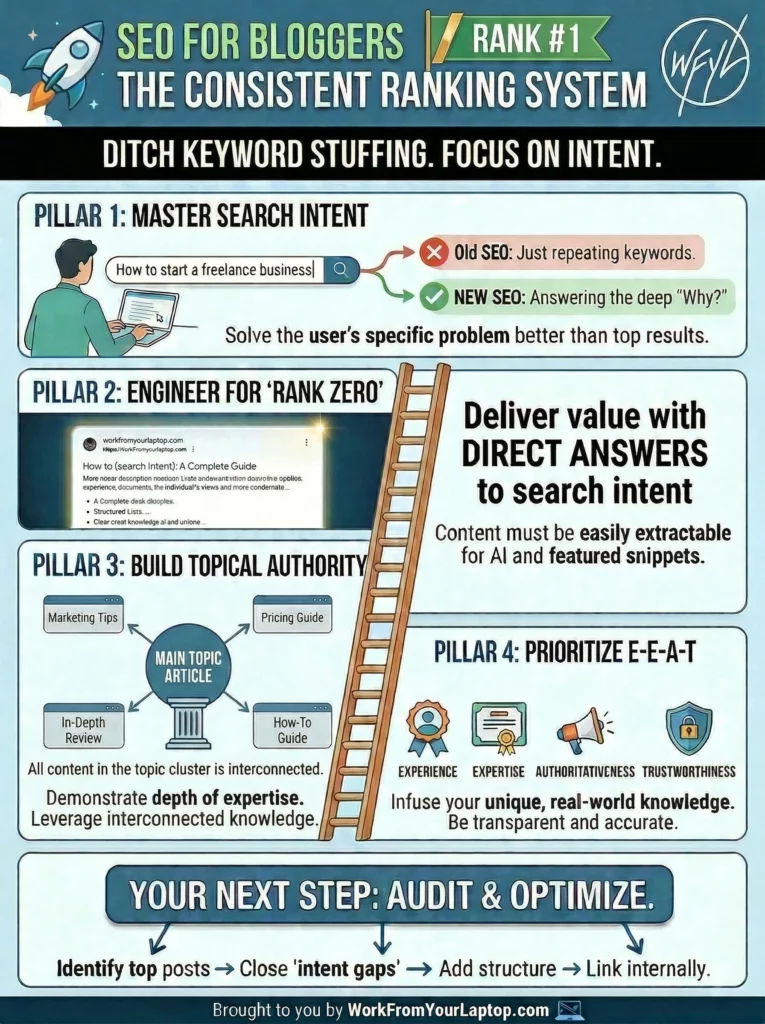
How To Get to the Top of Search Rankings Consistently infographic

Trying to make money online and still not seeing results? Create your FREE STARTER ACCOUNT with the same straightforward training I’ve used to create full time revenue online. No matter your experience, this step by step training delivers! Click here and get started NOW!


Frequently Asked Questions

Does AI-generated content hurt my SEO rankings?
Not necessarily. Google focuses on the “helpfulness” of content, not the tool used to write it. If your content provides unique value, experience, and accuracy, it will perform well. If it’s generic, repetitive, or inaccurate, it will fail regardless of whether a human or AI wrote it.

How often should I update my old blog posts?
You should review and update your content whenever the information becomes stale, or at least every 6–12 months. Updating old posts with fresh data, new insights, and broken link fixes is often faster than writing new content and signals to Google that your site remains current.

What is the fastest way to build topical authority?
Focus on “content clusters.” Choose a core pillar topic and create a comprehensive main page for it. Then, write 5–10 supporting articles that answer specific sub-questions and link them all back to the pillar page. This structure tells search engines exactly what your site specializes in.


Want More Search Engine Optimization Strategies?

SEO is the key to building traffic! Don’t stop your momentum now! Dive into these guides and turn that traffic into revenue!

  • How To Get to the Top of Search Rankings Consistently
    SEO for Bloggers: How To Get to the Top of Search Rankings Consistently
  • What is Generative Engine Optimization GEO
    Generative Engine Optimization (GEO): How to Optimize for AI‑Driven Search

  • SEO vs PPC which is more effective in 2024
    SEO vs PPC: Which is More Effective in 2024? Numbers Don’t Lie!
  • How the 2024 HCU Update has Affected SEO
    How the 2024 Google HCU Has Impacted SEO – Strategies for Recovery
  • Why is my bounce rate over 100
    Why is my bounce rate over 100?
Written by Eric Cantu · Categorized: Essential Reads, SEO (Search Engine Optimization)

Aug 03 2025

Generative Engine Optimization (GEO): How to Optimize for AI‑Driven Search

What is Generative Engine Optimization GEO

AI is changing how people find your content, and if you’re still optimizing just for Google, you’re already behind. It’s time to not only write for SEO, but for GEO too.

TL;DR: What is Generative Engine Optimization (GEO)?

Generative Engine Optimization (GEO) is how you structure your content to be easily understood, cited, and summarized by AI tools like ChatGPT, Perplexity, and Google’s Search Generative Experience.

  • GEO is SEO for AI tools like ChatGPT, Perplexity, and Google SGE. If you want your content cited by AI, you have to write for AI comprehension.
  • Use natural language and clear structure. AI tools prefer content that’s easy to break into chunks and summarize.
  • Topical authority is your secret weapon. Build strong internal linking and cover related topics deeply to be considered a source of truth.
  • Structured data is no longer optional. Schema markup helps AI understand your content and quote it correctly.
  • Don’t ditch SEO, just evolve it. GEO builds on SEO principles and expands them to work with how large language models retrieve answers.
🔍 Have ChatGPT Summarize This Article

What’s In This Article? Quick Jumps

  • What Is GEO and Why Should You Care?
  • How Is GEO Different from SEO?
  • The Rise of AI-Driven Search Tools
  • How to Make Your Content GEO-Optimized
  • Why Context, Authority, and Structure Now Matter More Than Ever
  • The Tools I Use to Stay Ahead of AI Search
  • Final Thoughts
  • Frequently Asked Questions

What Is Generative Engine Optimization, and Why Should You Care?

GEO (Generative Engine Optimization) is the process of optimizing your content to rank in AI-driven search results like those found in ChatGPT, Perplexity, and Google’s Search Generative Experience (SGE).

As bloggers we have to constantly adapt. The truth of our reality is that It’s no longer just about blue links on Google, it’s about becoming the source that AI tools pull from and recommend.

And if your blog content isn’t structured with that in mind, you’re missing a huge opportunity to future-proof your traffic.


How Is GEO Different from SEO?

Let’s clear this up right now: GEO doesn’t replace SEO, it builds on it.

Where traditional SEO focuses on getting your page to rank in Google’s ten blue links, GEO is about making your content the kind AI tools like ChatGPT and Perplexity want to quote, summarize, or link to directly.

GEO takes into account how LLMs (Large Language Models) are trained, how they ingest content, and what they need in order to trust your site as a credible source. That means things like:

  • Semantic clarity
  • Concise and scannable structure
  • Reinforcement of your authority across a niche

It’s SEO with a new lens. If you’re not thinking about how AI models see and summarize your site, you run the risk of becoming invisible to a growing segment of online searchers. Personally, I think it’s important enough that I add an actual button to trigger ChatGPT to summarize my article. Try it above and see what I mean.


The Rise of AI-Driven Search Tools

We’re already seeing a major shift. Tools like:

  • Perplexity.ai – citing sources in real-time, similar to a research assistant
  • Google SGE – pulling summaries and displaying answers above traditional search results
  • ChatGPT with Browsing – scanning live content and citing pages for up-to-date info

These platforms don’t care about keyword stuffing or backlink count. They care about clarity, expertise, and context. If you nail those three things, you start becoming the answer — not just a search result.

Related post: Check out my article “Why I Replaced Google With ChatGPT” and see why I’m done sifting through links when I need answers!


How to Make Your Content GEO‑Optimized

Alright, here’s where we shift gears from theory to application. Want your blog posts to rank in AI answers? Here’s what works:

1. Structure like you’re writing a study guide

Use clear H2 and H3 headers, short paragraphs, and bold takeaways. AI tools scan top-down, so content that’s easy to chunk and summarize wins. Check out my article “Tips for Writing Engaging Blog Posts” for my personal tips on not just grabbing your reader’s attention, but AI as well.

2. Start with topical authority

Cover your niche thoroughly. For example, if you’re writing about affiliate marketing, don’t just create one overview. Write about tools, strategies, platforms, use cases, trends, etc. This tells AI you’re not just relevant, but you’re a reliable authority.

3. Include actual answers, not just keywords

Instead of padding content with fluff, get to the point. Answer questions clearly and early. Think featured snippet style. Always be thinking of which sections in your post AI could potentially pull from and how these would look and fit in the SERPS.

4. Schema, schema, schema

Use FAQ schema, Article schema, Product schema, anything that helps AI understand the type and purpose of your content. I include custom JSON-LD in every post here on Work From Your Laptop and it’s made a huge difference in my visibility.

5. Link smartly

AI tools use context from your site structure to determine expertise. Internal links between related topics help reinforce your authority and improve crawlability. This applies to AI crawlers just as much as search engines.


Why Context, Authority, and Structure Matter More Than Ever

The shift from keyword-first to context-first is already here.

You’re no longer competing just on who can rank for “best affiliate program.” You’re competing on who explains it the best, most clearly, and most consistently across multiple posts.

Google is already using generative summaries in their SERPs. Perplexity is rewarding domain expertise over content farms. ChatGPT cites sources that it can easily quote and digest.

This is why GEO matters. It rewards clarity, consistency, and usefulness, not just clever SEO tricks.


The Tools I Use to Stay Ahead of AI Search

Want to set your site up for GEO success? Here’s what’s in my toolkit:

  • ChatGPT-4o – for real-time content audits, structuring, and simplifying language. I use this literally every day, for hours each day.
  • Google Search Console – to identify content gaps and fine tune existing posts. I use this hand in hand with GPT all the time.
  • SurferSEO – solid tool for balancing traditional SEO with new optimization styles. Check out my full SurferSEO review here.
  • Schema Markup Validator – to test the code I embed in each post. You simply enter the url of your article and it double checks that your code is correct. Try it here.
  • WordPress with custom HTML blocks – for inserting my JSON-LD schema manually. The block editor is built for this stuff, and the Custom HTML block is a lifesaver.

I’m not affiliated with these tools, they’re just what I use personally. And if you want help setting this all up, hit me up inside Wealthy Affiliate, where I coach people through this entire process step by step.

Trying to make money online and still not seeing results? Create your FREE STARTER ACCOUNT with the same straightforward training I’ve used to create full time revenue online. No matter your experience, this step by step training delivers! Click here and get started NOW!


Final Thoughts

GEO is already shaping how people discover your content online. If you’re still optimizing like it’s 2015, you’re going to get left behind. Write for humans first, structure for AI second, and stay consistent with your topical coverage.

What Do You Think? Have you started optimizing for AI-driven search yet? Are you seeing more traffic from Perplexity, ChatGPT, or SGE?

Drop your thoughts in the comments or hit me up directly. And if you want more walk-throughs like this, don’t forget to subscribe to WFYL on YouTube. I break topics like this down with easy to follow screen shares and tutorials with you looking right over my shoulder as I work.


Frequently Asked Questions

What is Generative Engine Optimization?
Generative Engine Optimization (GEO) is the process of optimizing your content so it’s easily understood and cited by AI tools like ChatGPT, Perplexity, and Google SGE. It builds on SEO but focuses on structure, clarity, and authority for AI models.

How is GEO different from SEO?
SEO focuses on traditional search engine ranking, while GEO is about making your content the kind that AI pulls from directly in summaries and chat responses. Both work together, but GEO is more tailored for the way LLMs process and reference data.

Do I still need backlinks for GEO to work?
Backlinks still help for SEO, but they matter less in GEO. What matters more is whether your content is clear, consistent, and part of a broader network of helpful, related posts. AI tools care about structure and authority more than raw link juice.


Want More AI Related Content Like This?

  • AI Vs Human Writers: Who Writes Better Content?
    AI Vs Human Writers: Who Writes Better Content?
  • how to write the perfect chatGPT 5 Prompt
    How to Write the Perfect ChatGPT-5 Prompt
  • How I Use ChatGPT to Get More Traffic to My Blog
    How I Use ChatGPT to Get More Traffic From My Existing Blog Posts
  • Why I Replaced Google With ChatGPT and Why You Should Too
    Why I Replaced Google With ChatGPT (And You Should Too)
  • Top AI Tools for Content Creation
    Top 10 AI Content Creation Tools in 2025: Honest Reviews from Real Users
  • How I Use ChatGPT for Content Creation and SEO
    How I Use ChatGPT to Automate Content Creation, SEO, and Affiliate Marketing

Written by Eric Cantu · Categorized: SEO (Search Engine Optimization)

Apr 25 2024

SEO vs PPC: Which is More Effective in 2024? Numbers Don’t Lie!

SEO vs PPC which is more effective in 2024

When it comes to SEO (Search Engine Optimization) or PPC (Pay per click), which is more effective in 2024? Can one be statistically proven to be better than the other, or should we as content creators be using a balance of both?

SEO vs PPC: Which is More Effective in 2024?

SEO results take longer to see but are better for the long term and have higher conversion rates. PPC can have immediate results and has a 50% higher ROI, but requires constant funding. Striking a balance between the two is your best bet as a digital marketer.

What’s the Difference Between SEO vs PPC?

When it comes to digital marketing, you have two options for driving traffic to your websites: search engine optimization (SEO) and pay-per-click (PPC) advertising. Both methods have their pros and cons, and the choice between them can be difficult.

What is SEO?: SEO involves optimizing your website and its content to rank higher in organic search results. This means creating high-quality content, placing keywords effectively, optimizing your website’s structure and metadata, and building high-quality backlinks.

What is PPC?: PPC, on the other hand, involves paying for ads that appear at the top of search engine results pages (SERPs) for specific keywords. You are charged for every click to your ad, and you create that ad with hopes that it converts enough times to pay for those clicks and still be profitable.

While SEO is a long-term strategy that takes time to see results, PPC can deliver immediate traffic and results. But it goes deeper than that.

The Evolution of SEO in 2024

Search Engine Optimization has changed in 2024. With the rise of AI, many content creators are questioning if SEO is still worth it. More and more of their audience is getting quick answers from AI and moving on, however this may be slightly misleading.

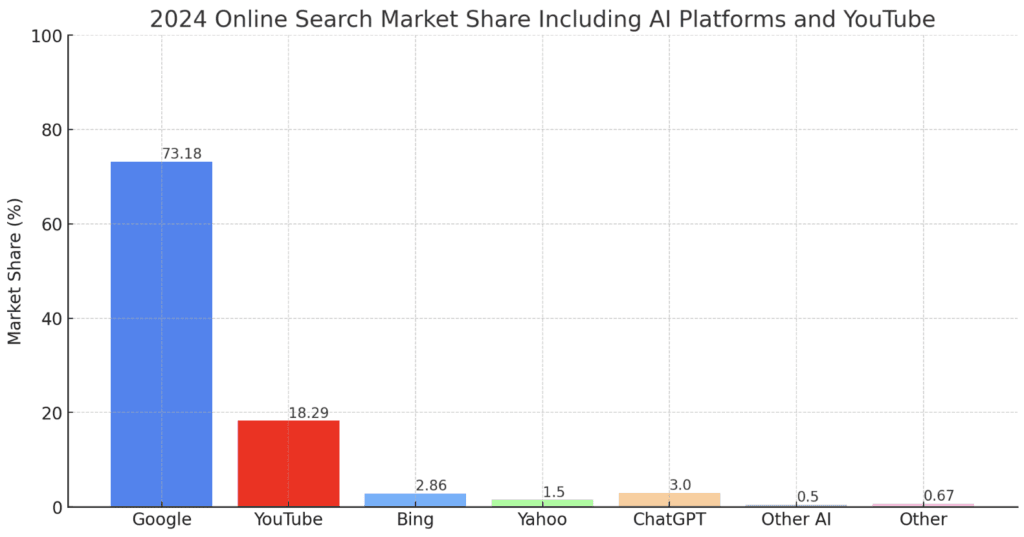
Stats show that Google still clearly has the stranglehold on all searches. And while Google and its 2024 Helpful Content Update (HCU) have had an major effect on SEO with so much UGC (user generated content) like Reddit and Quora forums finding their way to the top of searches, how do website content creators compete?

SEO is still a crucial aspect of digital marketing. There will always be a need to optimize content to attract organic traffic. It’s just a matter of learning how to adapt to the current needs and behaviors of your audience.

Now more than ever, content creators need to:

  • Optimize for mobile
  • Focus on long tail keywords
  • Optimize for voice search

What are the top SEO Strategies for Current Algorithms in 2024?

While creating high-quality, relevant content that’s optimized for both your audience and search engines should always be a priority as a content creator, in 2024 new strategies have emerged..

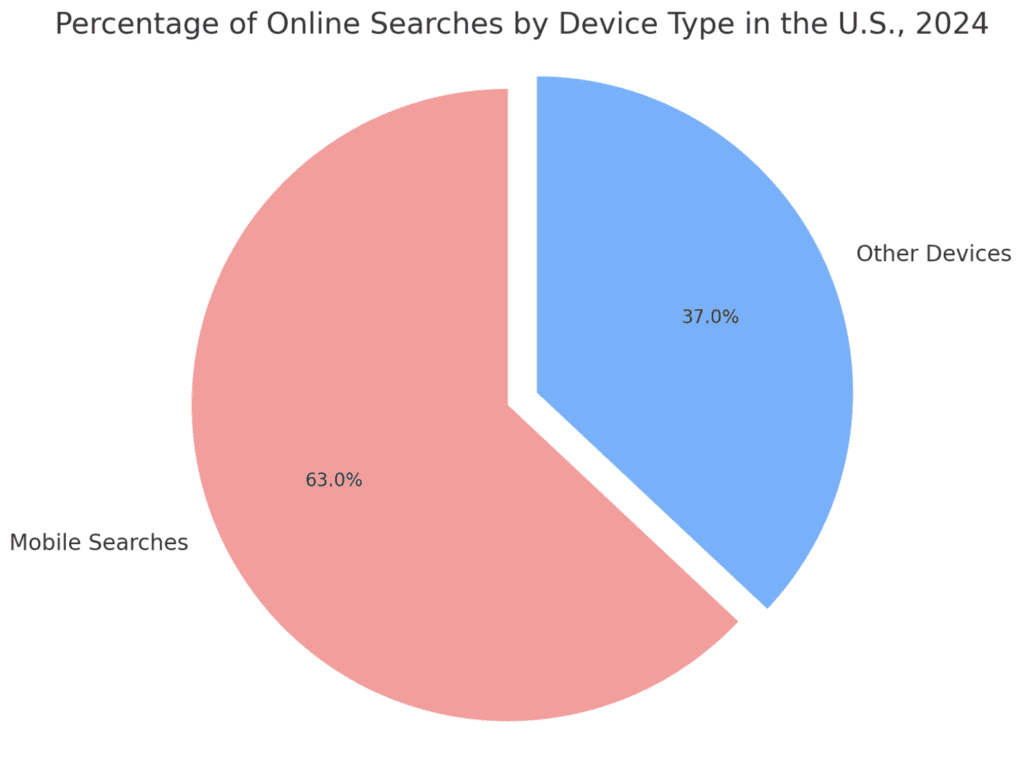
Optimize your content for mobile: This is a strategy that’s been growing more and more important as of late. According to this website, mobile devices account for about 63% of online searches in the U.S. in 2024. Because of this you have to make sure your content looks just on all devices!

Are you making sure your images stack on mobile? How about centering images in between paragraphs instead of wrapping text around them which can look wonky on mobile? These considerations are more important than ever when you understand how your audience is absorbing your content.

mobile device search

Focus on long tail keywords for much better conversions: Long tail keywords are defined as keywords that are longer and more specific, usually at least three words or more in length. A keyword like “basketball” is a very broad and general keyword, whereas a long tail keyword like “what are the best dribbling exercises for beginners” is much more specific and detailed.

So when you focus on these long tail, specific keywords, what happens is your audience arrives at your content finding exactly what they were looking for. This is big for conversions and ranking.

Optimizing for voice search: With the rise of AI assistants like Siri, Alexa, ChatGPT, and more, voice search has become another route your audience is using to find answers to their searches. They will simply ask their specific question to their AI assistant and bypass Google altogether.

Now, it’s important to understand that Google and YouTube search are still by far the most used route for finding answers, but it’s important to adapt your strategies for the growing voice search as well.

Is SEO a Waste of Time Infographic

Optimizing for voice search actually goes hand in hand with focusing on long tail keywords, since most voice searches are very specific in their structure.

Understanding PPC

Fundamentals of Pay-Per-Click

PPC advertising allows you to bid on specific keywords or basically “buy” phrases that your target audience might search for when looking for products or services. When a user clicks on your ad, you’re charged. The cost of the click varies depending on the competition for the keyword, the quality of the ad, and other factors.

One of the key advantages of PPC advertising is that it allows you to target specific audiences based on their demographics, location, interests, and other criteria. This means you can reach those potential customers who are more likely to convert into paying customers.

Once a PPC campaign is fine tuned, it can be very profitable. Check out these 34 eye opening profitable PPC stats.

One thing that is very important to understand though is that PPC campaigns take time (and money) to fine tune. If you jump into PPC without an understanding of what converts organically, you can quickly find yourself drowning in an expensive money pit.

PPC Trends and Innovations in 2024

In 2024, as Google fine tunes what it wants to be after their Helpful Content Update, I’ve personally seen much more paid ads at the top of certain keyword searches. Typically, I’d say this isn’t good for SEO, as users are arriving on a Google results page and even if you’re in a top spot, the user can’t see that until they scroll down past all the ads.

However, what this does mean is there is a growing opportunity in PPC. And just like with SEO, voice search is becoming increasingly popular, which means that businesses will need to optimize their PPC ads for voice queries we well.

Another trend we can expect to see in 2024 is the rise of video ads. Video is becoming an increasingly popular medium for advertising, and platforms like YouTube and Facebook are making it easier for businesses to create and run video ads.

How Do SEO and PPC Compare With Each Other?

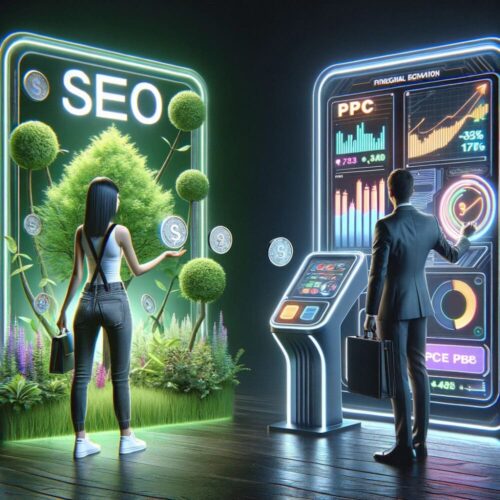
SEO vs PPC

Cost Implications

When comparing SEO and PPC, SEO is generally cheaper than PPC since it’s focused on optimizing your website to rank higher in search engine results pages organically, which is free of charge. With PPC obviously, there’s a requirement to pay for each click on your ad, which can quickly add up.

Traffic Potential

Both SEO and PPC have the potential to drive traffic to your website, but they differ in the way they generate traffic. SEO can result in more organic traffic, while PPC can generate more targeted traffic.

While SEO can take time to see results, it can result in more sustained traffic over time. PPC can generate more immediate traffic, but it can be costly in the long run.

Conversion Rates

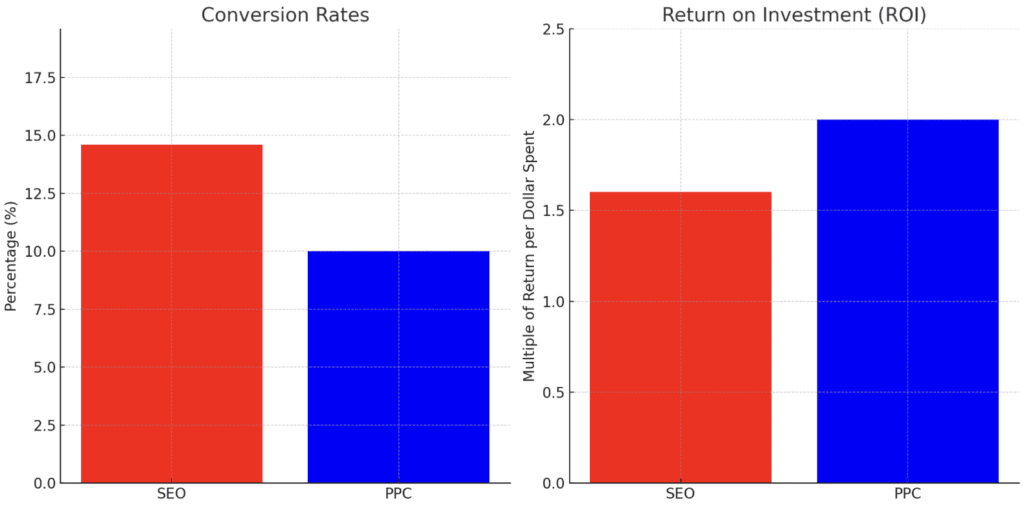
According to recent studies, organic search has a 14.6% conversion rate, while PPC has a 10% conversion rate. However, the conversion rate can vary depending on the quality of your website, the relevance of your keywords, and other factors.

It’s important to note that PPC typically has a better return on investment (ROI) than SEO. On average, businesses can expect to earn $2 for every $1 spent on PPC, compared to $1.60 for every $1 spent on SEO. However, the ROI can vary depending on the industry and competition level.

SEO vs PPC ROI

Time Investment

SEO and PPC also differ in the amount of time and effort required to see results. SEO can take several months to see results, while PPC can generate immediate traffic. However, SEO can result in more sustained traffic over time, while PPC can be costly in the long run.

It’s also important to remember that SEO requires ongoing effort to maintain and improve your rankings, while PPC requires ongoing investment to maintain your ad campaigns.

Can SEO and PPC Work Together?

In 2024, an integrated approach to SEO and PPC is becoming more and more popular. When you combine the two strategies, you can achieve greater visibility, traffic, and conversions on your website content.

Benefits of a Combined Approach Using Both SEO & PPC

The benefits of running SEO and PPC together include:

  • Keyword and conversion data from PPC can be fed into organic search (SEO).
  • Geographic areas with weaker SEO coverage can be covered by PPC.
  • A combined approach can help businesses dominate search engine results pages (SERPs) and increase brand visibility.
  • Combined data from both sources gives a better understanding of your target audience
  • High converting keywords for PPC can then be optimized for an SEO strategy

Trying to make money online and still not seeing results? Create your FREE STARTER ACCOUNT with the same straightforward training I’ve used to create full time revenue online. No matter your experience, this step by step training delivers! Click here and get started NOW!

Final Thoughts

Both SEO and PPC have their pros and cons, from time investment to money investment. Instead of thinking SEO vs. PPC, start thinking SEO and PPC. Combining both strategies provides a more effective approach to your digital marketing efforts.

If you are looking for a long-term investment that can provide cost-effective, credible, and sustainable traffic growth, then SEO is the way to go. However, it requires patience and a willingness to invest in quality content, technical optimization, and link building.

On the other hand, if you need immediate results and have a flexible budget, then PPC can give you a leg up. It allows you to target keywords precisely, test different ad copies, and track your ROI.

What do you think? Have you had a tough time getting your PPC campaign to become profitable? Is SEO seeming like a waste of time after Google’s 2024 HCU Update? Let me know in the comments section below! I’d love to hear your perspective and I always reply!

Frequently Asked Questions

What is the cost difference between implementing SEO and PPC?
Generally, SEO is a more cost-effective strategy in the long term, as it can provide sustainable traffic growth without the ongoing costs of PPC campaigns. However, there may be situations where PPC is more cost-effective, such as when targeting highly competitive keywords or during specific promotional campaigns.

How do changes in search engine algorithms affect SEO and PPC effectiveness?
Changes in search engine algorithms can have a significant impact on the effectiveness of both SEO and PPC strategies. Both SEO and PPC strategies need to be adaptable to continue to be effective.

What are the measurable differences in ROI between SEO and PPC campaigns?
PPC campaigns have a higher ROI in the short term, as they can provide immediate results. However, SEO campaigns have a higher ROI in the long term, as they can provide sustainable traffic growth without the ongoing costs of PPC campaigns.

Still Hungry for Growth?
Dive Into These Handpicked Articles! ⬇️

  • How to Drive Traffic to Your Affiliate LInks
    5 Smart Ways to Drive Traffic to Your Affiliate Links in 2026
  • Why Affiliate Marketing Isn't a Pyramid Scheme
    4 Reasons Why Affiliate Marketing Isn’t a Pyramid Scheme
  • Done For You Businesses Scam Legit
    Are Done For You Online Business Opportunities Legit? (2026 Update)
  • Online Coaching Business Scams Exposed
    11 Online Business Coaching Scams Exposed & How to Avoid Them (2026 Update)
  • Is Affiliate Marketing Still Worth It in 2026?
    Is Affiliate Marketing Still Worth It in 2026?
  • Why You Need to Stop Obsessing Over Analytics
    Why You Need to Stop Obsessing Over Analytics!

Written by Eric Cantu · Categorized: SEO (Search Engine Optimization)

Apr 20 2024

How the 2024 Google HCU Has Impacted SEO – Strategies for Recovery

How the 2024 HCU Update has Affected SEO

The Google Helpful Content Update (HCU) has been a hot topic in the world of SEO (Search Engine Optimization) since its release. This update has had a significant impact on search engine traffic, and impacted how we view SEO.

How Has the 2024 Google HCU Impacted SEO?

The 2024 Google HCU update has turned SEO on its head, prioritizing content written for people instead of search engines and featuring UGC (user-generated content) at the top of the SERPS. There is less focus on keyword placement and more on search intent.

Overview of Google HCU

The HCU is a core algorithm update that is intended to promote quality content and limit the search presence of content that is unhelpful or purposely written to satisfy search engine bots. The HCU has been rolled out in several updates since its launch in 2022, with the most recent update being released in March 2024.

With each update, Google has been tweaking its algorithm to better understand the intent behind searches being made. Google has elevated the significance of E-A-T (Experience, Authority, and Trustworthiness) qualities in content, and this has led to a noticeable shift towards more interactive and engaging content.

This update has also led to changes in keyword optimization, with Google favoring content that is written for humans rather than search engine crawlers. This has led to UGC (user-generated content) finding itself at the top of the SERPS (which many content creators aren’t happy about).

Another important aspect of the HCU is its emphasis on user experience. Google continues to pay careful attention to user engagement signals such as bounce rate, time on site, and click-through rate to determine the relevance and usefulness of content. Websites that provide a positive user experience and keep users engaged are more likely to rank higher in search results.

But what can we do if we feel we were creating solid content that is now lost in the abyss of the internet? Is SEO a total waste of time now? Or can we adapt our strategies and find a way to still rank?. 

What is HCU’s Impact on SEO Ranking Factors?

Supposed Emphasis on Content Quality

With the HCU update, some content creators are pulling out their hair. Google states that quality has become a crucial ranking factor, however there are a ton of seemingly low-quality sites at the top of the SERPS, like Reddit and Quora.

The main factor here is that Google understands that user-generated content is created by humans asking other humans questions in forums. And there isn’t any keyword stuffing or gaming the system to rank. Apparently, Google loves this.

Unfortunately, the actual quality of Reddit and Quora and other UGC can be lower than the quality posts ranking below them. Still, websites must ensure that their content is informative, well-researched, and provides value to their audience, also focusing on creating content that is relevant and up-to-date.

User Experience Optimization

User experience has always been an essential factor in SEO. And with the HCU update, it’s supposed to hold even more value.. Websites must ensure that their users have a seamless and enjoyable experience while browsing their website. This includes fast loading times, easy navigation, and mobile responsiveness.

Websites must also focus on creating a visually appealing website that’s easy to read and navigate. The website should be optimized for different devices, including desktops, tablets, and smartphones. This helps improve the user experience and increase engagement.

Mobile Usability Emphasis

Mobile usability has become a crucial factor in SEO since the HCU update. Make sure your website is mobile-friendly! According to this website, mobile devices account for about 63% of online searches in the U.S.

mobile device search

What are the Changes to Keyword Optimization After the HCU?

Shift from Keyword Density to Relevance

With the introduction of the Helpful Content Update (HCU), Google has shifted its focus from keyword density to relevance. This means that websites that used to stuff their content with keywords to rank higher aren’t going to be seeing the light of day. Instead, Google now rewards websites that produce content that is relevant to the user’s search query.

To optimize for relevance, you need to understand the intent behind your audience’s search. This means doing solid keyword research and creating content that answers those searches. Google’s algorithms will recognize the relevance of the content and rank it higher in search results.

Long-Tail Keyword Strategy

Another change that the HCU has brought to keyword optimization is the importance of long-tail keywords. Long-tail keywords are phrases that are more specific and targeted than general keywords. For example, instead of targeting the keyword “shoes,” (this wouldn’t be a good focus keyword anyway, way too general), you should target the long-tail keyword “women’s running shoes” or even better “which women’s running shoes are recommended by pediatrists?”

Check out these stats on long-tail keywords:

  1. Prevalence: Long-tail keywords make up a significant portion of all search queries, with analytics indicating that as many as 91.8% of all search queries are long-tail keywords​ (Embryo)​.
  2. Conversion Rates: These keywords are known for their high conversion rates, averaging around 36%, which is significantly higher than the conversion rates of more general searches​ (The HOTH)​.
  3. Specificity and Targeting: Because they are more specific, long-tail keywords allow businesses to target niche markets more effectively. This specificity makes them easier to rank for and less expensive to target in advertising campaigns​ (Embryo)​.
  4. Search Volume and Competition: While long-tail keywords typically have lower search volumes, this also means they face less competition, making them an appealing option for businesses looking to optimize their SEO strategies​ (The HOTH)​.

The reason why long-tail keywords are important is that they are more likely to match the user’s search intent. And remember, with the HCU, Google is now prioritizing the user’s search intent over exact keyword matches.

How Should You Change Your SEO Strategy After the HCU?

Tracking the Important Google HCU Metrics

To effectively measure the impact of the HCU, you need to track those metrics that Google is placing more focus on like bounce rate, time on site, and conversion rate. By monitoring these metrics, you’ll be able to measure whether the HCU has positively or negatively impacted your site’s performance.

Evolution of SEO Reporting

SEO reports should now include information on page experience. This includes metrics such as page load speed, mobile-friendliness, security, and relevancy of content. As the HCU aims to promote helpful content and has a major focus on user experience, you have to make sure that your content is informative, engaging, and relevant to your target audience.

What are the New SEO Best Practices?

New Approaches to Content Creation

According to the HCU, the focus is on creating content that is informative, relevant, and useful to the user. As I showed at the top of the article though, there’s a slight disconnect here, because so many UGC forums are topping the SERPS.

That being said, focus on value. No keyword stuffing to game the system! Understand the search intent and deliver! Create content that is optimized for both the user and the search engines (but lean toward more toward the user). Use LSI keywords, high-quality visuals, and attention getting headings and subheadings to break up the content.

Technical SEO Adjustments

As mentioned above, with more and more users on mobile, one of the most significant changes is the need for websites to be mobile-friendly. Google has made it clear via the HCU that websites that are not mobile-friendly will not rank well.

Other technical SEO adjustments include improving website speed, using schema markup, and optimizing images. Website speed is critical, and Google has specifically stated that it’s a ranking factor. Schema markup is essential for providing search engines with additional information about your content, while optimizing images can help improve the user experience.

What is the HCU’s Effect on Local SEO?

Google’s Helpful Content Update has impacted local SEO as well. The HCU focuses on providing high-quality localized information to users, which means that businesses must invest more in their local SEO efforts to stay relevant.

To improve their local SEO, businesses should consider creating location-specific content that provides value to their local audience. Additionally, businesses should focus on optimizing their Google My Business (GMB) profile. This includes adding accurate and up-to-date information about the business, such as the address, phone number, and hours of operation.

Has the HCU Impacted Voice Search Optimization?

Along with the rise of AI comes voice search. More and more people are speaking to either GPT, Siri, Alexa or another AI assistant to get answers.

To optimize for voice search, websites should focus on answering specific questions that users may ask. This requires a different approach to keyword research and optimization. This again is a reason for long-tail keywords and conversational phrases becoming so much more important for voice search optimization.

Make sure your content is structured in a way that’s easy for voice assistants to understand. Use clear and concise language, break up content into easily digestible sections. Lists and tables can be particularly useful in this regard.

Trying to make money online and still not seeing results? Create your FREE STARTER ACCOUNT with the same straightforward training I’ve used to create full time revenue online. No matter your experience, this step by step training delivers! Click here and get started NOW!

Final Thoughts

If you understand where Google’s focus is you can make adjustments and use this opportunity to adapt your content to actually make it more helpful and deliver more value to your audience. Don’t pull your hair out and give up! Adapt and overcome!

What do you think? Did you lose a significant amount of traffic as a result of the recent HCU.? What have you done to adjust? Are you utilizing other mediums? Let me know in the comments section below! I’d love to hear your perspective and I always reply!

Frequently Asked Questions

What’s the best way to recover from the Google Helpful Content Update?
Start with a content audit, remove low-quality pages, target long-tail keywords, and optimize for voice search. Elevate E-E-A-T across all content to rebuild trust with search engines.

How can I stay compliant with Google’s E-E-A-T guidelines?
Focus on showcasing expertise in your niche, earning authoritative backlinks, and maintaining transparency and site security to build trust.

How did the Google Core Update change SEO?
It penalizes low-quality and overly optimized content, prioritizes user intent over keyword stuffing, and rewards content that performs well on mobile and voice search.

Still Hungry for Growth?
Dive Into These Handpicked Articles! ⬇️

  • How to Drive Traffic to Your Affiliate LInks
    5 Smart Ways to Drive Traffic to Your Affiliate Links in 2026
  • Why Affiliate Marketing Isn't a Pyramid Scheme
    4 Reasons Why Affiliate Marketing Isn’t a Pyramid Scheme
  • Done For You Businesses Scam Legit
    Are Done For You Online Business Opportunities Legit? (2026 Update)
  • Online Coaching Business Scams Exposed
    11 Online Business Coaching Scams Exposed & How to Avoid Them (2026 Update)
  • Is Affiliate Marketing Still Worth It in 2026?
    Is Affiliate Marketing Still Worth It in 2026?
  • Why You Need to Stop Obsessing Over Analytics
    Why You Need to Stop Obsessing Over Analytics!

Written by Eric Cantu · Categorized: SEO (Search Engine Optimization)

Feb 15 2023

Why is my bounce rate over 100?
Why is my bounce rate over 100

If you’ve ever had to ask yourself, “Why is my bounce rate over 100?” then I feel your frustration. Thankfully this is an issue that can be fixed! Let’s dive into why this happens and what to do about it.

Why Is My Bounce Rate over 100?

A bounce rate higher than 100 can be the result of your analytics seeing more visitor exits than entries. It can stem from a technical issue, unexpected user behavior, or even your content!

Key Takeaways

  • Understanding Bounce Rate: Bounce rate is defined as the percentage of visitors who leave your site after viewing only one page, indicating a lack of engagement or interest.
  • Common Causes of High Bounce Rate: Factors contributing to a high bounce rate include slow loading times, poor mobile optimization, misleading content, intrusive pop-ups, and overall poor user experience.
  • Technical Issues Leading to Over 100% Bounce Rate: Inflated bounce rates can result from technical glitches like duplicate tracking codes, incorrect tracking settings, and cross-domain tracking issues.
  • Content-Related Factors: Not enough white space, poor internal linking, and low-quality content can drive visitors away, increasing the bounce rate.
  • Strategies to Reduce Bounce Rate: Improvements such as enhancing page speed, creating high-quality content, optimizing for mobile, improving navigation, and integrating multimedia, like videos, can significantly lower bounce rates and boost engagement.

Let’s take a look at several actionable steps you can take to lower your bounce rate and what this will mean to your website’s traffic and performance.

Understanding Bounce Rate and How It’s Calculated

So what is bounce rate?

  • Bounce Rate Defined: The percentage of visitors who leave a website after viewing just one page, known as a “one-and-done” visit.
  • Bounce Rate Example: As an example, a 60% bounce rate means 60 out of 100 visitors leave the site after only one page.
  • Bounce Rate Range: Typical bounce rates vary between 26% to 70%, with rates over 60% considered high.
  • Extremely High Bounce Rates: Rates of 90% or higher are alarmingly high and need immediate attention to identify underlying issues.
  • Bounce Rate Over 100%: Instances of bounce rates exceeding 100% are usually due to technical issues in analytics tracking.
  • Revenue Impact: High bounce rates can significantly affect potential revenue earned from website visits.

Common Reasons for a High Bounce Rate

When you have a high bounce rate it means your content just isn’t ENGAGING your audience! Here are the 5 most common reasons that can happen:

  • Slow loading times. If your website is slow and takes too long to load, guess what? Your audience is BOUNCING! The difference between a 1 second and 3 second load time drives bounce rates WAY up!
  • Poor Mobile Optimization. Just about everyone nowadays is online via mobile. Make sure your website is optimized for mobile devices! If your audience can’t read or navigate your site, they’re bouncing.
  • Misleading Content. Have you ever arrived at a website and you instantly realize the title was click bait? Don’t ever do this to your audience! Be on point!
  • Pop ups. This for SURE has happened to me. If I arrive at a website and annoying pop ups fill my screen, I’m out!
  • Poor user experience. Overall bounce rate is a direct reflection of user experience. If you have broken links, a wall of text, or just unclear direction, your audience will get frustrated and leave without seeing more.

Related Article at WorkFromYourLaptop.com!

Ever thought of using AI to help you write great, engaging content? Check out “Can I Use ChatGPT for Content Writing?” and see how to use this amazing tool to your blogging advantage!

Technical Issues that Can Inflate a Bounce Rate over 100%

Now let’s talk technical. I’ve shown why a high bounce rate can happen, but an INFLATED bounce rate is a whole other story.

Here are the top 3 technical issues that can cause this:

  • Duplicate tracking codes. Multiple tracking codes on a single page can cause analytics to count multiple visits from a single person. If you do use tracking codes, keep it to one per page.
  • Incorrect tracking settings. Personally, I don’t deal with tracking codes, but some allow you to dive into their settings. Done incorrectly, it can cause the more exits than entries issue.
  • Cross-domain tracking issues. If you have internal links that take your audience to a different subdomain, this could cause analytics to think they’re leaving completely. Again, make sure your tracking settings are correct.

Reasons Your Content May Be Driving Visitors Away

While technical tracking issues can inflate your bounce rate to over 100%, let’s not forget that your very own CONTENT can be helping to drive them away too!

  • Not Enough white space. Don’t hit your readers with a wall of text! Let your content breathe! Arriving at a website like that will make them back out immediately!
  • Poor internal linking. This is almost so obvious that you can forget about it! Without internal linking your audience literally can’t dive deeper into your website if they wanted to!
  • Poor content quality. Misspelled words, poor grammar, and lack of a clear thought process in your writing will have readers wondering why they even bothered clicking on your content. Take the time to make sure your writing is on point!

Strategies for Reducing Bounce Rate & Improving Engagement

Guess what? Now that you know the common causes to a high bounce rate, fixing it is relatively straightforward and simple.

  • Improve any page speed issues. Slow loading times can be the result of lack of image optimization, code not being minified, and even hosting.
  • High quality content. If your audience is arriving at your post and you’re instantly delivering on answering their question, they’re going to be SATISFIED and looking for more!
  • Optimize for mobile. More and more of your audience are finding your content from their smart phone or tablet. Make sure your website is optimized for a great mobile device user experience!
  • Improve website navigation. Always make sure your website is easy to navigate. Clear menus, good internal linking, and a straightforward way of getting to your content will greatly improve your bounce rate.
  • Use multimedia in your posts. A quick and easy way to have your audience stick around is incorporating VIDEO into your posts. Embedding YouTube content is easy and, trust me, your audience LOVES video!
  • Exit intent pop ups. Exit intent pop ups show up right as the user is exiting the page. If you have a high bounce rate, maybe consider utilizing a pop up that offers something (free gift, discount, etc.) that encourages them to stay and look around more.

Trying to make money online and still not seeing results? Create your FREE STARTER ACCOUNT with the same straightforward training I’ve used to create full time revenue online. No matter your experience, this step by step training delivers! Click here and get started NOW!

Final Thoughts

A bounce rate over 100% is almost always related to a technical tracking issue. To further lower your bounce rate, always aim to create high quality content that stirs up engagement.

How’s your website’s bounce rate? Have you been able to fix your bounce rate using the methods mentioned above? What methods have you used that I didn’t list? Let me know in the comments section below!

Frequently Asked Questions

What Defines a Bounce Rate in Web Analytics?

A bounce rate is defined as the percentage of visitors who navigate away from the site after viewing only one page. This metric is crucial in understanding user engagement and the effectiveness of a website in retaining visitors.

How Can a Website Achieve a Bounce Rate Lower than 60%?

To achieve a bounce rate lower than 60%, focus on improving site speed, ensuring mobile optimization, providing clear and relevant content, minimizing pop-ups, and enhancing overall user experience. These factors contribute significantly to keeping visitors engaged and reducing bounce rates.

What Causes a Bounce Rate to Exceed 100%?

A bounce rate exceeding 100% is often the result of technical issues, such as duplicate tracking codes, incorrect tracking settings, or misconfigured cross-domain tracking in analytics tools.

Why Is Mobile Optimization Crucial for Reducing Bounce Rate?

Mobile optimization is crucial because a significant portion of web traffic comes from mobile devices. A site that is not optimized for mobile can lead to a poor user experience for mobile visitors, increasing the likelihood of them leaving the site quickly.

What Are the Key Strategies to Lower a High Bounce Rate?

Key strategies to lower a high bounce rate include optimizing page loading speed, ensuring content aligns with user expectations, improving navigation, and enhancing the overall aesthetic and functionality of the site. These improvements can make the site more engaging and user-friendly.

Related Posts

    Written by Eric Cantu · Categorized: SEO (Search Engine Optimization)

    • Home
    • Sign Up
    • Blog & Search
    • Privacy Policy
    • Affiliate Disclosure

    Copyright © 2026 · Work From Your Laptop · Eric J. Cantu · All Rights Reserved