• Skip to main content
  • Home
  • Sign Up
  • Blog & Search
  • Privacy Policy
  • Affiliate Disclosure

WORK FROM YOUR LAPTOP

  • Start Here
    • Watch the Video Tutorial
    • FAQs
    • Start Your FREE TRAINING!
  • Blog
  • Meet Eric

Blogroll

Jun 25 2026

Wordform AI Review: What They Don’t Tell You About the $67 Price

Wordform AI review

Someone from Wordform AI emailed me today wanting me to add their tool to my “Top AI Tools for Content Creation” list. In return, they’d give me a backlink. But before I put my name on anything, I have to check it out first. And what I found out about how they sell this thing tells you more than any feature list ever could.

Here’s the honest breakdown if you’re also doing your due diligence for this product.


Is Wordform AI a Scam? 7 Things You Need to Know Before You Buy

  1. It’s a real, working tool, not a scam. But it’s sold the pushy “make money online” way by marketer Brandon Hays.
  2. $67 is just the front door. The webinar pushes pricey upsells once you’re in.
  3. Affiliates are banned from criticizing it. They can’t use the word “scam.” That’s why every review is glowing.
  4. No honest reviews exist. There’s nothing real on Trustpilot, G2, Capterra, or Reddit.
  5. The marketing is pure hype: “479 words per minute,” “$100M+ campaigns,” “AI research pigs.”
  6. The refund isn’t as easy as it sounds. The homepage promises “no questions, same day,” but the actual rules are much stricter.
  7. It’s risky for Google. Pumping out mass AI posts is exactly what Google penalizes. Google policy on scaled content
🔍 Have ChatGPT Summarize This Article

What’s In This Article (Quick Jumps)

  • What Is Wordform AI?
  • How Much Does Wordform AI Cost?
  • Wordform AI Features and Functionality
  • My Experience Researching Wordform AI
  • Wordform AI Testimonials, Pros & Cons
  • Final Thoughts
  • Frequently Asked Questions

What Is Wordform AI?

Official website: https://wordform.ai


wordform ai review

Wordform AI is a tool that promises to write blog posts for you with AI. You give it a keyword or a title. Then its bot, named “George Allwell,” does the research, builds an outline, and writes a full post with images.

It says it does all this in about 7 minutes. It also offers one-click posting to WordPress, 35+ built-in call-to-action buttons, and a claim that its writing can pass AI detectors.

Never paste unaltered AI content directly to your blog. Huge no-no. You’ll lose your audience, Google doesn’t like it, and you’ll lose all your authority and traffic. This opens the whole AI vs human writing debate, and it’s exactly why the human touch still wins. Here’s my full breakdown: AI vs Human Writers: Who Writes Better Content?

So who’s behind Wordform AI? The company is SCPS Technologies LLC. You’ll find that name in their Terms of Service, with a copyright that runs 2023-2026. The founder is Brandon Hays, who calls himself a “Traffic & AI Expert.”

Hays has done this before. He launched a niche-research tool called Niche Pig Pro back in April 2024. He sold it through MunchEye, a site where “make money online” products get launched with affiliate webinars. Wordform AI launched the same way in October 2024, with a 10-day push and a bunch of live webinars.

Why does this matter? Because it tells you what kind of product this is and how they market it. This isn’t a big company with a public team and a support office. It’s a product sold mostly through webinars to the “make money online” crowd (lots of hype, unrealistic promises of revenue, etc.)

The affiliate page lists the target buyers as internet marketers, make-money-online folks, newbies, “bizopp” seekers, and small business owners.

Who it’s for: beginners and affiliate marketers who want lots of content fast and don’t want to write it. Who it’s not for: anyone building a real brand that needs to last through Google updates, anyone who wants a clear team and a real support history, or anyone who hates webinar-style selling.

How Wordform AI Compares to Competitors

Here’s how Wordform stacks up against three better-known AI blog writers. I pulled these prices straight from their own pricing pages:

  • Koala Writer: The best-known “AI articles that rank” tool. It starts at $9/month (15,000 words) and goes up. The popular plan is $49/month. It checks the live Google results as it writes, posts to WordPress, Shopify, and more, and adds internal links for you. Best part: it has 19,000+ paying users and real reviews on Trustpilot, Capterra, and Product Hunt. One honest catch: the word counts are based on the cheapest AI model, so picking a better model uses up your words about twice as fast. I used to use this one myself. Check out my Koala Writer review here.
  • Cuppa: Has the nicest editor of the group, about $38/month to start. You bring your own OpenAI key, which keeps the cost per article low.
  • Byword: Built for bulk. About $5 per article, or bigger packages. Good for volume, but the quality can be hit or miss.

The HUGE difference between these 3 and Wordform AI: Wordform AI doesn’t have any actual, real reviews from real public users. MASSIVE red flag. (More on this further below).


How Much Does Wordform AI Cost?

Right now the public price is a one-time payment, not a monthly plan:

  • $67 one time for 30 article credits. They call it the “30 Kick-Off Special.” No monthly fee. You use the credits whenever you want. That works out to about $2.23 per article for the first 30.
  • “$1 per extra article” after that, but read the fine print. The site says you can “optionally purchase additional articles at $1 per article if you run out.” But it doesn’t say how. I seriously doubt you can just pay $5 and get 5 articles, surely there’s a minimum. The “$1” comes from their marketing line “$150 articles for $1 each”.
  • You also get the content editor, training, and email/chat support.

Some older review sites (Tekpon, SoftwareWorld) still show monthly plans of $49, $99, and $199. Those don’t match what the site sells now.

Wordform’s own Terms do mention monthly billing, so those plans might exist behind the login or might be coming. But the price you see in public today is the $67 pack.

There’s also a usage cap in the Terms: up to 300 sources scraped per month and 150 images per month (1,000 total). Most people won’t hit it, but heavy users will.

Upsells (This Is the Important Part)

Here’s something many reviews I saw missed. Wordform’s real sales engine is a webinar. The company calls it a “high-ticket front-end with recurring back-end offers.” This means they get you in cheap, then sell you more expensive modules and tools. The affiliate funnel shows a front-end plus three upsells (they call them OTO1a, OTO1b, and OTO2).

This means their sales plan is to hit the end user with more than one upsell.

Now here’s the part that confused me at first, and it might confuse you too. Wordform’s own affiliate page says promoters earn up to $647 for each customer. But $647 to an affiliate means a very expensive purchase needs to be made, upwards of $1000.

This proves that the $67 entry is just the very first step. After that, the buyer gets walked through much pricier add-ons like coaching or “done-for-you” packages that can run hundreds or even thousands of dollars.

I couldn’t find the exact upsell prices, because that doc needs a login. So I’ll be honest and call that part unclear, so check what they actually offer you at the webinar. Just don’t treat $67 as the full cost. It’s the floor, not the ceiling.


Wordform AI Features and Functionality

Here’s what the tool says it does, pulled from its own site:

  • One-click article writing: Type a topic, get a full post (intro, body, ending) with images in about 7 minutes.
  • “Deep-web” research and citations: It says it scans the web for stats, studies, and quotes, and can add citations. (Check these yourself. AI tools often make up sources that don’t exist.)
  • The George Allwell bot: Their AI writer. They say it writes at “479 words per minute” using “$100M+ frameworks.”
  • Content scaling: Turn one topic into “100 unique articles.”
  • Free niche, keyword, and headline tools: On the site, these feed the writer.
  • 35+ built-in CTAs: Add a call-to-action for any offer at the end of a post in one click.
  • Automatic AI images: It makes images to match each section. No design tools needed.
  • WordPress posting: Download, copy, send to Google Docs, or post right to WordPress.
  • Beats AI detectors: It says it swaps out overused words so the writing slips past AI checkers.

“100 articles from one topic” plus “beat the detector” is exactly the kind of thing Google has been cracking down on. So it could help you in the short run and hurt you later.

If you actually want your content to rank (and even get pulled into AI search results), that’s what GEO is about. Here’s my full guide to Generative Engine Optimization.


My Experience Researching Wordform AI

So this is what I found while researching it, not a full test drive. If I ever do a hands-on test, that’ll be its own post. But what I found is enough to raise an eyebrow.

The first thing I noticed was a wall of reviews that all sounded the same. Every “review” I opened (SoftwareWorld, openPR, a dozen blogs) used almost the same words. And they all ended with affiliate links or a webinar signup.

One “review” wasn’t even about the writing. It bragged about a “$260 commission” the person earned for promoting the tool. That’s not a review. That’s a sales pitch dressed up like one.

Then I found Wordform AI’s affiliate rules and why all the reviews sound the same: Affiliates can’t use bad language about the product, including the word “scam,” in anything they post. They also can’t do any “negative” promotion. Wordform AI affiliate documentation

So all those glowing reviews aren’t proof people love it. It’s that the people promoting it aren’t allowed to say anything bad. Once I saw that, that pretty much ended my interest.

There’s also a tight refund window. The homepage promises an easy “30-day, no-questions, same-day refund.” But the real Terms are stricter. You can get a refund on your first charge within 30 days, or on your last monthly rebill within 7 days (Again, another mention of monthly pricing even though the sales page says it’s a one time purchase).

And some users felt refunds are only given if the company feels like it. That’s not a scam, since lots of software works this way, but it’s important to be aware of that.

To be fair, (and I always try to find some positives unless I’m reviewing a total scam) here’s the good side: A few of the less salesy write-ups did say the writing reads okay and needs less cleanup than plain ChatGPT. For a beginner, that first post probably feels like magic.

Work From Your Laptop YouTube Subscribe

Wordform AI Testimonials, Pros & Cons

Don’t take my word for it. Here are positive and negative reviews I was able to gather from online forums such as Reddit, Trustpilot, and others.

One important note first: unlike most tools I review, I could not find real, honest reviews from regular users. Trustpilot, G2, Capterra, and Reddit had nothing real. Every “review” came from affiliates or from Wordform’s own blog.

And remember, affiliates aren’t allowed to say anything bad. So read the “good” list below with a big grain of salt. That missing honest feedback is the biggest finding in this whole review.

✅ Wordform AI Positive Mentions

  • The 7-minute, one-click writing is the most-praised feature (affiliate reviews).
  • The long-form writing reads better than plain ChatGPT (AI Content Review).
  • One-click WordPress posting saves real time (affiliate write-ups).
  • The auto images for each section save you a step (Wordform site).
  • The 35+ CTAs are handy for affiliate posts (moralreview).
  • The free headline, keyword, and niche tools are actually useful (wordform.ai).
  • One user said traffic grew within a month of posting (Tekpon listing).
  • The editor is a lot like the WordPress one (moralreview).
  • Beginners say it’s easy with no writing skills (SoftwareWorld).
  • The “humanize” button is said to lower AI-detector scores (moralreview).

❌ Wordform AI Complaints & Concerns

  • Affiliates aren’t allowed to criticize it, not even to use the word “scam.” That ruins the whole review pool (Wordform affiliate rules).
  • No real, honest reviews exist on Trustpilot, G2, Capterra, or Reddit (my own research).
  • The real sales funnel is a webinar with pricey upsells ($647 per sale to affiliates), way past the $67 entry price (Wordform affiliate page).
  • The refund promise sounds easier than the real rules (first charge within 30 days, rebill within 7, some only at their say-so).
  • The marketing is full of hype red flags: “479 words per minute,” “$100M+ campaigns,” “AI research pigs” (Wordform site).
  • The writing can feel cookie-cutter and needs edits to add personality (AI Content Review).
  • The “100 articles from one topic” and “beat the detector” approach can get you punished by Google (industry view).
  • It’s sold to the “make money online” crowd through the MunchEye launch scene, which has a lot of here-today-gone-tomorrow products (Wordform affiliate page).
  • Older review sites show out-of-date prices, so it’s hard to know what you’ll really pay (Tekpon, SoftwareWorld).

Final Thoughts

Wordform AI is a real, working tool. But the webinar selling, the pricey upsells, the total lack of honest reviews, and rules that stop affiliates from criticizing it mean I can’t call it safe enough to recommend.

What do you think? Have you actually paid for and used Wordform AI, not promoted it as an affiliate, but really used it on your own site? I’d love to hear from a real customer, because honest voices are so hard to find for this one.

What did the webinar try to sell you after the $67 entry? Did the refund work out fairly? And is your AI content still ranking six months later, or did a Google update bury it? Drop a comment below. One real story beats a hundred inflated affiliate “reviews.”

Trying to make money online and still not seeing results? Create your FREE STARTER ACCOUNT with the same straightforward training I’ve used to create full time revenue online. No matter your experience, this step by step training delivers! Click here and get started NOW!


Frequently Asked Questions

Is Wordform AI a scam or is it legit?
Wordform AI isn’t a scam in the real sense. It’s a working AI writing tool from a real company (SCPS Technologies LLC, founded by Brandon Hays), and it makes articles for a $67 one-time pack. But “legit” and “trustworthy” aren’t the same thing. The missing honest reviews, the pricey webinar upsells hidden behind a cheap front price, and the affiliate rule that bans any criticism all mean you should be more careful than with a normal AI writing tool. Test it with money you can afford to lose, and read the real Terms of Service before you pay.

Does Wordform AI content actually rank on Google?
It depends on how you use it. Cranking out lots of barely-edited AI posts (the “100 posts from one topic” idea Wordform sells) is exactly what Google has been cracking down on since 2024. AI content can rank when it’s helpful, fact-checked, and adds real first-hand experience. But pumping out posts just for volume is a known way to get buried or removed from Google. No tool changes that, Wordform included. And “passes AI detectors” does not mean “safe from Google.” Those are two different things.

What are the best Wordform AI alternatives?
If you want an AI blog writer with a real track record, look at Koala ($9 to $49/month, checks live Google results, one-click WordPress posting, 19,000+ paying users with public reviews), Cuppa (about $38/month, great editor, bring your own AI key for cheap articles), or Byword (about $5 per article, built for bulk SEO posts). All three show their prices up front and have active user communities, the kind of trust Wordform doesn’t have yet.

This is a personal-finance and online-business topic, and your situation is unique. I’m a content creator who reviews these platforms, not a financial advisor. Always do your own due diligence and check the official site for the latest details before spending any money.


Want More Honest Reviews?

Check out these reviews and learn how to spot the schemes and scams from the tools that can actually help you!

  • Wordform AI review
    Wordform AI Review: What They Don’t Tell You About the $67 Price
  • Cash Tracking System Scam Review
    7 Red Flags That Prove Cash Tracking System Is a Scam

  • Keala Kanae Power Code Masterclass review scam
    Keala Kanae’s Power Code Masterclass Review: The Free Bait Before the $29K Hook

  • Genesis by Inspirean Keala Kanae Scam or Legit Review
    7 Reasons Why Keala Kanae’s Genesis by Inspirean Is a Bad Idea – Honest Review

  • 7 figure accelerator review
    7 Figure Accelerator Review
  • Mastermind.com Review
    Mastermind.com Review: Scam or the Ultimate Knowledge Business Tool?

Written by Eric Cantu · Categorized: Reviews & Comparisons

Jun 22 2026

5 Smart Ways to Drive Traffic to Your Affiliate Links in 2026

How to Drive Traffic to Your Affiliate LInks

The only way you’ll make money in affiliate marketing is by getting clicks on your actual affiliate links. Period. The good news is that traffic isn’t magic. It’s a system, and once you know these five way that actually make a difference, you can stop guessing and start building.

How Do I Get Traffic to My Affiliate Links in 2026? 5 Smart Ways That Still Work

  • Build content that earns the click. Deep, honest articles that fully answer the reader’s question are what rank, get recommended, and turn visitors into buyers.
  • Optimize for search the right way. Match real search intent, use natural keywords, and structure your pages so the answer is easy to find.
  • Use social media to meet people where they already are. Pick one or two platforms, deliver value first, and weave links in instead of blasting them.
  • Treat Pinterest like the search engine it is. Visual search keeps sending steady, buyer-ready traffic to affiliate content — especially in lifestyle, finance, and tech niches.
  • Build an email list you actually own. It’s the one traffic channel no algorithm can take away from you. Grow a list, deliver value, and you’ve got traffic on demand.
🔍 Have ChatGPT Summarize This Article

What’s In This Article (Quick Jumps)

  • What Is Affiliate Traffic
  • Why Driving Traffic to Affiliate Links Matters Right Now
  • My Experience Learning to Drive Traffic
  • The 5-Step Breakdown: How to Drive Traffic That Converts
  • The Myth-Buster: Traffic “Hacks” That Waste Your Time
  • Your Next Steps
  • Final Thoughts
  • Frequently Asked Questions

What Is Affiliate Traffic?

Affiliate traffic is just people landing on your well written, well structured content and clicking through your affiliate links. Without traffic, there are no clicks. And without clicks, there are no commissions or revenue.

Here’s a mistake many beginners get backwards: they obsess over getting accepted by affiliate programs and placing their links before building their traffic. Spoiler alert: a perfect affiliate link with nobody looking at it earns exactly zero. The skill that actually pays you is getting the right people in front of those links in the first place.

And the “right people” part matters. You don’t want just any traffic. You want targeted traffic. You want the people who are already looking for the kind of solution your link points to.

And that’s what the five channels in this article are built to bring you.

Related article: Check out my full guide on beginner blogging mistakes and how to avoid them and start learning how to get past those beginner hurdles so many lose their momentum on!


Why Driving Traffic to Affiliate Links Matters Right Now

Targeted traffic is the single biggest driver of affiliate income. In 2026, content from independent affiliates and reviewers is more valuable than ever. Even AI search tools pull their recommendations mostly from affiliate and review content, not big brand websites. McKinsey research on AI-powered search

Let me put that in plain English, because it’s good news for you. When people research what to buy, they trust independent voices like honest, value-packed reviews. They’re looking for “here’s what actually worked for me” content. That’s you! You’re the value-delivering blogger!

That’s the whole reason affiliate marketing works.

Even the AI Overview answer at the top of searches builds its recommendations mostly from affiliate sites and reviews, not from brand websites. McKinsey found a brand’s own site makes up only 5–10% of what these tools pull from. So that honest, real content you’re creating doesn’t just rank at the top of Google, it’s the raw material that every discovery tool leans on.

This means that when you write a genuinely helpful article, you’re not just chasing one traffic source, you’re potentially feeding all of them. The people who do this well are getting rewarded. The thin, copy-paste directly from AI crowd is getting squeezed out and that’s exactly the kind of shift that favors people willing to do honest work.

So driving traffic isn’t just step one. It’s the skill. Master it, and everything else in affiliate marketing gets easier.

Related article: You may know a lot about SEO, but do you know about GEO?


My Experience Learning to Drive Traffic

When I first started blogging back in 2017, this was all very new to me. Like most new bloggers, I focused on making my site look nice, and then (without even realizing it) I went on to write my articles way too “salesy” and didn’t have the right amount of focus on actual value delivery.

As you consistently publish high-value content, you’ll notice one thing. The articles that rank will honestly and completely answer a real question someone was typing into Google. I’m not talking about half an answer wrapped in a sales pitch. I’m talking answer first, value elaboration second.

The focus shouldn’t be on the affiliate links at all. The affiliate links weave seamlessly into content that genuinely helps the reader.

In the fire service, the first thing we do at any fire scene is a size up. You read what’s actually in front of you before you commit to a plan of attack. You don’t fight the fire you wish you had. You fight the one that’s right in front of you.

So instead of pushing out random posts and hoping and praying for traffic to arrive, you have to look at what Google is telling us they want. They want EXPERIENCE. That’s not to be confused with expertise. You don’t have to be an “expert” to have a real experience with the topic at hand. Google’s Official E-E-A-T Update

That means, once we simplify it all down, we just need to:

  1. write content that genuinely helps, and
  2. find your target audience where they are

Let’s break this down step by step.


The 5-Step Breakdown: How to Drive Traffic That Converts

The most reliable affiliate traffic in 2026 comes from five channels: search-optimized content, smart SEO, targeted social media, Pinterest visual search, and an owned email list. Master one before adding the next, and your traffic compounds instead of scattering. 10+ Free Traffic Sources for Affiliate Marketing in 2026 (wecantrack)

Let’s get into the meat of it. Here’s the system, step by step.

Step 1: Build Content That Earns the Click

This is the foundation, so I’m putting it first. Write content so helpful that clicking your link feels like the obvious next step. That means going deep, being honest, and actually answering the question.

Why does this work? Because people click links from sources they trust. When you write a review where you’ve actually used the thing, or a guide that fully solves the reader’s problem, you earn that trust. The link stops feeling like an ad and starts feeling like an actual helpful recommendation.

Pro Tip: Most new bloggers forget to add real first-hand detail. Drop in a specific quirk, a real number, a “here’s what surprised me” moment. That’s what makes a reader believe you and click. And even if you’ve never personally gotten hands-on with the product or service, share the actual hands on testimonials shared by others and add your own personal take on it.

Step 2: Optimize for Search the Right Way

Match the search intent, then structure your page so the answer is easy to find. Answers go right up at the top. Don’t just target a keyword, target the actual question behind it and directly answer it.

Since search engines reward content that clearly and quickly answers what the reader asked, do your part and lead with a direct answer near the top. Use clear headers, and write in easy to understand language. Your readers love when the answer is easy to find. This makes them stay on the page longer and check out the rest of your content.

Pro Tip: Don’t sleep on long tail keywords! So many new bloggers forget that “best [product] for [specific situation]” keywords convert way better than broad ones. Someone searching “best email tool for a brand-new blogger” already knows exactly what they want. So when they arrive at your blog that gives them exactly that, the natural next step is the click-through to your solution.

Step 3: Use Social Media to Meet People Where They Are

Pick one or two platforms and show up consistently with value. You don’t need to be everywhere all the time. You just need to be somewhere, reliably.

Whether it’s Instagram, YouTube, X or TikTok, the same principles we’re applying to blog posts apply to social media content: deliver value first, sell second. Post helpful tips, quick demos, behind-the-scenes stuff. This is the kind of content that earns attention. Then weave your links in where they genuinely fit, like a YouTube description or inside a helpful reply.

Pro Tip: Consistency beats going viral. One viral post you can’t repeat is worth less than showing up three times a week for a year. Steady presence keeps you in the feed and in their mind.

Step 4: Treat Pinterest Like the Search Engine It Is

Use Pinterest as a visual search engine to send steady, buyer-ready traffic to your content. This one gets slept on constantly, and it’s a huge mistake.

I had no idea just how powerful Pinterest is. It’s not really social media, it’s a visual search engine where people go looking for ideas and solutions and they full expect to see links within pins to click through and find the answers to their questions. That’s HUGE for a blogger! Create pins that link back to your affiliate articles, optimize them with the right keywords, and they keep working for months.

Related article: Check out my full guide on Pinterest SEO: How to Drive Traffic to Your Blog and learn learning how to use this visual search engine to drive massive targeted traffic to your content!

Step 5: Build an Email List You Actually Own

Grow an email list so you have a traffic source no algorithm can touch. This is the one channel nobody can take from you, and that matters more than ever in 2026.

Every other channel you use runs on rented land. If Google changes an update, your traffic drops. If a social media platform tweaks its algorithm, your reach vanishes. But your email list is yours and yours alone. You can send traffic to a new article or offer any time you want.

The key to growing it is giving people a reason to sign up, called a lead magnet, like a free checklist or a mini-guide. Then deliver real value in your emails, not just pitches. Build trust, and a chunk of your list will click whatever you point them to.

Work From Your Laptop YouTube Subscribe

The Myth-Buster: Traffic “Hacks” That Waste Your Time

Every single blogger goes through this. You set out in front of you exactly what you need to do, and then you try to find some kind of shortcut to get there quicker.

Stop torturing yourself like this. It only delays your progress and empties your wallet.

  • Myth #1: “Just copy and paste your links everywhere and the numbers will work out.” Nope. Blasting affiliate links into Reddit threads, Facebook groups, and random comment sections is the fastest way to get banned and labeled a spammer.
  • Myth #2: “You need a huge audience before you can drive any traffic.” This is backwards. Search engines and Pinterest don’t care how many followers you have. You don’t need an audience to start. You build the audience by doing the work.
  • Myth #3: “Chase whatever traffic source is trending this week.” Every few months there’s a new shiny “secret” traffic hack. But the marketers actually winning aren’t hopping between ten platforms. That’s not efficient at all. Get really good at one or two channels, make them profitable, then expand.

And whatever you do never chase or spend money on any online scheme that guarantees it will explode your traffic. It’s IMPOSSIBLE for a system to guarantee growth unless they’re using bots. This is true whether they’re promising traffic to your website or to your instagram or to your YouTube channel.

Want to see schemes like this in action? Check out my reviews of UpGrow App, Social Growth Engine, YouBoost, and GoViralish.


Your Next Steps

Okay, you’ve got the full picture. Now let’s turn it into action.

Start with just one channel. Seriously. Pick the one that fits you best. Love writing? Go all-in on Steps 1 and 2 and make your content the best answer out there. More visual? Start with Pinterest. Maybe dive into Instagram if it’s a good fit. One or two MAX. Don’t spread yourself too thin.

Next, commit to consistency. And I’m not talking about days or weeks. Think months. Traffic compounds. The article you write today might not pop for a while, but once it does, it keeps working. Same with a list or a Pinterest account. You’re planting seeds, and seeds need time and steady watering to grow.

You don’t need a huge following, a big budget, or some secret hack to drive traffic. You need one honest, genuinely helpful piece of content and one channel to share it on. Do that, do it again next week, and you’re already ahead of most people who are still waiting for the perfect moment.


Final Thoughts

Pick one traffic channel today and create one genuinely helpful, honest piece of content for it. Don’t chase hacks, ever. Be the most useful answer your reader can find. Start now, stay consistent.

What do you think? Which traffic channel are you going to focus on first? And what’s been holding you back from committing to just one? Have you tried any of these and hit a wall? Drop your questions and comments into the comments section below! I always answer and I love hearing what you have to say.

Trying to make money online and still not seeing results? Create your FREE STARTER ACCOUNT with the same straightforward training I’ve used to create full time revenue online. No matter your experience, this step by step training delivers! Click here and get started NOW!


Frequently Asked Questions

What is the best traffic source for affiliate marketing in 2026?
It depends on your niche, but organic traffic from search-optimized content remains the most sustainable. Pinterest, YouTube, and email also drive highly targeted, buyer-ready traffic that converts well over time.

How do I drive traffic to my affiliate links without an audience?
Start by creating honest, in-depth content that answers real buyer questions, then optimize it for search. Pinterest and SEO can send targeted traffic before you have any followers, since both work like search engines.

Can I drive affiliate traffic without spending money on ads?
Absolutely. Content, SEO, Pinterest, social media, and email marketing all drive free, targeted traffic. These methods take time and consistency, but they build long-term, compounding affiliate income without paid advertising costs.


Want More Affiliate Marketing Strategies?

Don’t slow your momentum now! Check out the rest of my guides and build your affiliate marketing business right from the ground up!

  • How to Drive Traffic to Your Affiliate LInks
    5 Smart Ways to Drive Traffic to Your Affiliate Links in 2026
  • Why Affiliate Marketing Isn't a Pyramid Scheme
    4 Reasons Why Affiliate Marketing Isn’t a Pyramid Scheme
  • Done For You Businesses Scam Legit
    Are Done For You Online Business Opportunities Legit? (2026 Update)
  • Online Coaching Business Scams Exposed
    11 Online Business Coaching Scams Exposed & How to Avoid Them (2026 Update)
  • Is Affiliate Marketing Still Worth It in 2026?
    Is Affiliate Marketing Still Worth It in 2026?
  • Why You Need to Stop Obsessing Over Analytics
    Why You Need to Stop Obsessing Over Analytics!

Written by Eric Cantu · Categorized: Affiliate Marketing Strategies

Jun 21 2026

4 Reasons Why Affiliate Marketing Isn’t a Pyramid Scheme

Why Affiliate Marketing Isn't a Pyramid Scheme

Maybe someone pitched you an “online business” and your gut said this feels like a pyramid. Or maybe you found affiliate marketing and you’re worried it’s the same trap with a nicer name. I’ve been doing this for years, so let me break it down for you.

First, let’s define our terms here: I’ll cover affiliate marketing, pyramid schemes, and the often confusing MLM (multilevel network).


Is Affiliate Marketing a Pyramid Scheme? 4 Reasons It Isn’t

  • The money comes from real customers. You earn when an actual shopper buys a product they want. A pyramid’s money comes from new recruits paying to join.
  • You’re not required to recruit. You can earn a full income from sales alone. In a pyramid, recruiting people is the only way to make money.
  • There’s a real product at the center. Affiliate marketing is built on products people are already searching for. A pyramid uses a “product” as a cover for what’s really just paying to join.
  • It’s legal. Affiliate marketing is a normal, legal way business gets done online. True pyramid schemes are illegal and get shut down by the FTC.
🔍 Have ChatGPT Summarize This Article

What’s In This Article (Quick Jumps)

  • What Is Affiliate Marketing and How Does It Work?
  • What Is a Pyramid Scheme?
  • What Is an MLM?
  • The Real Difference Between Affiliate Marketing and a Pyramid Scheme
  • My Experience with MLMs and Pyramid Schemes
  • Your Next Steps
  • Final Thoughts
  • Frequently Asked Questions

What Is Affiliate Marketing and How Does It Work?

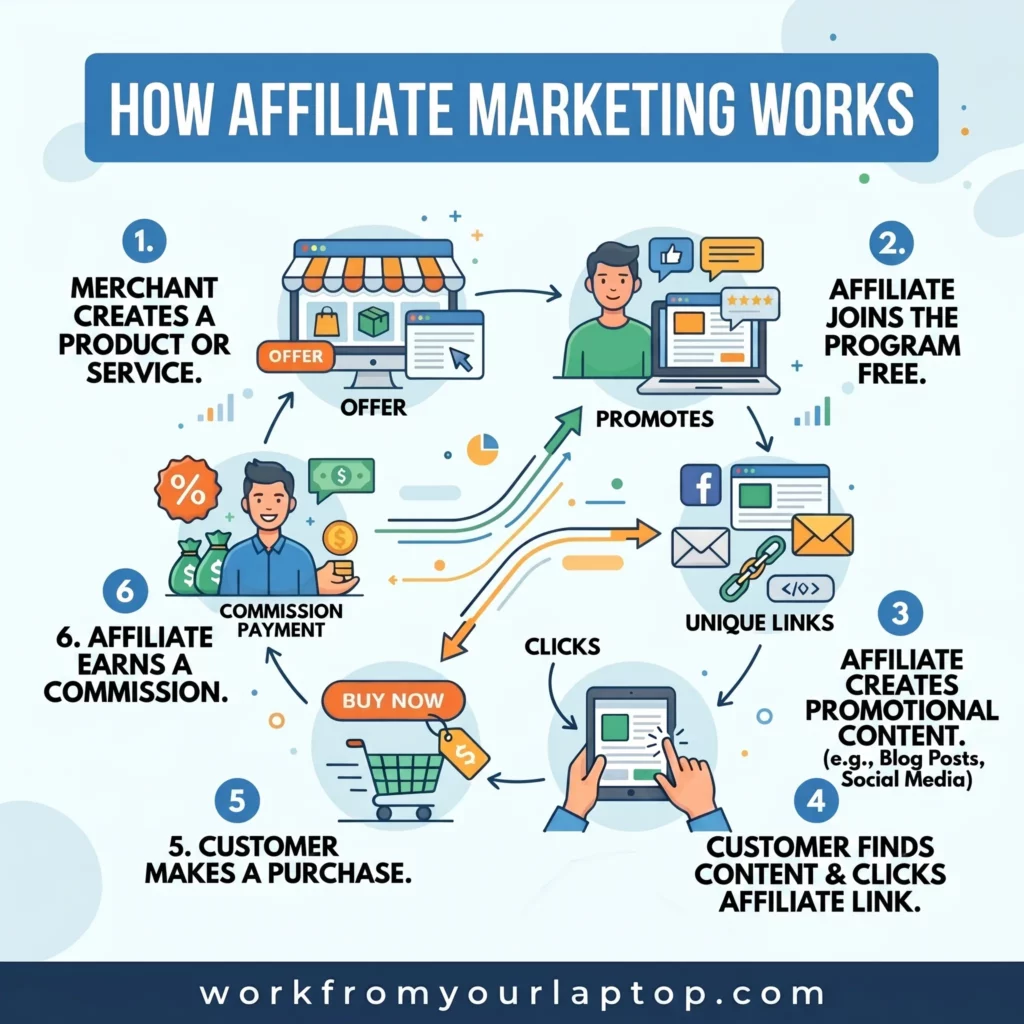
Affiliate marketing is a performance-based model where you earn a commission by promoting another company’s products. You share a unique affiliate link, and when someone buys through it, you earn a percentage of the sale. There’s no cost to join and no recruiting involved.

In plain English, affiliate marketing is all about connecting people with the products or services they’re already looking for online. If you live on planet earth and have ever bought something online, chances are you’ve participated in the affiliate marketing process without even knowing it.


is affiliate marketing a pyramid scheme how affiliate marketing works

Here’s how it works:

  • Someone does a search.
  • That search brings them to a website (often a review of the product) where they find more info on a product they want.
  • Then a special link (called an affiliate link) takes them to the seller’s website (Amazon, WalMart, BestBuy, etc.) where they buy it.

Every time that happens and a sale is made, the affiliate earns a commission. That commission is usually a percentage of the sale. There’s no limit to how many times you can earn one, and some are even recurring with subscriptions.

So every time you see a blogger writing a review, or a YouTuber doing a video, or your favorite Instagrammer showing off a product, that’s affiliate marketing at work. You’re the middle man connecting a buyer with a seller they already trust. That’s it. No team, no recruiting, no buy-in.

It’s how I make full time revenue online. Trust me, it’s legit.


What Is a Pyramid Scheme?

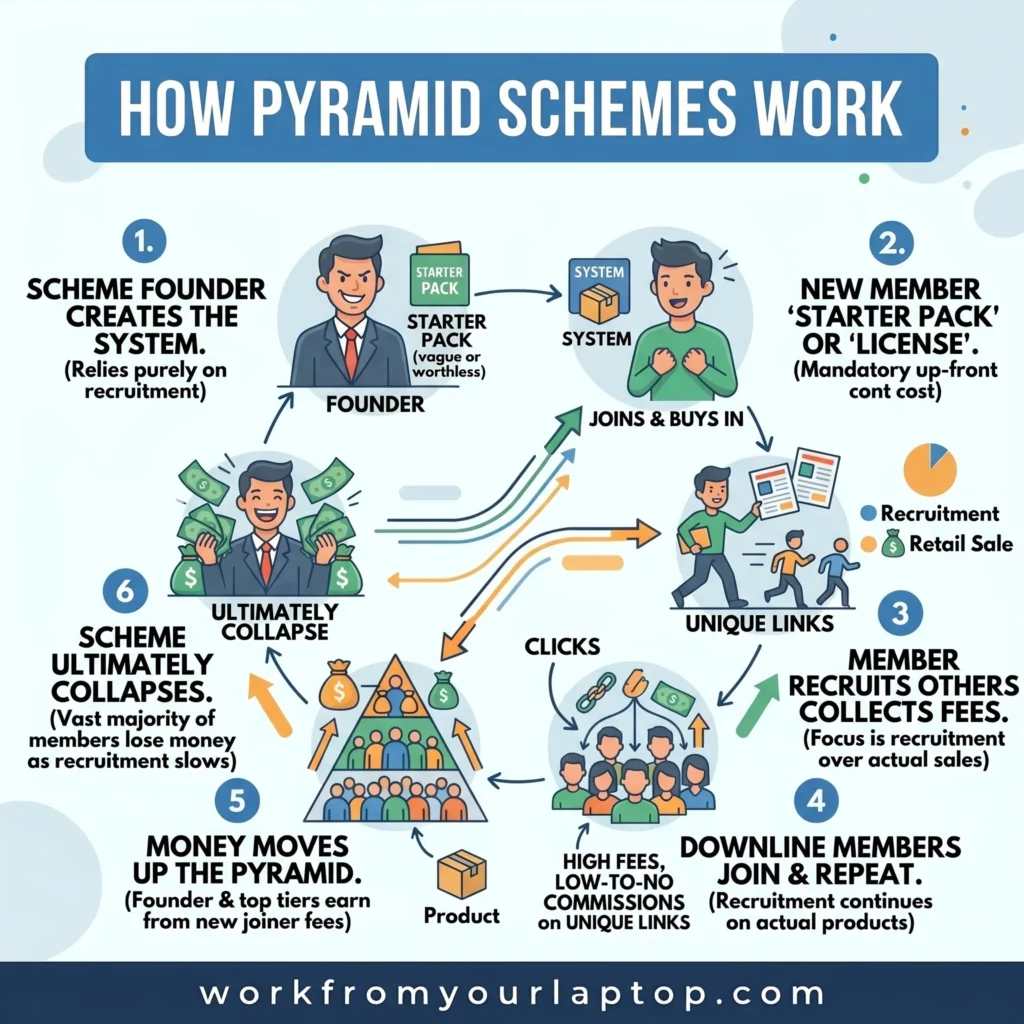
A pyramid scheme is an illegal model where participants pay to join and earn money primarily by recruiting others who also pay in, rather than from selling a real product to genuine customers. Because the money comes from new recruits, it collapses once recruiting stops. FTC guidelines on pyramid schemes

A pyramid scheme is 100% illegal. It may look like a business on the outside, but it’s just people paying people, with no actual product or service involved.

The Federal Trade Commission goes after them hard. That’s a big difference from affiliate marketing, which is a completely legal, normal way business gets done online every single day.


is affiliate marketing a pyramid scheme how pyramid schemes work

The way pyramid schemes typically work is you pay money to join, then you make your money back by recruiting other people who also pay to join. They recruit more people who pay, and so on. The cash flowing through the whole thing comes from new recruits, not from selling a real product to real customers.

That’s why pyramid schemes always collapse. At some point you run out of new people to recruit, and everyone at the bottom loses. There’s no real product driving it, so once the recruiting stops, the money stops.

Cash gifting schemes are pyramid schemes. You wouldn’t think people would fall for these, but in times of desperation, common sense goes out the window. Check out these often bizarre cash gifting schemes I’ve reviewed: Cash Tracking System, Too Damn Easy


What Is an MLM?

An MLM (multi-level marketing), also called network marketing, is a legal model where participants sell a real product and can also recruit others to sell it, earning a share of their team’s sales. The presence of a genuine product sold to real customers is what separates a legal MLM from an illegal pyramid scheme. FTC Business Guidance on MLMs

People often mix up pyramid schemes with MLMs, but they’re not the same thing.

MLM stands for multi-level marketing (you might also hear it called network marketing). It’s the model behind companies like Avon, Mary Kay, and Amway. You sell a real product, and you can also recruit other people to sell it, earning a cut of what your team sells.

So your aunt selling supplements and talking all about her home business on Facebook? Yeah, she’s not a hardened criminal. That’s a legal MLM, not a pyramid scheme.

The key difference is there’s an actual product or service here. In a real MLM, actual customers buy actual products. In a pyramid scheme, there’s no real product, and the only money coming in is from people paying to join. That’s the line between legal and illegal.

So why do people lump them together? Because MLMs have that same “recruit a team” structure. When you see the downlines drawn out, it looks like an actual pyramid, and a bad MLM can blur right into pyramid territory if the product is just a cover for recruiting. But the model itself is legal.

In my experience, MLMs just aren’t sustainable. If you get in early, you can maybe earn some quick cash, but the later in the game you get in the harder it is to find people. On top of that, MLMs pretty much DEMAND you push hard to recruit friends, family, total strangers, and it never ends.

And the income numbers are rough. The FTC says most people who join MLMs make little or no money, and some lose money. I’ve done several reviews of MLMs like World Ventures (now DreamTrips) and more. The comments can sometimes get heated when you tell them their business isn’t sustainable, but the numbers don’t lie.


The Real Difference Between Affiliate Marketing and a Pyramid Scheme

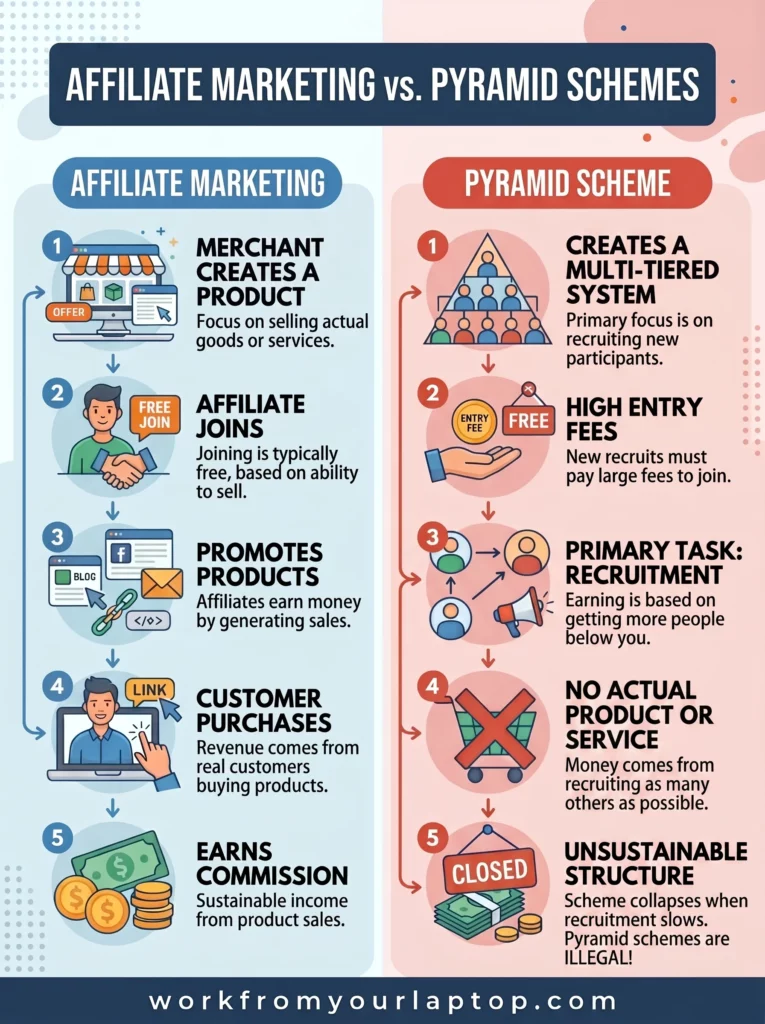
The defining difference is the source of the money. Affiliate marketing pays commissions earned from product sales to real customers, with no fee to participate. A pyramid scheme generates money from new recruits who pay to join, not from genuine product sales. FTC Business Guidance on MLMs

People overthink this. It really comes down to one question.

Where does the money come from?

In affiliate marketing, the money comes from a real customer buying a real product. You shared a link, someone out in the world bought something they wanted, and you earned a cut. The customer isn’t joining anything. They’re just shopping.

In a pyramid scheme, the money comes from the people getting recruited. They pay to join, and that payment goes to the people above them. There’s no actual product or service.

That’s the whole thing. One is fueled by shoppers. The other is fueled by recruits. Once you see it that way, you can’t unsee it.


is affiliate marketing a pyramid scheme

True affiliate marketing is one of the most legit ways to earn online. No buy-in, no recruiting, no pressure on your friends and family. You earn by helping people find products they already want.

We’re not knocking on people’s doors trying to sell them things they don’t want. We create content around a niche we’re passionate about, we follow good SEO practices so that our content ranks at the top of the search engines, and then every day people buying things online find our content because it’s relevant to them.

Pro Tip: When someone shows you an “opportunity,” ignore the flashy income screenshots and “ground floor opportunity” hype. Ask yourself: Is there an actual product to sell?  If not, you know immediately it’s a pyramid scheme. If there’s a product or service but it’s built heavily on recruitment, it’s an MLM.

Work From Your Laptop YouTube Subscribe

My Experience with MLMs and Pyramid Schemes

My very first introduction to online business was through multilevel marketing. There was a program called “Ignite” and it involved getting paid on electricity bills. I’m not gonna lie, it was fun, and I made some money.

But it was painfully transparent that there was no way to sustain it. Never ending recruiting gets brutal. The hype of “just get 3 people to do this and you’ll get paid on their success” is empty when you’re recruiting person after person who does absolutely nothing.

When the vast majority of your team earns no money it’s hard to sell it as a great opportunity. Soon, the top tier earners all leave at once to the next thing.

The sad thing is that the “next big thing” is usually an illegal pyramid scheme or something that is technically “legal,” but very, very shady. And who is left to recruit?

Trust me, they’re just not worth your time.

I wanted something sustainable where I didn’t need to depend on anyone else but myself. I started doing some research on how online business works, and I found Wealthy Affiliate. I followed the training like a robot and I never turned back.

In my day job as a fire captain, the first thing we do on any call is a scene size up. With online business opportunities, read the situation first. Fall back on your common sense. Now that you know the points to key in on, you’ll never get suckered again.


Your Next Steps

So where does this leave you? You came here worried affiliate marketing might be a scam. Now you know it isn’t. It’s one of the most honest ways to earn online, because you only get paid when you help a real person buy something they actually want.

Here’s how to put that to work.

First, protect yourself. If someone ever tries to recruit you into a “business opportunity,” look at where the money comes from. Are people earning by selling a real product to normal customers? Or are they mostly earning by signing up new people who pay to join? If it’s the second one, that’s a pyramid scheme. Walk away. Run!

Second, if you want to build something real, start small. Pick one niche you genuinely care about. Sign up for a free affiliate program in that space, like Amazon Associates. Then write content that answers the questions real people are typing into Google every day.

No team to build. No people to pester. Just you, helping people find what they’re already looking for, one piece of content at a time. Do that consistently, and you’re building something that can pay you for years.

Related article: So how hard is affiliate marketing? Check out my full guide on “Why Most 9-5ers Fail at Affiliate Marketing” and learn the mistakes not to make so you can build your business right from the start!


Final Thoughts

Affiliate marketing isn’t a pyramid scheme. It pays you for real sales to real customers, with no recruiting and no buy-in. Today, learn the one question that protects you: where does the money come from?

What do you think? Have you ever been pitched something that felt like a pyramid? What tipped you off? And if you’re looking to get started with affiliate marketing, what’s the one thing still holding you back? Drop it in the comments section below! I read and reply to every single one.

Trying to make money online and still not seeing results? Create your FREE STARTER ACCOUNT with the same straightforward training I’ve used to create full time revenue online. No matter your experience, this step by step training delivers! Click here and get started NOW!


Frequently Asked Questions

Is affiliate marketing legal?
Yes, affiliate marketing is completely legal. You earn commissions for promoting products and driving real sales. You just follow some basic rules, like disclosing your affiliate links to stay compliant with FTC guidelines and reporting your income for taxes.

Is affiliate marketing an MLM?
No. An MLM (multi-level marketing) pays you partly for recruiting a team and earning off what they buy. Affiliate marketing has none of that. You earn only from sales you drive, with no team under you. MLMs are legal, but the FTC reports most people in them make little or no money.

Do you have to pay to start affiliate marketing?
No. Affiliate programs like Amazon Associates are free to join, and your commissions come from the seller. Paying for training or tools to learn the skill is a normal business cost. The red flag is paying a company for the right to earn its commissions, which points to a pyramid scheme.


Want More Affiliate Marketing Strategies?

Affiliate marketing is how I created full time revenue online. Check out the following guides and learn more on how you can find the same success.

  • How to Drive Traffic to Your Affiliate LInks
    5 Smart Ways to Drive Traffic to Your Affiliate Links in 2026
  • Why Affiliate Marketing Isn't a Pyramid Scheme
    4 Reasons Why Affiliate Marketing Isn’t a Pyramid Scheme
  • Done For You Businesses Scam Legit
    Are Done For You Online Business Opportunities Legit? (2026 Update)
  • Online Coaching Business Scams Exposed
    11 Online Business Coaching Scams Exposed & How to Avoid Them (2026 Update)
  • Is Affiliate Marketing Still Worth It in 2026?
    Is Affiliate Marketing Still Worth It in 2026?
  • Why You Need to Stop Obsessing Over Analytics
    Why You Need to Stop Obsessing Over Analytics!

Written by Eric Cantu · Categorized: Affiliate Marketing Strategies

Jun 19 2026

7 Red Flags That Prove Cash Tracking System Is a Scam

Cash Tracking System Scam Review

If a stranger walked up and pitched you a system where you just “gift” someone $500 and expect to get rich, your gut would definitely tell you something was off. Listen to your gut! Cash Tracking System is one of the clearest examples I’ve seen of a completely illegal scheme dressed up to look legitimate.


Is Cash Tracking System a Scam? 7 Red Flags

Yes. Cash Tracking System is a cash-gifting scheme that regulators and courts treat as an illegal pyramid scheme. Here are the 7 red flags that give it away:

  • There’s no product to sell. The whole “business” is just moving cash up the chain.
  • You only get paid by recruiting. That’s the textbook definition of a pyramid scheme.
  • The owners are hidden. No name, address, or phone, just a privacy proxy.
  • The “tax-free gift” claim is a trap. Money you expect back isn’t a gift; it’s income.
  • The fine print contradicts the pitch. Its own disclaimer admits “no profit making benefits.”
  • Everyone gets the same clone website. You compete against your own upline.
  • It’s legally an illegal pyramid scheme. Organizers risk felonies, participants misdemeanors.
🔍 Have ChatGPT Summarize This Article

What’s In This Article (Quick Jumps)

  • What Is Cash Tracking System?
  • How Much Does Cash Tracking System Cost?
  • How Cash Tracking System Actually Works
  • My Experience Looking Into Cash Tracking System
  • Cash Tracking System Testimonials, Defenders & Complaints
  • Final Thoughts
  • Frequently Asked Questions

What Is Cash Tracking System?

Official website: cashtrackingsystem.com (member login page)
You might also see it pushed through clone pages like financialfreedomsites.com. More on that in the “My Experience” section.

Cash Tracking System Scam Review

DO NOT fall for schemes scams like Cash Tracking System. It advertises itself as a wealth creation system, but it’s nothing more than an illegal cash gifting scheme.

The way it works: you’re usually referred into it by someone you met online. The website isn’t even accessible without an invitation and a password and it’s only a few pages with limited info. Once inside, you watch a series of mega hype-heavy videos promising financial freedom, and then, finally, you’re asked to “pledge” cash to the person who invited you.

And then it’s your turn to go find some other suckers

Who’s behind it and how old is it? This is always the murky part. There’s never a clear founder or even founding year for these shady platforms. Some sources list it as being founded in 2004, 2009, or “around 10 years old”.

The founder is listed only as “Mark R.,” with other names like “George Graves” floating around, but searches don’t connect any real person to the company. MAJOR RED FLAG.

Who is it for? Honestly, no one. It’s marketed at people who are tired of a 9-to-5 and want fast money without selling anything. But the only people who can actually profit are the small number who got in early and sit near the top. Pyramid scheme anyone?

How It Compares to Its “Competitors”

Its closest relatives are other cash-gifting and recruitment-first schemes, not legitimate programs:

  • Blessing Loom / Money Board / “Circle Game”: A near-identical social-media pyramid where you pay in (often around $100) expecting roughly $800 back, recruiting others while you wait. The FTC calls it a chain-letter scam and it’s identical to Cash Tracking System.
  • Too Damn Easy: This was my first cash gifting scam review. So bizarre and so eerily similar. Check out the full Too Damn Easy review here.

How Much Does Cash Tracking System Cost?

Pricing details are all over the place, so an “exact” current number is hard to confirm.

  • Entry “pledge” levels: Four levels, starting at a $500 pledge and climbing, roughly $500, $1,000, and $2,000 tiers. Other reports cite levels totaling $500, $1,500, $3,500, and even upward of $10,500.
  • Monthly fee: Around a $39 monthly charge to stay active. Some older reports list $34.95 plus a setup fee. This is the fee for your clone website.

Upsells and Hidden Costs

This is where it gets worse.

  • Higher pledge levels (positioned as “essential”): The amount you pledge determines how much others are allowed to pledge to you. So, of course, you’re pressured to pay in at the highest level to “unlock” bigger payouts. This is the core upsell, and it’s designed to maximize what you risk, but make you “feel” like you’re gonna cash in big time. Cha-ching! (Nope.)
  • Paid training courses (positioned as “optional”): Way overpriced optional courses, in the range of $600 to $1,100, sold to “help you succeed”. Complete trash. Classic marketing technique to make you feel like, “ok, I’m not going to buy the $600 course, or the $1100 course, I’m just going to make a pledge and that’s it.”
  • The monthly website fee: You’re paying a monthly fee for a clone site that’s literally a carbon copy of everyone else’s, so you don’t stand out at all.

Related article: Check out my full guide on 11 Online Business Coaching Scams and start learning how to recognize obvious online scams that prey on the naive and vulnerable!


How Cash Tracking System Actually Works

Strip away the videos and the “financial freedom” language, and the mechanics are basic. Here’s the breakdown:

  • You pay a “cash pledge” to your recruiter. Someone joins, pays a pledge to the person who referred them, then has to go find more people to do the same.
  • Your pledge level caps your income. If you pledge $500, you can only receive from people who also pledge $500. Pledge more, and you “unlock” the ability to receive more. “You want the most, don’t you?” This pressures everyone to pay in at higher levels.
  • There is nothing to actually sell. THERE IS NO PRODUCT. Period. The entire point is finding more recruits. This makes it ILLEGAL.
  • You get a clone website and “training modules.” The modules are advertised, but reviewers found there’s no real support or training. You’re completely on your own to recruit.
  • The fine print contradicts the sales pitch. The site itself states there are “no profit making benefits of any kind”, which of course directly contradicts all the videos promising wealth.

Listen, I feel like I’m shooting fish in a barrel here, but you’d be surprised just how many people fall for this stuff. It’s not that they’re dumb or stupid, it’s that when you are desperate for something to work and you see something online that promises the world there’s something inside you that thinks, “What If?“

Never make a decision based on emotion. When something looks unbelievable, sleep on it and I guarantee in the morning you’ll thank yourself for taking a second look with fresh eyes.

Work From Your Laptop YouTube Subscribe

My Experience Looking Into Cash Tracking System

Let me state the obvious here: I definitely did not pledge money into this system, and I urge you with everything I have to not participate either. My “experience” here is the same researching process I use for every program I review. I dig through the funnel, the sales pages, and the breadcrumbs of real users online.

After years of doing this, patterns jump out instantly, and Cash Tracking System set off nearly every “ding” in my warning systems.

The first thing I ran into: the wall of secrecy. Most programs have an official website you can check out. With this one, I couldn’t even view anything without an invitation and a password. When I went looking for ownership details for the website, I was hit with a privacy proxy and no address, phone number, or owner listed. Red flag.

The clearest negative is what happens to normal people who join. Over and over again, reading report after report, the story repeats: people pay in, struggle to get anyone interested, and don’t make their money back. The end.

Some reported getting harassed with daily prerecorded calls (up to ten minutes long) after enrolling. So long story short, look forward to harassment, regret, and a lighter bank account.

In the fire department it’s common to hear “Trust, but confirm.” In the case of Cash Tracking System, please do not trust. You know better than this. Trust your gut!

If you’re serious about online business, affiliate marketing is the one true, proven, way to make money online legitimately and it’s doable even with no experience, as long as you put in the work and have the right training.

Never, EVER get scammed into any kind of cash gifting system.


Cash Tracking System Testimonials, Defenders & Complaints

Like I always say, don’t take my word for it. Here’s what I gathered from forums like Realscam.com and JustAnswer, along with review sites, and comment sections.

I always try my hardest to share both sides, but for this kind of scheme, the only “success stories” you hear are from current members defending the money they’ve already put in, which is EXACTLY how these schemes keep going.

✅ What Defenders of Cash Tracking System Say

  • “It’s been around 20 years, if it were a scam it wouldn’t last.” (promoter testimonial)
  • “It’s the most transparent opportunity I’ve ever been involved with.” (promoter testimonial)
  • “I’m making more money part-time than most people make full-time.” (promoter testimonial)
  • “You can gift up to $14,000 a year tax-free, so this is legal.” By the way, this is a complete misreading of gift-tax law.
  • “I was fully qualified at the $6,500 level on day one when a friend joined under me.” (promoter testimonial)
  • “The 7-part video presentation was impressive and detailed.” (promoter testimonial)

❌ Cash Tracking System Complaints

  • People report they simply don’t make back the money they put in.
  • Even when members get the offer in front of people, prospects just aren’t interested.
  • Complaints of daily prerecorded phone calls lasting up to 10 minutes.
  • Everyone gets the same generic clone website, so members compete against each other with identical pages.
  • No transparency. Owners, address, and phone numbers are all hidden.
  • The site’s own fine print admits there are no profit-making benefits.
  • Multiple reviewers conclude it’s an illegal cash-gifting scheme and warn people away.

Final Thoughts

Cash Tracking System is a cash-gifting pyramid scheme with no product, hidden ownership, and a legal disclaimer that quietly admits it won’t make you money. My verdict is simple: stay away and keep your cash.

What Do You Think? I’d love to hear from you in the comments. Have you been invited into Cash Tracking System or a similar “gifting” program? What did the pitch sound like and who invited you? Total stranger? Friend?

Did you lose money in a scheme like this, and if so, how did you find out it was a pyramid? And what’s the one red flag you wish you’d spotted sooner?

Please don’t hesitate to chime in below! Your story might be the one that saves the next reader from making the same mistake.

Trying to make money online and still not seeing results? Create your FREE STARTER ACCOUNT with the same straightforward training I’ve used to create full time revenue online. No matter your experience, this step by step training delivers! Click here and get started NOW!


Frequently Asked Questions

Is Cash Tracking System legal?
No, not as a money-making business. While giving a genuine, no-strings gift is legal, handing over cash so you can recruit others with the promise of getting cash back is an illegal pyramid scheme, which is not what the tax code’s gift rules cover (JustAnswer). State agencies treat gifting clubs as criminal enterprises, where organizers face felony charges and participants face misdemeanors (NC DOJ). No matter what it’s called, a “circle,” a “pledge,” or a “cash gifting system”, recruitment-based gifting falls under anti-pyramid laws.

Can you actually make money with Cash Tracking System?
A tiny number of people near the top do, but the math guarantees most won’t. In every pyramid scheme, only a few early joiners profit, and the vast majority lose everything they invest because the model needs an endless supply of new recruits to keep paying out (Washington State AG). The most common real-world outcome is that you won’t make back the money you put in. This is a high-risk recruitment scheme, not passive income or a legitimate work-from-home business.

Is the “tax-free gift” claim about cash gifting true?
This is one of the most misleading parts of the pitch. The IRS only allows cash to be treated as a tax-free gift when nothing is expected in return, but in this system, you pledge money specifically expecting cash back, which makes it income, not a gift. In one federal case, scheme organizers were convicted partly for telling recruits the money was tax-free “gifts” and then filing false tax returns (U.S. DOJ). Treating recruitment payouts as nontaxable gifts can create serious tax-fraud exposure.

This is a personal-finance and online-business topic, and your situation is unique. I’m a content creator who reviews these platforms, not a financial advisor. Always do your own due diligence and check the official site for the latest details before spending any money.


Want More Honest Reviews?

Don’t slow your roll just yet! Check out these other reviews of platforms that say they’ll help you. Which ones are legit and which ones are scams?

  • Wordform AI review
    Wordform AI Review: What They Don’t Tell You About the $67 Price
  • Cash Tracking System Scam Review
    7 Red Flags That Prove Cash Tracking System Is a Scam
  • Keala Kanae Power Code Masterclass review scam
    Keala Kanae’s Power Code Masterclass Review: The Free Bait Before the $29K Hook
  • Genesis by Inspirean Keala Kanae Scam or Legit Review
    7 Reasons Why Keala Kanae’s Genesis by Inspirean Is a Bad Idea – Honest Review
  • 7 figure accelerator review
    7 Figure Accelerator Review
  • Mastermind.com Review
    Mastermind.com Review: Scam or the Ultimate Knowledge Business Tool?
Written by Eric Cantu · Categorized: Reviews & Comparisons

Jun 17 2026

How To Write Engaging Blog Posts That Keep Readers Hooked in 2026

how to write an engaging blog post that keeps readers hooked

Ever click on a blog post, you read one line, and you’re like “nope”? Yeah. Me too. And in 2026, your readers are doing that faster than ever. The good news? Keeping them hooked is a skill you can get better at, and I’m gonna show you exactly how it works.

How Do You Write a Blog Post That Keeps Readers Hooked?

You keep readers hooked by opening a curiosity gap in the first line, writing in a real human voice, breaking text into skimmable chunks, and giving your perspective so the post can’t be summed up by an AI. Hold attention and Google rewards you.

  • Win the first 5 seconds or lose the reader. Your opening line decides everything.
  • Voice is your moat. AI can copy facts. It can’t copy you.
  • Skimmers are the majority. Most folks scan first, so write for the scroll.
  • Open loops pull people forward. Tease what’s coming, then deliver.
  • Dwell time is the scoreboard. The longer they stay, the higher you rank.
🔍 Have ChatGPT Summarize This Article

What’s In This Article (Quick Jumps)

  • What Is an Engaging Blog Post?
  • Why Engaging Writing Matters Right Now
  • My Experience Learning to Hook Readers
  • The Core Strategy: How to Keep Readers Hooked
  • How to Snag the AI Overview Top Spot!
  • Your Next Steps
  • Final Thoughts
  • Frequently Asked Questions

What Is an Engaging Blog Post?

Let’s get this class started.

An engaging blog post is one that grabs your reader’s attention fast and holds it all the way to the end. This is done by:

  • pulling in the reader with a strong hook,
  • keeping them moving with a clear flow,
  • and it feels like a real person is talking to them, not a robot reading a list of facts.

And here’s the flip side to that coin. A boring post just answers a question. An engaging post makes you want the answer, then makes you enjoy getting it.

That difference is HUGE, both in terms of your reader’s user experience AND your content being popular or completely lost in the abyss of the internet. Let me show you why.


Why Engaging Writing Matters Right Now

Engaging, original writing is now what earns visibility. Google states that unique, compelling, genuinely useful content influences a site’s presence in AI search more than any other factor. As AI answers the basic questions, the human voice readers actually stay for is the durable advantage. Google’s official AI search guidance

In 2026, Google often answers the question before anyone clicks your link. This caused Google search traffic to publishers to decline dramatically in 2025.

Ouch. But trust me when I say the sky is NOT falling. Here’s the part that’s a lifesaver if you’re a blogger or content creator.

The AI Overview didn’t kill blogs. It performed a stress test. It exposed which posts were just dry facts a robot could repeat, and which ones had a real human worth reading. The dry-fact posts got swallowed. The ones with a voice? They’re still standing.

And don’t think the AI Overview spot is unattainable. You can absolutely get snagged into that spot. And when you do, your clicks are actually better clicks because the AI has already pre-qualified you as an authority. So if you can hook them, they stick around longer than ever.

Don’t worry, I’ll show you tips for snagging that AI Overview spot a little further down.

So let’s show you how to get some dwell time on your blog. Dwell time shows your readers are engaged and your content is relevant. Google loves this so it’s now more crucial than ever. The longer your readers stay, the louder you’re telling Google, “Hey, this post is the real deal.”


My Experience Learning to Hook Readers

It’s totally normal when you first start writing blogs to sound like a textbook. That’s definitely how I started. Oh wait, that’s because back in my day WE ACTUALLY WROTE OUR BLOGS!

Now you all have AI doing everything for you, but I digress. AI tools for content creation are must haves, but it’s an ABSOLUTE MUST to add the human element when writing content or you’re gonna be killed.

Don’t just pack as much info as possible into a post. And definitely don’t leave the pasted AI as-is if you’re using AI to help write some of your content.

Pro tip: When you’re reading your post before you hit publish (yes, you need to read your own stuff!), read your intro out loud. Is it boring? Does it even sound like you?. If it doesn’t it’s time to rewrite every word of it.

Every word.

Make it sound like you’re actually talking to a friend. Try opening with a question, tease what’s coming. This is called the hook. With a good hook, dwell time will climb and comments will start showing up. That one subtle change can flip the switch for your blog.

As a Fire Captain, when we do any training, you learn fast that nobody wants a lecture. Make it so you’re telling a story based on your own experiences and you have all their attention. People don’t connect with data. They connect with you. 

So that’s the message I need you to remember: you are the part of your blog that AI can’t copy. A robot can list ten tips, but it can’t tell your personal story or share your unique perspective. Lean into that, and you’ve got something no AI Overview can steal.


The Core Strategy: How to Keep Readers Hooked

Keeping readers hooked relies on five moves: open with a curiosity gap, write in an authentic human voice, format for skimmers, use open loops to maintain momentum, and close with interaction. Together these maximize dwell time and produce content AI engines cannot replicate.

Alright, this is the meat of the article. Let’s go step by step.

Step 1: Win the First 5 Seconds

Your first couple of lines do 90% of the work. Mess it up and the rest doesn’t matter.

The trick is something called the curiosity gap. Our brains are hardwired to look for closure when presented with incomplete information. Create an open loop, and the brain registers it as a problem that needs solving. It’s like an itch in your brain that can only be scratched if it keeps reading.

So open with a small mystery, a bold claim, or a question or something completely relatable. You need a tease that promises a payoff.

A few first lines that work:

  • “Quick confession: I once did X, and here’s what happened.”
  • “Here’s the part no one tells you about…”
  • “You’re doing this wrong. Here’s why.”

Pro Tip: With your intro, get right to the point. Start on the most interesting sentence you’ve got. Don’t start telling a story. Remember, you have 5 seconds to win!

Step 2: Write Like a Real Human

This is your superpower in 2026. AI writes the safe, average version of everything. Don’t mute your perspective by just pasting AI content as-is.

I’m an expert trainer inside Wealthy Affiliate. One of my pet peeves is when new members starting writing to their WA blogs (which are supposed to read like progress reports or journal entries) with nothing but pasted AI slop.

When you write about a topic from genuine personal experience, with your own voice, and with positions not everyone will agree with, you create something an AI Overview can’t extract the value from without linking directly to you. Your perspective is the content.

So use contractions, short sentences, and the word “I.” Share your real opinions. Tell your stories. Take a stand. If a popular tip is garbage, say so. That’s the stuff a robot can’t fake.

Step 3: Format for Skimmers

Here’s a stat you might not be ready for. Readers only read around 20% of your content. Think about it. When you arrived here did you read every single word on the screen? Or did you start skimming and grazing?

We need to make our content skimmable that way our readers can quickly find and dive into the section of our content that holds the answer they’re looking for. And since we don’t know where they’re going to dive, we need to make every section valuable!

Here’s how to make a post skimmable:

  • Keep paragraphs short. Two or three lines, max.
  • Use bold to highlight key points so skimmers catch them.
  • Break sections with clear H2 and H3 headers that work like signposts.
  • Lean on bullet lists to chunk info fast.

This isn’t just pretty. It works. White space keeps readers moving..

Pro Tip: Most people forget to check their post on a phone. Pull it up on mobile before publishing. If you see a giant gray text wall, chop it up. That’s where readers bail.

Step 4: Use Open Loops to Keep Momentum

A hook gets them in. Open loops keep them moving. Tease what’s coming next so they won’t stop.

By raising questions and delaying complete information, you create momentum that pulls the reader through your writing. Add a little tension. Don’t be boring!

At the end of a section, drop a little breadcrumb like:

  • “But there’s one mistake that ruins all of this. More on that in a sec.”
  • “That worked… until it didn’t. Here’s what changed.”

The second you read that your brain picked up on the teaser I had earlier in this post didn’t it? I teased about how I was going to teach you how to snag the AI Overview spot. That tease acts like a tiny promise. Keep making them, keep keeping them, and readers glide all the way to the bottom.

Step 5: Turn Readers Into a Conversation

The post shouldn’t end when the reader finishes. The best blogs feel like a two-way street.

So end with an open-ended question that invites your readers to leave real answers. Don’t just end with “Thoughts?” Ask something specific they’ll actually want to weigh in on. Then reply to every comment you get. When people feel heard, they come back, and they bring friends.

This matters more than ever, because in 2026 the smartest bloggers are building direct relationships with their readers. They’re building email lists, communities, and bookmarks. A comment section is where that loyalty starts.

Pro Tip: If you can, break the ice by commenting first and then pinning that comment. I do this all the time on YouTube, and you know what? I’m gonna find a way to do it on this website too. Readers are way more likely to reply when they see the host already in the room.

Work From Your Laptop YouTube Subscribe

How to Snag the AI Overview Top Spot!

You earn AI Overview visibility by creating unique, first-hand content that goes beyond common knowledge, organizing it with clear headings and sections, and meeting Google’s technical requirements so the page is indexed and snippet-eligible. Google confirms there are no special tricks, just strong, people-first SEO is the path. Google’s official AI search guidance

Now for the resolution to the tease I promised at the top. See how I did that?

Here’s the good news before we even start: if you’ve followed the rest of this guide, you’re already halfway there. The stuff that keeps a human reading is the exact same stuff that gets you cited. Clear answers. Real structure. And sources you can trust.

Google’s been very clear about this: There are no special optimizations required to appear in AI Overviews. The strong fundamentals we’ve covered still matter the most, so your best advantage is making those fundamentals easier for AI to understand..

So just write naturally and make it easy to read. Here are the three moves that get you there.

Answer the Question First, Then Explain

Open your main, key sections with a short, direct answer, then elaborate. Don’t make the reader (or the AI) dig for it. Give the payoff up front, right away, then elaborate.

I do this with my TL;DR box up top and my “direct answer blocks” that start key sections. Our human eyes are drawn to it, and the AI just happens to love it too.

Back It Up With Real, Named Stats

AI engines don’t want your opinion floating in space. They want claims they can trust. A vague “studies show people like short posts” does nothing. “A 2008 Nielsen Norman Group study found readers consume about 20% of a page” has way more punch and gives the engine something solid to stand on.

Pro Tip: Name your source right in the sentence. It builds trust with readers and gives the AI a reason to cite you over the next page.

Structure It So AI Can Follow

AI reads your post by its structure, meaning the headings are very important. And it lifts your content in standalone pieces. So two things.

  • Use clear H2s and H3s that map your post like a table of contents.
  • And write each section so it stands on its own, with no “as I mentioned” or “building on our previous point” , etc.. If a chunk can’t be pulled cleanly, it won’t get pulled at all.

Your Next Steps

Here’s what I want you to do today. Open your most popular old post and read just the first one or two sentences. Be honest. Does it hook you?

If it doesn’t right away, rewrite it with a curiosity gap. Open a loop. Make a promise. That one tweak can be the make or break move that gets your reader to stay for the rest!

Then scroll through that same post on your phone. How does it feel? Too busy? Is the content able to breathe? Do you have any walls of text? If so, break them up into short paragraphs and add a couple of headers.

Last, check the ending. Is there a real question waiting for the reader? Does it nudge them to chime in? If not, add one. Then watch your comments and your dwell time over the next couple weeks.

Here’s the a-ha I want you to walk away with: You don’t need to be a better writer to win in 2026. You just need to be a better host as your readers are welcomed into your website. Hook them at the door, keep them comfortable, give them something only you can give, and invite them to stay and chat.

Do that, and the rankings and traffic follow. Every single time.


Final Thoughts

Today, go fix the first line of one post. Open a curiosity gap, sound like a real human, and tease what’s next. That one change does more for engagement than anything else you’ll do this week.

What do you think? What’s the one piece of advice in this article that really stood out to you? Think back to blogs that have made you read every word. What did the writer do to pull that off? And be honest, is your own intro hooking people or scaring them off?

Drop your experiences down in the comments. I read and reply to every single one.

Trying to make money online and still not seeing results? Create your FREE STARTER ACCOUNT with the same straightforward training I’ve used to create full time revenue online. No matter your experience, this step by step training delivers! Click here and get started NOW!


Frequently Asked Questions

How do you hook readers in the first sentence of a blog post? Open a curiosity gap. Lead with a bold claim, a question, or a small mystery that promises a payoff. This creates an open loop your reader’s brain feels compelled to close, pulling them deeper into the post instead of bouncing back to search.

Why do readers leave a blog post so quickly? Most readers leave because of slow warm-up intros, dense text walls, or a generic voice that feels AI-written. With only 27% of people reading thoroughly, weak formatting and no clear hook push skimmers away within seconds, tanking your dwell time.

How do I keep readers engaged all the way through a blog post? Use open loops between sections to tease what’s coming, write in a real human voice with short skimmable paragraphs, and close with a question that invites comments. These moves boost dwell time, the key engagement signal search and AI engines reward in 2026.


Want More On Blogging and Copywriting?

Check out these full guides! Don’t slow your momentum! Get after it! You got this!

  • how to write an engaging blog post that keeps readers hooked
    How To Write Engaging Blog Posts That Keep Readers Hooked in 2026
  • Choosing the right blogging platform 2025
    Choosing The Right Blogging Platform in 2025
  • How to Start a Successful Blog Featured Image
    10 Simple Steps to Starting a Successful Blog
  • Common Beginner Blogging Mistakes
    16 Beginner Blogging Mistakes And How To Avoid Them
  • how to create a strong personal brand as a blogger
    How To Create A Strong Personal Brand As A Blogger
  • how to write a blog for affiliate marketing
    How To Write a Blog For Affiliate Marketing

Written by Eric Cantu · Categorized: Blogging and Copywriting

  • Page 1
  • Page 2
  • Page 3
  • Interim pages omitted …
  • Page 29
  • Go to Next Page »
  • Home
  • Sign Up
  • Blog & Search
  • Privacy Policy
  • Affiliate Disclosure

Copyright © 2026 · Work From Your Laptop · Eric J. Cantu · All Rights Reserved