• Skip to main content
  • Home
  • Sign Up
  • Blog & Search
  • Privacy Policy
  • Affiliate Disclosure

WORK FROM YOUR LAPTOP

  • Start Here
    • Watch the Video Tutorial
    • FAQs
    • Start Your FREE TRAINING!
  • Blog
  • Meet Eric

Social Media for Affiliates

Apr 24 2026

Pinterest SEO for Bloggers: Turning Pins into Website Traffic

Pinterest SEO for Bloggers: Turning Pins into Website Traffic

If you’re treating Pinterest like Instagram or TikTok, you’re doing it wrong. It’s time to stop acting like Pinterest is only a social media platform and start using it like it’s a search engine. If you aren’t using it to send people to your blog, you’re missing out on your best readers.

TL;DR: How Do I Use Pinterest to Drive Blog Traffic?

Pinterest drives traffic by functioning as a visual search engine. To convert viewers into website visitors, you need to create “click-bait” pins, not in the deceptive sense, but in the sense that your pin design and headline must promise a solution that the user can only fully access by clicking through to your blog post.

  • Prioritize Outbound Clicks: Your primary metric is “Link Clicks,” not “Saves” or “Followers.”
  • Solve, Don’t Just Show: Your pin must clearly communicate the value of the blog post.
  • Bridge the Gap: Use your pin to introduce a problem and your blog post to provide the solution.
  • Design for Intent: Stop making “pretty” pins; make “actionable” pins that invite a click.
  • Don’t fight the algorithm: Use “scout”, “image” and “TOBI” pins to keep Pinterest happy.

What’s In This Article (Quick Jumps)

  • Why Pinterest Matters for Traffic Right Now
  • My Experience with Using Pinterest for Blog Traffic
  • Step-by-Step Breakdown: The Core Strategy for Clicks
  • Common Pinterest Mistakes & What to Avoid
  • Your Next Steps In Mastering Pinterest SEO
  • Final Thoughts
  • Frequently Asked Questions

Why Pinterest Matters for Traffic Right Now

Pinterest is one of the most powerful, underrated traffic drivers for bloggers. Unlike social media platforms where content dies in hours, Pinterest content is evergreen. A single, well-optimized pin can drive consistent, high-intent traffic to your website for months or even years after you first post it.+1

If you ignore Pinterest, you’re missing out on a huge search engine that people use to plan, learn, and buy stuff. At its core, Pinterest is a visual discovery engine. Winning at Pinterest is much more than dominating social media. Think of it like a giant mood board where people go to save ideas.

Unlike social media apps which seem to be meant for trolling and starting arguments and scrolling through random stranger’s selfies, Pinterest is built for searching for answers.

Here are its strong points:

  • It’s a Search Engine: People go to Pinterest to type in a problem or a goal, like “DIY home office ideas.” They’re looking for answers, not just entertainment.
  • Long-Term Value: On social media, your post is usually forgotten in 24 hours. On Pinterest, your content acts like an asset. A pin you create today can still be found and clicked on months or even years from now.
  • Higher-Quality Traffic: Because people are searching for specific ideas, when they find your pin, they’re already looking for the information you have. This makes them much more likely to click through to your website to learn more.
  • Organized Discovery: Users save your content to “boards,” which act like organized file folders. This keeps your content relevant and easy to find for future users, rather than letting it get buried in a noisy feed.

In my experience Pinterest connects people looking for answers with the content you’ve made to help them. Plain and simple. It turns your website into a go-to resource that people can find, even a long time after you first posted it.

This is a perfect fit for a blogger.


My Experience with Using Pinterest for Blog Traffic

I was never a Pinterest guy. I honestly always thought it was just a social network for stay-at-home moms. I thought it was a place to look at home decor and cookie recipes. I didn’t see any real business value in it.

Then, I saw the light. I watched an expert class series on Wealthy Affiliate specifically talking about using Pinterest to drive targeted traffic to your blog. Again, at first I thought that was for people in the “home decor” or “antiquing” niches. I was 100% wrong.

That expert class series changed everything for me. I realized Pinterest isn’t really social media at all. It’s a search engine just as powerful as YouTube. When you build your boards right, not only are you keeping Pinterest happy, gaining a following there, but your driving high quality traffic to your site as well.

I learned about “scout pins,” “image pins,” and “TOBI pins.” That was my real “a-ha” moment. There’s a science to it all. And the final result is a huge boost of traffic that converts.


Step-by-Step Breakdown: The Core Pinterest Strategy for Clicks and Website Visits

The core strategy is to create “Click-Through Pins” by using keyword-optimized titles and descriptions, then designing visuals that explicitly promise a result or “how-to” answer that requires a click to access, all while creating pins that Pinterest loves and keeping the algorithm happy. 

Let’s talk Pinterest strategy that works. We want to build our Pinterest following the right way, and then drive targeted traffic to our blog content.

1. The “Click-Bait” Solution Design

This isn’t the “click bait” you’re thinking of. It’s all about getting attention. Your pins and their design need to be hyper relevant. But we also don’t want to just have spammy pins all over our boards. I use Wealthy Affiliate Image Studio to create unbelievably high quality pins and they’re as simple as typing a prompt.

Now, let’s talk about the 3 different types of pins you want to use to give your boards the high value your Pinterest audience is looking for while still driving that traffic to your blog content without being spammy.

2. Understanding Scout, Image, and TOBI Pins

This is really the meat of what I want you to understand. You can’t just spam links to your blog. You need to create an ecosystem that adds value to people who love Pinterest.

Remember, Pinterest wants its user to love the platform, so don’t fight against the algorithm. Add value to your Pinterest boards the right way and the natural follow through when you’re delivering answers will be the click-throughs.

  • Scout Pins: These are highly relevant, high-quality images. They don’t have an external link, a title, or a description, they just have an assigned board. Because they don’t take the user away from the app, Pinterest loves them. They keep your boards looking full and professional instead of “spammy.” Plus, they’re great for driving traffic to your boards.
  • Image Pins: These are your bread and butter. They have an optimized title, a clear description, an assigned board, and a link that goes directly to your article. They’re the perfect bridge between your scout pins and your content.
  • TOBI Pins (Text Over Background Image): These are the next level. They have everything an image pin has: the title, description, board, and link, but you also add simple text overlays on the image. This makes it super obvious that clicking the pin will lead to a direct answer. Personally, I like going a slightly different route and use WA Image Studio to create full infographics for my articles. It’s like TOBI pins on steroids!
  • Pro Tip: Use Scout pins to fill out your boards and build authority. Then, sprinkle in your Image and TOBI pins to guide those users to your actual articles. You can have multiple iterations of your image and TOBI pins. Have fun with it!

3. The “Destination URL” Strategy

This should be self explanatory, but I want to drive this point home. Be exact with your linking.

Don’t just link to your website. Link every image and TOBI pin directly to the article that gives the direct answer to the user’s question. If you’re pinning a recipe, link it directly to the recipe article. If you are pinning a tutorial, drive that traffic directly to that specific article.


Common Pinterest Mistakes & What to Avoid

Beginners fail when they chase vanity metrics over traffic. Common mistakes include pinning for aesthetic over utility, ignoring keyword intent, failing to use clear CTAs, neglecting to check link-through analytics, and treating boards as “mood boards” instead of SEO-organized content categories.

  1. Ignoring Link Testing: Not making sure your pins actually go to your site.
    • Solution: Periodically click your own pins. Make sure the link isn’t broken and goes to the intended page.
  2. Poor Mobile Optimization: Pins that look bad on phones.
    • Solution: Always check your pins on your phone. Mobile is how everyone operates. Make sure the mobile experience delivers.
  3. The “Save-Only” Crisis: You get way too focused on pin saves, but not enough click-throughs to your content.
    • Solution: Sure, saves are a good thing, it means you’re on the right track. But try adjusting your TOBI pins to have more of a CTA in the text. “Full Guide Inside!” or “Click to Read More!” can nudge your audience just enough
  4. Not finding balance: Having way too many TOBI pins and not enough scout pins.
    • Solution: For every article you write you have at least one scout pin. This gives your boards balance. They are highly relevant images with no agenda. They get more eyes to your boards where the image and TOBI pins can do the rest of the work of getting eyes on your content.

Work From Your Laptop YouTube Subscribe

Your Next Steps in Mastering Pinterest SEO

Now, let’s implement this strategy. Your next step is to look at your top 5 blog posts. For each article, create 3 new pin designs.

One will be a scout pin (relevant, but not overly specific to the article, broader in design), one will be an image pin (more specific to the article topic), and one will be a TOBI pin (highly specific with text overlayed on the image). Don’t stress about them being “pretty.” Focus on them being “useful.”

Once they’re ready, it’s time to put your plan into action. You’ll create and upload your pins to your boards. If you’re like me you’ll start getting addicted to the pins you’re creating and you’ll want to create more and more image pins in different styles for each article. Do it! It’s fun!

And don’t worry if every once in a while an image pin you create isn’t quite specific enough for the article you’re creating it for. Ask yourself, “Is it still relevant?” If so, make it a scout pin! Again, have fun with this!

Over time, you’ll find yourself adding high-quality, relevant pins to your boards and filling them up. This keeps Pinterest happy. Do this for a full month and take a look at how many clicks your pins are getting. All those clicks to your pins are soon to be click-throughs to your content!

Make those pin descriptions inviting! Let your audience know that the answer to what they’re looking for is right around the corner. Deliver that value!

This is the shift from just playing around on social media to actually building a business. You’re creating a roadmap for your readers by using a platform for what it’s meant for, delivering value, and using this tool to get eyes on your own content.. You’re now understanding what it means to be a professional blogger!

Check out my Pinterest boards here!


Final Thoughts

Stop trying to be an influencer and start being a search result. Create Pinterest content that delivers value to your audience, but also entices them to find more details in your content. Deliver value, keep Pinterest happy, and build your blog traffic.

What do you think? Have you been sleeping on the potential of Pinterest for your blog traffic? Do you have a Pinterest account yet? Follow mine here!

  • Are you struggling with getting “saves” but no “clicks”?
  • Which one of the pin types do you like creating the most?
  • What’s your tool of choice for creating your pins?
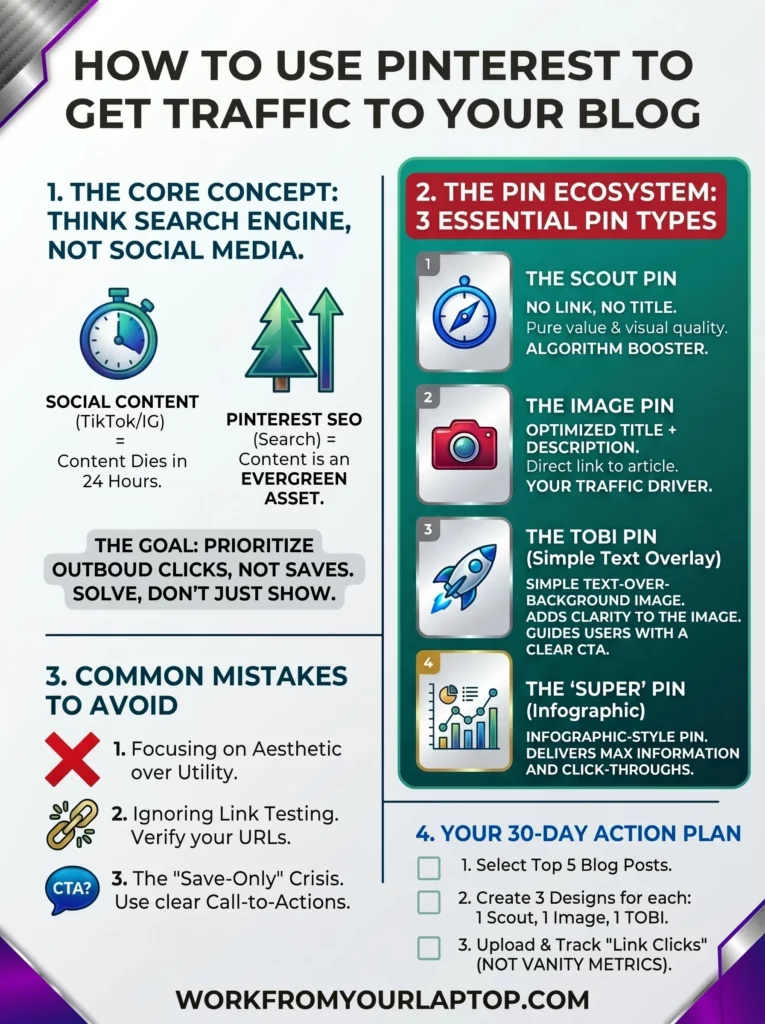
Pinterest SEO for Bloggers Infographic

Trying to make money online and still not seeing results? Create your FREE STARTER ACCOUNT with the same straightforward training I’ve used to create full time revenue online. No matter your experience, this step by step training delivers! Click here and get started NOW!


Frequently Asked Questions

Why are my pins getting saved but not clicked?
Your pin is likely providing too much information upfront. If the user feels they’ve already “gotten” the value from the image, they have no reason to click. Make your pin a “teaser” that requires a click to see the full solution.

Do I need a large following to get traffic?
No. Pinterest is a search engine. A brand-new account with zero followers can drive massive traffic if the pins are SEO-optimized for search terms that people are already actively typing into the platform.+1

What is the best type of pin for driving traffic?
The best pins are those that promise a specific result (like “5 ways to X” or “The guide to Y”). Listicles, “How-to” guides, and tutorials perform the best because they have a high-intent, problem-solving nature.


Want More Social Media Marketing Strategies?

Keep that momentum going! Check out my guides to explode your social media presence!
  • Pinterest SEO for Bloggers: Turning Pins into Website Traffic
    Pinterest SEO for Bloggers: Turning Pins into Website Traffic
  • Repurposing Your Blog Content Into Social Media Posts
    Repurpose Your Blog Content: A 3-Step Guide to Turning Articles into Social Posts
  • Threads vs X vs Bluesky Review
    Threads vs. BlueSky vs. X: Which Platform is Best for Affiliate Marketing?
  • Affiliate Marketing Strategies for Social Media
    Affiliate Marketing Strategies For Social Media in 2025

Written by Eric Cantu · Categorized: Social Media for Affiliates

Apr 14 2026

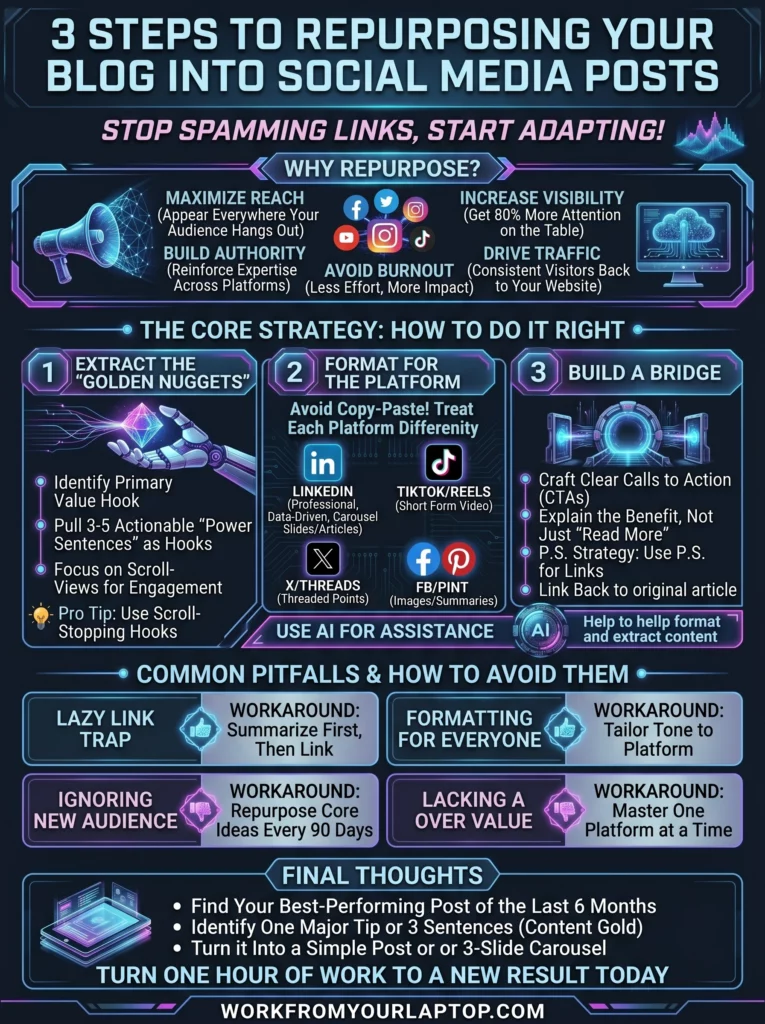
Repurpose Your Blog Content: A 3-Step Guide to Turning Articles into Social Posts

Repurposing Your Blog Content Into Social Media Posts

Your audience, no matter your niche, is on the socials. Instead of spamming the link to your latest article all over Facebook, Twitter, Instagram, LinkedIn, Pinterest, Threads, TikTok. (…jeez are there really this many?), how about repurposing that article into a perfectly fitting social media post? Let me show you how I do it.

TL;DR: How to repurpose blog content for social media?

Repurposing involves breaking your long-form blog post into platform-specific assets like short-form video scripts, carousel slides, and threaded tweets. By “atomizing” your core message, you increase reach, maximize content lifespan, and drive consistent traffic back to your primary website.

  • Audit: Identify your highest-performing, evergreen blog posts.
  • Atomize: Extract the core argument into 3-5 distinct sub-topics.
  • Adapt: Reformat those points for the native features of your chosen social platforms.
🔍 Have ChatGPT Summarize This Article

What’s In This Article? (Quick Jumps)

  • Why Repurposing Your Blog Content Matters
  • My Experience Turning Blog Posts Into Social Media Posts That Convert
  • Step by Step Breakdown: The Core Strategy
  • Common Pitfalls & What to Avoid
  • Your Next Step
  • Final Thoughts
  • Frequently Asked Questions

Why Repurposing Your Blog Content Matters

Content repurposing is the practice of systematically deconstructing long-form articles into micro-content for social distribution. This strategy maximizes audience reach, reinforces your authority across multiple channels, and solves the creator’s burnout problem by ensuring high-value information is seen by your target audience in their preferred format.

Trust me when I say that in the current era of blogging, the “post and pray” method is officially dead. Social media platforms massively prioritize high-engagement content over spammy link-dropping. Your link will not only get ignored but it’ll probably get you shadow banned.

If you ignore this opportunity, you’re leaving about 80% of your audience’s attention on the table. Never leave meat on the bone! Mastering social media marketing is all about owning your niche by appearing everywhere your audience already hangs out.

Do it right and it won’t take up all your time either.


My Experience Turning Blog Posts Into Social Media Posts That Convert

When I first started my online business, I thought that to grow, I’d have to come up with never ending brand new ideas. It was intimidating. I didn’t realize that the most successful people online aren’t the ones making the most content, it’s the ones who are best at reusing what they already have.

The “a-ha” moment for me happened when I looked back at an article I had written months before that was doing well. I realized that one long piece of writing actually had five or six smaller, ideas hidden inside it that were perfect nuggets I could use for social media.

This lightbulb moment really did take the pressure off. It made my work much easier and more organized. One article could provide content for a Facebook post, a post on Threads, an Instagram reel, and more. I had an actual plan.

In blogging, you don’t need to build a brand-new toy every time you want to play. Just take your existing bricks and rearrange them into something new. A great business gets more done without getting stressed out.

And that’s exactly what repurposing your blog posts can do for you and your business. Let me show you my method that’s worked for me.

Related article: Repurposing for Pinterest can be really fun! Check out my guide on how to turn your Pinterest traffic into traffic for your website!


Step-by-Step Breakdown: The Core Strategy

A successful repurposing workflow requires a structured transformation process: identifying the primary value hook, distilling the content into platform-specific modules, and scheduling the rollout. This approach ensures consistent messaging while catering to the unique consumption habits of users on various social media platforms.

1. Extract the “Golden Nuggets”

Don’t try to condense your whole article. There’s way too many pieces. Focus on the most actionable takeaway or the one point that goes against the grain. (Those are great for social media). Pull out 3-5 “power sentences” from your post. These are gonna be your hooks.

Pro Tip: If a sentence makes you pause while reading it, it’ll do the same for your reader. And when they pause they stop their scroll. Use these too hook them in.

2. Format for the Platform

Each social media platform has its vibe and its style. Don’t just copy and paste the same thing into all your platforms. Play to each platform’s wheelhouse; AI is great for this.

Pro Tip: Ask you AI tool of choice to transform a short blurb form your blog post into “a perfect video for TikTok”, or “a great reel for Instagram”, or “a tweet that will demand retweets” and watch it give you the perfect direction on how to do exactly that.

Related article: Not sure whether to post on X or Threads? Check out my comparison guide “Threads vs X vs Bluesky”.

3. Build a “Bridge”

Every piece of repurposed content needs a clear “Call to Action” that links back to the original blog post. Don’t just say “read more”; explain the benefit of clicking through.

Pro Tip: Use a “P.S.” at the bottom of your post to link to the article, rather than putting the link in the main body.


Common Pitfalls & What to Avoid

Common errors in content repurposing include direct link-spamming, failing to adjust tone for platform-specific audiences, and ignoring the visual requirements of social algorithms. Avoiding these pitfalls requires a mindset shift from “promoting a link” to “delivering value” through native social media formats.

  1. The “Lazy Link” Trap: Just posting a link to your blog is the fastest way to get shadow banned. Workaround: Summarize and give some context in the caption first, then link to the full read.
  2. Formatting for Everyone: LinkedIn isn’t TikTok. Workaround: Tailor your tone. Be professional and data-driven on LinkedIn; be personal and raw on short-form video.. Remember, AI is great at doing this for you.
  3. Ignoring the “New” Audience: Thinking that because you already posted it, everyone saw it. Workaround: You can actually repurpose the same core idea every 90 days. Your audience changes, and reminders help.
  4. Lacking a System: Waiting for inspiration. Workaround: Spend just one hour on Sunday “content mining” your existing blog posts for the week ahead. Just feed a post into your AI tool of choice and ask it to pull the best nuggets
  5. Focusing on Volume over Value: Trying to post everywhere at once. Workaround: Master one platform before moving to the next. I like to focus on two max. Don’t spread yourself so thin.
Work From Your Laptop YouTube Subscribe

Your Next Step

Your next move is to stop staring at that blank cursor and start looking backward. What do I mean? Go find your best-performing blog post from the last six months. Look for the one that got the most comments or shares. Pull out three key sentences or one major tip from that article. Remember, you can use AI for this. This is your “content gold” that you’re going to use for your social media posts

Now, take those three points and turn them into a simple, three-slide carousel for LinkedIn or a quick, punchy list for a social post. I know I sound like a broken record by now, but helloooooo, use AI for this! This process takes a high-value idea that you’ve already proven works and giving it a second life in front of a whole new group of people.

You’ll be surprised at how much easier it is to “create” when you’re just using AI to rearrange gems you’ve already polished.

Once you hit publish on that repurposed post, you’ll feel the same “a-ha” moment I did.. You just turned one hour of past work into a brand-new result today. This is how you win the long game without burning out.

Start small today, and watch how this simple habit turns your “old” writing into your most powerful new growth engine.


Final Thoughts

Content repurposing is about efficiency, not laziness. Take one “Golden Nugget” from a past article today and turn it into a short-form post. That’s your only goal for the next 24 hours.

What do you think? Don’t get shy on my now. I love hearing your perspective on things. Answer the two questions below in the comments section and be honest. This is going to help you improve your results.

  • Which of the platforms you use do you find the hardest to adapt your blog content for?
  • Do you prefer “summarizing” an article or “expanding” from one specific point for social media?
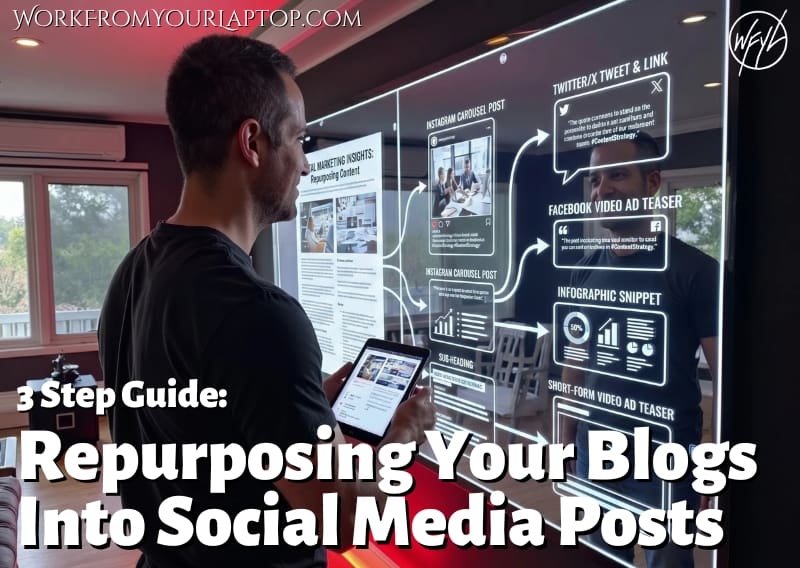
Repurposing Your Blog Content Into Social Media Posts infographic

Trying to make money online and still not seeing results? Create your FREE STARTER ACCOUNT with the same straightforward training I’ve used to create full time revenue online. No matter your experience, this step by step training delivers! Click here and get started NOW!


Frequently Asked Questions

Is it okay to post the exact same text across all social media platforms? No. Each platform has a different “language” and user intent. Adapt your tone and format to fit the native style of the platform (e.g., LinkedIn vs. X/Twitter) to ensure the algorithm favors your content.

How often should I repurpose old blog content? You should aim to refresh and repurpose evergreen content at least once every 3–6 months. This allows you to introduce the same high-value information to new followers who missed it the first time around.

Does repurposing content hurt my SEO? No. Distributing summaries of your content to social media helps drive traffic, which acts as a positive signal to search engines. Just ensure the social post links back to your original, canonical article on your own website.


Want More Social Media Strategies?

No matter your niche, your audience is hanging out on social media! Learn how to find and connect with them and get those conversions your content deserves!

  • Pinterest SEO for Bloggers: Turning Pins into Website Traffic
    Pinterest SEO for Bloggers: Turning Pins into Website Traffic
  • Repurposing Your Blog Content Into Social Media Posts
    Repurpose Your Blog Content: A 3-Step Guide to Turning Articles into Social Posts
  • Threads vs X vs Bluesky Review
    Threads vs. BlueSky vs. X: Which Platform is Best for Affiliate Marketing?
  • Affiliate Marketing Strategies for Social Media
    Affiliate Marketing Strategies For Social Media in 2025

Written by Eric Cantu · Categorized: Social Media for Affiliates

Sep 12 2025

Threads vs. BlueSky vs. X: Which Platform is Best for Affiliate Marketing?

Threads vs X vs Bluesky Review

Every year there seems to be a new big social app. Twitter once felt unbeatable, then Musk bought it and many left. That’s when Threads and BlueSky took off. So which one works best for affiliate marketing in 2025?


TL;DR: Which platform, Threads, X, or Bluesky, works best for affiliate marketing?

Threads is currently the hottest growth platform, BlueSky is ideal for niche and community building, and X (formerly Twitter) is regaining traction but remains competitive. The best choice depends on your niche and posting strategy.

  • Threads for growth: Explosive user adoption, great engagement for lifestyle niches like fashion and health.
  • BlueSky for niches: Decentralized, strong community culture, best for digital services and thoughtful content.
  • X for reach: Still the largest overall, good for fast-paced engagement and affiliate conversions.
  • Link strategies differ: Direct links work on all three, but link-in-bio tools like Linktree or solo.to are essential for multi-offer affiliates.
  • Posting tactics matter: Each platform has its own frequency, content type, and engagement sweet spot.
🔍 Have ChatGPT Summarize This Article

What’s In This Article? (Quick Jumps)

  • Threads for Affiliate Marketing
  • BlueSky for Affiliate Marketing
  • X for Affiliate Marketing
  • Posting Strategies: Platform Playbook
  • Final Thoughts
  • FAQs

Threads for Affiliate Marketing


Threads vs X vs Bluesky Review Threads logo

Website: threads.com

Meta’s Threads got really big really fast with 30 million people signing up in one day, and over 100 million in just a week. I remember being on instagram and suddenly this “Create Your Threads Account” prompt popped up. That first day was crazy, and it was actually fun talking with brand new people who would reply back without anything to sell you.

Then of course, the excitement reached a plateau and it dropped down to about 8 million daily users by the end of summer 2023. But the cool part is it bounced back.

By 2025, Threads has over 115 million daily users and is still growing. How did this happen? Meta pushed Threads hard through Instagram, added new features like trending topics and better search, and asked influencers to start posting early.

This mix made people give it another try. For marketers, it means a big, curious audience that is still figuring out how they like to use the app.

Affiliate Link Strategies on Threads

  • Direct Links: Threads lets you share clickable links, so you can drop affiliate links right into your posts. Since posts are short, keep your message simple and friendly.
  • Link in Bio: Many people use a link-in-bio page like Linktree or solo.to when they have more than one product to share. This way your posts stay clean but your followers can still find your offers.
  • Content-first approach: Threads works a lot like Instagram. Posts that teach, entertain, or tell stories usually do best. Give value first, then share your link.

Related post: Check out my full guide on driving traffic to your affiliate links! This is the lifeblood of your business, so get it right!

Niche Examples

  • Health: Share short wellness tips, easy habits, or bust a common myth, then link to supplements, workout gear, or apps.
  • Fashion: Post outfit ideas, style guides, or trend alerts, then share links to clothes or accessories.
  • Digital Services: Talk about why you use a tool, compare it to others, and then link to it with your affiliate tag.

Posting Tips for Threads

  • Frequency: Posting 2-3 times a day keeps you active. Some people mix one fun post, one tip, and one question to keep things fresh.
  • Best Content Types: Chatty posts, lifestyle photos, quick how-tos, or slides with useful info. Behind-the-scenes stuff also works because the app feels casual.
  • Hashtags & Engagement: Threads doesn’t really use hashtags yet, but comments and reposts matter a lot. Ask real questions, reply to comments, and encourage shares to get noticed.

BlueSky for Affiliate Marketing


Threads vs X vs Bluesky Review Bluesky logo

Website: bsky.app

BlueSky is smaller (about 38 million users), but it’s been growing super fast, up 370% in just one year. It’s built on something called a decentralized protocol, which basically means it’s run differently than big apps like Twitter.

BlueSky is something I hadn’t tried myself yet, but after researching I can see the appeal of it.

It honestly just feels calmer. Instead of people racing to post quick takes and fake AI inspirational thoughts, the community likes longer chats and actual conversations.

Many people joined because they were tired of all the noise, rants, and constant selling via bots on other apps. I totally get that. My X account feels like a massive echo chamber of nothing but people selling their latest course. So on Bluesky, the lack of all that makes it easier for your posts to stand out.

For affiliates, this is great because your posts don’t have to compete with endless bots or fake AI posts. Since BlueSky is still young, you can grow a name for yourself early on.

Affiliate Link Strategies on BlueSky

  • Direct Links: You can share links, but users like it better when you explain why you recommend something instead of just dropping the link with no context.
  • Link in Bio: Works really well on BlueSky since most posts are more like chats. People often click on bios to learn more. You can use tools like Linktree or solo.to to keep all your offers in one spot.
  • Community over clicks: People here like honesty. If you push products too hard, it can turn them off. A better way is to share your story and then connect it to the product naturally.

Niche Examples

  • Health: Write longer posts about your daily routines or healthy habits, then link to an app or product you really use. For example, a post about your morning routine with a meditation app link fits well.
  • Fashion: Talk about brands you care about, especially sustainable or eco-friendly ones. Then share your affiliate link to their products. Explaining why you like the brand works better than a quick ad.
  • Digital Services: BlueSky’s audience likes tech, so reviews or tutorials on digital tools do great. Show how you use the tool step by step, then share your link.

Posting Tips for BlueSky

  • Frequency: Post 1–2 times per day, but make your posts thoughtful. Quality beats quantity here.
  • Best Content Types: Longer text posts, community chats, real recommendations, and how-to guides. Funny memes don’t do as well as honest stories.
  • Hashtags & Engagement: BlueSky doesn’t really use hashtags much. Instead, focus on starting conversations and replying to others. Ask questions, join chats, and build back-and-forth instead of chasing viral hits.

X for Affiliate Marketing


Threads vs X vs Bluesky Review X logo

Website: x.com

Let’s talk about the big one in the room. X has gone through a lot of ups and downs. After Elon Musk took over, many people stopped using it. The app lost about 75 million users when Linda Yaccarino was in charge, then daily activity dropped by 10% in 2025, and Europe lost another 10 million users.

For me, like I mentioned at the top, it all started feeling like a massive echo chamber of fake tweets being engaged with by people looking to sell their latest course. Nothing but AI created motivational quotes for businesses being liked by other creators doing the exact same thing and it just all feels, well, fake.

Changes in rules, new features that didn’t stick, and ad problems all made people leave. But it’s still massive, with over 600 million users each month. With many users coming back, X is still where breaking news and trending topics often show up first.

For affiliate marketers, this means you can still get lots of eyes on your posts if you know how to play it smart.

Looking for some automation on X? Check out my review of Postwise and start scheduling your content easily!

Affiliate Link Strategies on X

  • Direct Links: Still useful, especially in fast-moving areas like fashion and digital products. Short links with clear action words work best.
  • Link in Bio: Super helpful if you promote more than one thing. It looks clean in the quick X feed. Tools like Linktree or solo.to make it easy to share many links.
  • Thread Marketing: Many people write longer “value threads” that end with a soft push to check their bio or link (see my Postwise review here [placeholder]). Threads with stories do better than plain ads.

Niche Examples

  • Health: Quick health tips, simple myth-busting, or short threads about routines. You can link to wellness products. Adding a picture or small chart makes it stronger.
  • Fashion: Posts about new trends, style comparisons, or photo sets with links to buy the look. Limited-time offers or discounts work great here.
  • Digital Services: How-to threads about software tools with a clear call to action link. Step-by-step guides with images or GIFs help people pay attention.

Posting Tips for X

  • Frequency: Aim for 3–5 short posts a day or 1–2 longer threads each week. Being steady is more important than posting too much.
  • Best Content Types: Quick posts, threads, memes, polls, and quote-posts with your thoughts. Mixing things up makes your feed fun to follow.
  • Hashtags & Engagement: Hashtags still help—use 1–2 per post. To get more reach, reply to others, ask questions, tag creators, and join trending chats.

Posting Strategies: Platform Playbook

Here’s a quick way to think about posting strategies: every platform has its own personality, and each one likes a different style of content. If you match what you post to that style, you’ll do better.

  • Threads: Threads feels casual and easygoing. Post 2–3 times a day. Mix things up with a fun or personal update, a helpful tip, and maybe a light call-to-action. Posts that feel like real thoughts or stories do better than ones that look like plain ads.
  • BlueSky: On BlueSky, it’s not about posting a lot, but posting something meaningful. Aim for 1–2 solid posts each day. Spend time writing longer posts, joining group chats, or sharing honest stories. People like helpful guides and answers to questions. That’s how you stand out in a smaller, more niche space.
  • X: X moves fast and likes a mix of styles. Posting 3-5 times a day works well, and adding 1-2 longer threads each week helps too. Memes, polls, quick takes, and storytelling threads all work. Changing up your content keeps people interested.

If spending time on your socials starts to feel overwhelming, you can always use a content scheduler.

For affiliate marketers, the trick is to put the right kind of content on the right app. Fashion and lifestyle posts do best on Threads, where photos and casual updates feel normal. Tech reviews and software guides fit better on BlueSky, because people there want deeper chats and explanations. Fast-moving deals, discounts, and viral trends rule on X.

Related article: Check out my full guide on Affiliate Marketing Strategies for Social Media! Up your social media game and watch your traffic and conversions explode!

The more you match your posts to the culture of each app, the easier it is to grow your audience and make sales without feeling worn out. And don’t forget that the easiest way to find social media content ideas is to repurpose your high-performing blog posts!


Final Thoughts

Threads is best for lifestyle niches, BlueSky for thoughtful audiences, and X for mass reach. All three have unique affiliate link strategies and posting rhythms.

What do you think? Have you tried promoting affiliate offers on Threads, BlueSky, or X? Which one is giving you the best results right now? Drop your experience in the comments! I’d love to hear what’s working (or not working) for you.

Trying to make money online and still not seeing results? Create your FREE STARTER ACCOUNT with the same straightforward training I’ve used to create full time revenue online. No matter your experience, this step by step training delivers! Click here and get started NOW!


Frequently Asked Questions

Is Threads good for affiliate marketing in 2025?
Yes. With over 115 million daily users and a growing focus on lifestyle content, Threads is great for health, fashion, and digital niches. Direct links and link-in-bio both perform well.

Is BlueSky worth using for affiliate links?
Absolutely. BlueSky is smaller, but its niche-friendly, decentralized structure makes it perfect for building trust. Affiliates who focus on authentic recommendations do well here.

How effective is X for affiliate marketing today?
Despite losing millions of users, X is still the biggest platform by reach. Affiliate marketers thrive by combining direct links, threads, and link-in-bio strategies.


Want More Social Media Marketing Tips?

  • Pinterest SEO for Bloggers: Turning Pins into Website Traffic
    Pinterest SEO for Bloggers: Turning Pins into Website Traffic
  • Repurposing Your Blog Content Into Social Media Posts
    Repurpose Your Blog Content: A 3-Step Guide to Turning Articles into Social Posts
  • Threads vs X vs Bluesky Review
    Threads vs. BlueSky vs. X: Which Platform is Best for Affiliate Marketing?
  • Affiliate Marketing Strategies for Social Media
    Affiliate Marketing Strategies For Social Media in 2025

Written by Eric Cantu · Categorized: Social Media for Affiliates

Apr 25 2025

Affiliate Marketing Strategies For Social Media in 2025

Affiliate Marketing Strategies for Social Media

With the rise of social media, affiliate marketing becomes an even more profitable opportunity to make money online. In this blog post, let’s talk about effective strategies for social media that can boost your affiliate marketing efforts.

TL;DR: How Can I Use Social Media for Affiliate Marketing?

Affiliate marketing success on social media comes from connecting with your audience, creating authentic content that delivers value to them, then tracking your performance and turning engagement into consistent conversions.

  • Choose social platforms where your target audience already spends time (Instagram, TikTok, LinkedIn, etc.).
  • Focus on building trust through genuine engagement and meaningful relationships.
  • Create high-quality, platform-fit content (videos, carousels, stories) and experiment with new features.
  • Stay updated on platform trends. See what’s working with other creators in your niche.
  • Track metrics (clicks, conversions, revenue) and optimize based on what’s working. Also consider influencer partnerships and exclusive offers.
🔍 Have ChatGPT Summarize This Article

What’s In This Article? (Quick Jumps)

  • Choose the Right Platform
  • Build a Strong Relationship with Your Audience
  • Create High Quality Content
  • Engage With Your Audience
  • Leverage Influencer Partnerships
  • Offer Exclusive Discounts and Deals
  • Stay Updated on Industry Trends
  • Disclose Your Affiliate Relationships
  • Track Your Performance
  • Final Thoughts
  • FAQs

Choose the Right Platform

When it comes to affiliate marketing on social media, each platform has its own unique audience and its own unique personality. You can’t take a post and place it on both TikTok and LinkedIn and expect them both to work the same way.

Consider the demographics of each platform and tailor your content accordingly. For example, if you’re targeting a younger demographic, platforms like Instagram and TikTok might be more effective. On the other hand, if you’re targeting professionals, LinkedIn could be the way to go.

Then there’s the similar platforms like X, Threads, and Bluesky. Which one is best for you? When I got my start, I went heavy on using my instagram for social media marketing. Understanding your audience is key to selecting the right platform for your affiliate marketing campaigns.

I’m also a firm believer that you can’t be everything to everyone. Instead of trying to have a presence on ALL social media platforms, I’d pick one or two you’re familiar and comfortable with and start with those.

Related article: Looking for a tool that uses AI to automate and schedule all your social media posts? Check out my full review of Content360! How about a tool to automate actions like commenting, liking, following, etc. Check out my full review of PhantomBuster!


Build a Strong Relationship with Your Audience

One of the most crucial aspects of successful affiliate marketing on social media is building a strong relationship with your audience. People are more likely to trust recommendations from someone they know and like.

This means putting a real focus on engaging with your followers, creating valuable content, and being authentic in your promotions while delivering the most value possible. This will make your audience much more receptive to your affiliate recommendations.

This also means making sure to never promote products or services that you yourself wouldn’t use. The last thing you want to do after all the work of finding your audience is to sell them out with products that don’t deliver.

Related article: Have you seen platforms that promise YouTube and Instagram growth and guarantee followers? Buyer beware! Check out my UpGrow App review, Social Growth Engine review, and YouBoost review and see just how similar they all are. Stay away!


Create High-Quality Content

Obviously, if you’re looking to build a social media following and turn that following into conversions and revenue for your affiliate marketing business, the actual content you create has to deliver value. You have to find a way to stand out and attract your audience’s attention while actually having some substance. behind what you’re creating.

Experiment with different formats such as videos, images, stories, and carousel posts to see what your audience seems to connect with the best. Tailor your content to fit the platform you’re using and make sure it provides value to your followers.

On instagram I’ve found that short reels (7-11 seconds) with text overlay get a ton of views and watch time. See what’s working for other creators in your niche and follow suit.

Also, don’t be afraid to experiment when a new feature gets rolled out. Social media platforms tend to elevate posts that use their new features to the top of the algorithm in an effort to get more users to try it out. Go all in and have fun!

Pro Tip: Don’t forget that the easiest way to create content is to repurpose your high performing blog content! A single blog post can be used for 5+ social media posts across multiple platforms!


Engage with Your Audience

Engagement is everything when it comes to successful affiliate marketing on social media. Engagement is one of the first true signs that you’re actually reaching your target audience. They’re finding your content and acting on it. This is a HUGE step and you want to do everything you can to encourage it.

This means ALWAYS responding to comments, messages, and questions from your followers to build a sense of community and trust.

Always encourage discussions around your affiliate products and provide valuable information to address any concerns or doubts. Active engagement with your audience shows your credibility and authenticity.

And when your audience is engaged and commenting on your content, you’ll notice your rise in the algorithm. Social media platforms are meant for engagement! The platform will reward you when you get people liking and commenting!


Leverage Influencer Partnerships

Collaborating with influencers in your niche can significantly boost your affiliate marketing efforts. Influencers already have a loyal following that trusts their recommendations, making them valuable partners for promoting affiliate products.

Reach out to influencers whose values align with yours and explore partnership opportunities to expand your reach and increase conversions. Remember, this has to be a win/win for both sides.

It wouldn’t make sense for a creator with a massive following to collaborate with you when you only have a handful of followers. Reach out to those in a similar niche with a similar following. This creates an even collaboration where both parties can benefit

Related article: Check out my full guide on how to win as a micro influencer and why this can explode your online business!

Work From Your Laptop YouTube Subscribe

Offer Exclusive Discounts and Deals

Everyone loves a good deal, so offering exclusive discounts and deals to your audience can incentivize them to make a purchase through your affiliate links.

In the past, I’ve negotiated with brands for this exact reason so they could give me special discounts or promotions that I could pass on to my followers. As an example, even a small 10% discount can be all it takes for your audience to click on your affiliate link and see it as more appealing. Limited-time offers and promo codes can create a sense of urgency and drive conversions.

Never be afraid to ask your affiliate program if they could offer you a special discount code you can pass on to your followers!


Stay Updated on Industry Trends

Anyone who’s on social media consistently can see it’s constantly evolving. You have to make it your focus to keep up with all the changing trends, new features, algorithm updates, etc., and stay ahead of the curve.

Don’t make this a chore, have fun with it! See what’s working for others and adapt a version of it for yourself. This will help you optimize your affiliate marketing strategy and stay relevant to your audience. Trust me when I say this will translate to likes, follows, comments, and most importantly REVENUE!.

Check out how brands use influencer marketing successfully on Social Media Today.


Disclose Your Affiliate Relationships

Transparency is key in affiliate marketing. Even though your audience is probably aware of how affiliate links work and understands that these links may trigger commissions your way, it’s still very important to have your disclosures in place where your audience can easily find them.

When posting on social media, clearly label your affiliate posts with #ad or #affiliate to ensure transparency. Honesty is always the best policy, and your audience will appreciate seeing your transparency.


Track Your Performance

So how will you know when your efforts are paying off? Analytics! I’m not an analytics guy myself, but I’ve found that social media analytics are really good at giving you the metrics you need to pay attention to.. Most social media platforms offer insights and analytics tools free of charge that allow you to track the performance of your posts.

Important metrics to pay attention to are click-through rates, conversion rates, revenue generated, and new follows. These metrics help you to understand what’s working and what’s not. Double down on what works and eliminate what doesn’t. Don’t be stubborn! The numbers don’t lie!


Final Thoughts

Affiliate marketing on social media can be a direct path to finding your target audience. Deliver value, build relationships with your audience, and create high-quality content to turn followers into consistent revenue.

Remember to be transparent about your affiliate relationships, collaborate with influencers, offer exclusive deals, and stay engaged with your audience to enhance your affiliate marketing efforts. Stay informed about industry trends and continuously optimize your strategy to achieve long-term success in affiliate marketing on social media.

What do you think? What kinds of hurdles have you encountered in your social media marketing journey? Is there anything in particular you’re having trouble achieving? Let me know your experience in the comments section below! I’m always eager to hear your feedback and I always respond!

Trying to make money online and still not seeing results? Create your FREE STARTER ACCOUNT with the same straightforward training I’ve used to create full time revenue online. No matter your experience, this step by step training delivers! Click here and get started NOW!


Frequently Asked Questions

What is the best social media platform for affiliate marketing in 2025?
The best platform depends on your target audience. Instagram, TikTok, and YouTube dominate for younger audiences, while LinkedIn works well for professional and B2B affiliate marketing.

How do you disclose affiliate links on social media?
Always clearly label affiliate posts with terms like #ad, #affiliate, or “sponsored” to maintain transparency and comply with FTC guidelines. Honest disclosures build trust with your followers.

What type of content works best for affiliate marketing on social media?
High-quality, value-driven content such as product reviews, tutorials, exclusive discount announcements, and behind-the-scenes stories tend to drive the most engagement and affiliate link clicks.


Still Hungry for Growth?
Dive Into These Handpicked Articles! ⬇️

  • How to Drive Traffic to Your Affiliate LInks
    5 Smart Ways to Drive Traffic to Your Affiliate Links in 2026
  • Why Affiliate Marketing Isn't a Pyramid Scheme
    4 Reasons Why Affiliate Marketing Isn’t a Pyramid Scheme
  • Done For You Businesses Scam Legit
    Are Done For You Online Business Opportunities Legit? (2026 Update)
  • Online Coaching Business Scams Exposed
    11 Online Business Coaching Scams Exposed & How to Avoid Them (2026 Update)
  • Is Affiliate Marketing Still Worth It in 2026?
    Is Affiliate Marketing Still Worth It in 2026?
  • Why You Need to Stop Obsessing Over Analytics
    Why You Need to Stop Obsessing Over Analytics!

Written by Eric Cantu · Categorized: Essential Reads, Social Media for Affiliates

  • Home
  • Sign Up
  • Blog & Search
  • Privacy Policy
  • Affiliate Disclosure

Copyright © 2026 · Work From Your Laptop · Eric J. Cantu · All Rights Reserved