Last updated on June 25, 2026 · Comprehensive breakdown, <10 min read

Someone from Wordform AI emailed me today wanting me to add their tool to my “Top AI Tools for Content Creation” list. In return, they’d give me a backlink. But before I put my name on anything, I have to check it out first. And what I found out about how they sell this thing tells you more than any feature list ever could.
Here’s the honest breakdown if you’re also doing your due diligence for this product.
Is Wordform AI a Scam? 7 Things You Need to Know Before You Buy
- It’s a real, working tool, not a scam. But it’s sold the pushy “make money online” way by marketer Brandon Hays.
- $67 is just the front door. The webinar pushes pricey upsells once you’re in.
- Affiliates are banned from criticizing it. They can’t use the word “scam.” That’s why every review is glowing.
- No honest reviews exist. There’s nothing real on Trustpilot, G2, Capterra, or Reddit.
- The marketing is pure hype: “479 words per minute,” “$100M+ campaigns,” “AI research pigs.”
- The refund isn’t as easy as it sounds. The homepage promises “no questions, same day,” but the actual rules are much stricter.
- It’s risky for Google. Pumping out mass AI posts is exactly what Google penalizes. Google policy on scaled content
What’s In This Article (Quick Jumps)
- What Is Wordform AI?
- How Much Does Wordform AI Cost?
- Wordform AI Features and Functionality
- My Experience Researching Wordform AI
- Wordform AI Testimonials, Pros & Cons
- Final Thoughts
- Frequently Asked Questions
What Is Wordform AI?
Official website: https://wordform.ai
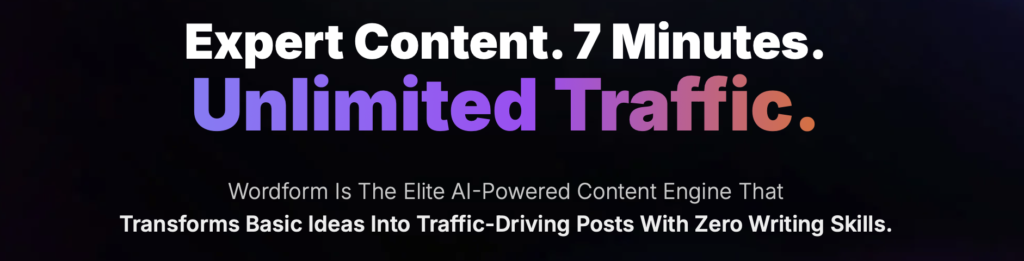
Wordform AI is a tool that promises to write blog posts for you with AI. You give it a keyword or a title. Then its bot, named “George Allwell,” does the research, builds an outline, and writes a full post with images.
It says it does all this in about 7 minutes. It also offers one-click posting to WordPress, 35+ built-in call-to-action buttons, and a claim that its writing can pass AI detectors.
Never paste unaltered AI content directly to your blog. Huge no-no. You’ll lose your audience, Google doesn’t like it, and you’ll lose all your authority and traffic. This opens the whole AI vs human writing debate, and it’s exactly why the human touch still wins. Here’s my full breakdown: AI vs Human Writers: Who Writes Better Content?
So who’s behind Wordform AI? The company is SCPS Technologies LLC. You’ll find that name in their Terms of Service, with a copyright that runs 2023-2026. The founder is Brandon Hays, who calls himself a “Traffic & AI Expert.”
Hays has done this before. He launched a niche-research tool called Niche Pig Pro back in April 2024. He sold it through MunchEye, a site where “make money online” products get launched with affiliate webinars. Wordform AI launched the same way in October 2024, with a 10-day push and a bunch of live webinars.
Why does this matter? Because it tells you what kind of product this is and how they market it. This isn’t a big company with a public team and a support office. It’s a product sold mostly through webinars to the “make money online” crowd (lots of hype, unrealistic promises of revenue, etc.)
The affiliate page lists the target buyers as internet marketers, make-money-online folks, newbies, “bizopp” seekers, and small business owners.
Who it’s for: beginners and affiliate marketers who want lots of content fast and don’t want to write it. Who it’s not for: anyone building a real brand that needs to last through Google updates, anyone who wants a clear team and a real support history, or anyone who hates webinar-style selling.
How Wordform AI Compares to Competitors
Here’s how Wordform stacks up against three better-known AI blog writers. I pulled these prices straight from their own pricing pages:
- Koala Writer: The best-known “AI articles that rank” tool. It starts at $9/month (15,000 words) and goes up. The popular plan is $49/month. It checks the live Google results as it writes, posts to WordPress, Shopify, and more, and adds internal links for you. Best part: it has 19,000+ paying users and real reviews on Trustpilot, Capterra, and Product Hunt. One honest catch: the word counts are based on the cheapest AI model, so picking a better model uses up your words about twice as fast. I used to use this one myself. Check out my Koala Writer review here.
- Cuppa: Has the nicest editor of the group, about $38/month to start. You bring your own OpenAI key, which keeps the cost per article low.
- Byword: Built for bulk. About $5 per article, or bigger packages. Good for volume, but the quality can be hit or miss.
The HUGE difference between these 3 and Wordform AI: Wordform AI doesn’t have any actual, real reviews from real public users. MASSIVE red flag. (More on this further below).
How Much Does Wordform AI Cost?
Right now the public price is a one-time payment, not a monthly plan:
- $67 one time for 30 article credits. They call it the “30 Kick-Off Special.” No monthly fee. You use the credits whenever you want. That works out to about $2.23 per article for the first 30.
- “$1 per extra article” after that, but read the fine print. The site says you can “optionally purchase additional articles at $1 per article if you run out.” But it doesn’t say how. I seriously doubt you can just pay $5 and get 5 articles, surely there’s a minimum. The “$1” comes from their marketing line “$150 articles for $1 each”.
- You also get the content editor, training, and email/chat support.
Some older review sites (Tekpon, SoftwareWorld) still show monthly plans of $49, $99, and $199. Those don’t match what the site sells now.
Wordform’s own Terms do mention monthly billing, so those plans might exist behind the login or might be coming. But the price you see in public today is the $67 pack.
There’s also a usage cap in the Terms: up to 300 sources scraped per month and 150 images per month (1,000 total). Most people won’t hit it, but heavy users will.
Upsells (This Is the Important Part)
Here’s something many reviews I saw missed. Wordform’s real sales engine is a webinar. The company calls it a “high-ticket front-end with recurring back-end offers.” This means they get you in cheap, then sell you more expensive modules and tools. The affiliate funnel shows a front-end plus three upsells (they call them OTO1a, OTO1b, and OTO2).
This means their sales plan is to hit the end user with more than one upsell.
Now here’s the part that confused me at first, and it might confuse you too. Wordform’s own affiliate page says promoters earn up to $647 for each customer. But $647 to an affiliate means a very expensive purchase needs to be made, upwards of $1000.
This proves that the $67 entry is just the very first step. After that, the buyer gets walked through much pricier add-ons like coaching or “done-for-you” packages that can run hundreds or even thousands of dollars.
I couldn’t find the exact upsell prices, because that doc needs a login. So I’ll be honest and call that part unclear, so check what they actually offer you at the webinar. Just don’t treat $67 as the full cost. It’s the floor, not the ceiling.
Wordform AI Features and Functionality
Here’s what the tool says it does, pulled from its own site:
- One-click article writing: Type a topic, get a full post (intro, body, ending) with images in about 7 minutes.
- “Deep-web” research and citations: It says it scans the web for stats, studies, and quotes, and can add citations. (Check these yourself. AI tools often make up sources that don’t exist.)
- The George Allwell bot: Their AI writer. They say it writes at “479 words per minute” using “$100M+ frameworks.”
- Content scaling: Turn one topic into “100 unique articles.”
- Free niche, keyword, and headline tools: On the site, these feed the writer.
- 35+ built-in CTAs: Add a call-to-action for any offer at the end of a post in one click.
- Automatic AI images: It makes images to match each section. No design tools needed.
- WordPress posting: Download, copy, send to Google Docs, or post right to WordPress.
- Beats AI detectors: It says it swaps out overused words so the writing slips past AI checkers.
“100 articles from one topic” plus “beat the detector” is exactly the kind of thing Google has been cracking down on. So it could help you in the short run and hurt you later.
If you actually want your content to rank (and even get pulled into AI search results), that’s what GEO is about. Here’s my full guide to Generative Engine Optimization.
My Experience Researching Wordform AI
So this is what I found while researching it, not a full test drive. If I ever do a hands-on test, that’ll be its own post. But what I found is enough to raise an eyebrow.
The first thing I noticed was a wall of reviews that all sounded the same. Every “review” I opened (SoftwareWorld, openPR, a dozen blogs) used almost the same words. And they all ended with affiliate links or a webinar signup.
One “review” wasn’t even about the writing. It bragged about a “$260 commission” the person earned for promoting the tool. That’s not a review. That’s a sales pitch dressed up like one.
Then I found Wordform AI’s affiliate rules and why all the reviews sound the same: Affiliates can’t use bad language about the product, including the word “scam,” in anything they post. They also can’t do any “negative” promotion. Wordform AI affiliate documentation
So all those glowing reviews aren’t proof people love it. It’s that the people promoting it aren’t allowed to say anything bad. Once I saw that, that pretty much ended my interest.
There’s also a tight refund window. The homepage promises an easy “30-day, no-questions, same-day refund.” But the real Terms are stricter. You can get a refund on your first charge within 30 days, or on your last monthly rebill within 7 days (Again, another mention of monthly pricing even though the sales page says it’s a one time purchase).
And some users felt refunds are only given if the company feels like it. That’s not a scam, since lots of software works this way, but it’s important to be aware of that.
To be fair, (and I always try to find some positives unless I’m reviewing a total scam) here’s the good side: A few of the less salesy write-ups did say the writing reads okay and needs less cleanup than plain ChatGPT. For a beginner, that first post probably feels like magic.

Wordform AI Testimonials, Pros & Cons
Don’t take my word for it. Here are positive and negative reviews I was able to gather from online forums such as Reddit, Trustpilot, and others.
One important note first: unlike most tools I review, I could not find real, honest reviews from regular users. Trustpilot, G2, Capterra, and Reddit had nothing real. Every “review” came from affiliates or from Wordform’s own blog.
And remember, affiliates aren’t allowed to say anything bad. So read the “good” list below with a big grain of salt. That missing honest feedback is the biggest finding in this whole review.
✅ Wordform AI Positive Mentions
- The 7-minute, one-click writing is the most-praised feature (affiliate reviews).
- The long-form writing reads better than plain ChatGPT (AI Content Review).
- One-click WordPress posting saves real time (affiliate write-ups).
- The auto images for each section save you a step (Wordform site).
- The 35+ CTAs are handy for affiliate posts (moralreview).
- The free headline, keyword, and niche tools are actually useful (wordform.ai).
- One user said traffic grew within a month of posting (Tekpon listing).
- The editor is a lot like the WordPress one (moralreview).
- Beginners say it’s easy with no writing skills (SoftwareWorld).
- The “humanize” button is said to lower AI-detector scores (moralreview).
❌ Wordform AI Complaints & Concerns
- Affiliates aren’t allowed to criticize it, not even to use the word “scam.” That ruins the whole review pool (Wordform affiliate rules).
- No real, honest reviews exist on Trustpilot, G2, Capterra, or Reddit (my own research).
- The real sales funnel is a webinar with pricey upsells ($647 per sale to affiliates), way past the $67 entry price (Wordform affiliate page).
- The refund promise sounds easier than the real rules (first charge within 30 days, rebill within 7, some only at their say-so).
- The marketing is full of hype red flags: “479 words per minute,” “$100M+ campaigns,” “AI research pigs” (Wordform site).
- The writing can feel cookie-cutter and needs edits to add personality (AI Content Review).
- The “100 articles from one topic” and “beat the detector” approach can get you punished by Google (industry view).
- It’s sold to the “make money online” crowd through the MunchEye launch scene, which has a lot of here-today-gone-tomorrow products (Wordform affiliate page).
- Older review sites show out-of-date prices, so it’s hard to know what you’ll really pay (Tekpon, SoftwareWorld).
Final Thoughts
Wordform AI is a real, working tool. But the webinar selling, the pricey upsells, the total lack of honest reviews, and rules that stop affiliates from criticizing it mean I can’t call it safe enough to recommend.
What do you think? Have you actually paid for and used Wordform AI, not promoted it as an affiliate, but really used it on your own site? I’d love to hear from a real customer, because honest voices are so hard to find for this one.
What did the webinar try to sell you after the $67 entry? Did the refund work out fairly? And is your AI content still ranking six months later, or did a Google update bury it? Drop a comment below. One real story beats a hundred inflated affiliate “reviews.”
Trying to make money online and still not seeing results? Create your FREE STARTER ACCOUNT with the same straightforward training I’ve used to create full time revenue online. No matter your experience, this step by step training delivers! Click here and get started NOW!
Frequently Asked Questions
Is Wordform AI a scam or is it legit?
Wordform AI isn’t a scam in the real sense. It’s a working AI writing tool from a real company (SCPS Technologies LLC, founded by Brandon Hays), and it makes articles for a $67 one-time pack. But “legit” and “trustworthy” aren’t the same thing. The missing honest reviews, the pricey webinar upsells hidden behind a cheap front price, and the affiliate rule that bans any criticism all mean you should be more careful than with a normal AI writing tool. Test it with money you can afford to lose, and read the real Terms of Service before you pay.
Does Wordform AI content actually rank on Google?
It depends on how you use it. Cranking out lots of barely-edited AI posts (the “100 posts from one topic” idea Wordform sells) is exactly what Google has been cracking down on since 2024. AI content can rank when it’s helpful, fact-checked, and adds real first-hand experience. But pumping out posts just for volume is a known way to get buried or removed from Google. No tool changes that, Wordform included. And “passes AI detectors” does not mean “safe from Google.” Those are two different things.
What are the best Wordform AI alternatives?
If you want an AI blog writer with a real track record, look at Koala ($9 to $49/month, checks live Google results, one-click WordPress posting, 19,000+ paying users with public reviews), Cuppa (about $38/month, great editor, bring your own AI key for cheap articles), or Byword (about $5 per article, built for bulk SEO posts). All three show their prices up front and have active user communities, the kind of trust Wordform doesn’t have yet.
This is a personal-finance and online-business topic, and your situation is unique. I’m a content creator who reviews these platforms, not a financial advisor. Always do your own due diligence and check the official site for the latest details before spending any money.
Want More Honest Reviews?
Check out these reviews and learn how to spot the schemes and scams from the tools that can actually help you!
- Wordform AI Review: What They Don’t Tell You About the $67 Price
- 7 Red Flags That Prove Cash Tracking System Is a Scam

- Keala Kanae’s Power Code Masterclass Review: The Free Bait Before the $29K Hook

- 7 Reasons Why Keala Kanae’s Genesis by Inspirean Is a Bad Idea – Honest Review

- 7 Figure Accelerator Review

- Mastermind.com Review: Scam or the Ultimate Knowledge Business Tool?


Ai is a great tool when used properly. It sounds like word form is being promoted to replace actual work by using a system to build your site for you. In theory this sounds wonderful but as you stated Google is not too fond of this approach and can have some repercussions. It’s important that people new to the arena know this and it’s wonderful that you are pointing this out. Do you see this lasting long or will it soon phase out when people learn how to properly use AI?
I’m glad you enjoyed this. We have to understand that there are many tools out there promising the world but the fact of the matter is, many don’t deliver. Thanks for the comment!