Last updated on June 17, 2026 · Comprehensive breakdown, <10 min read
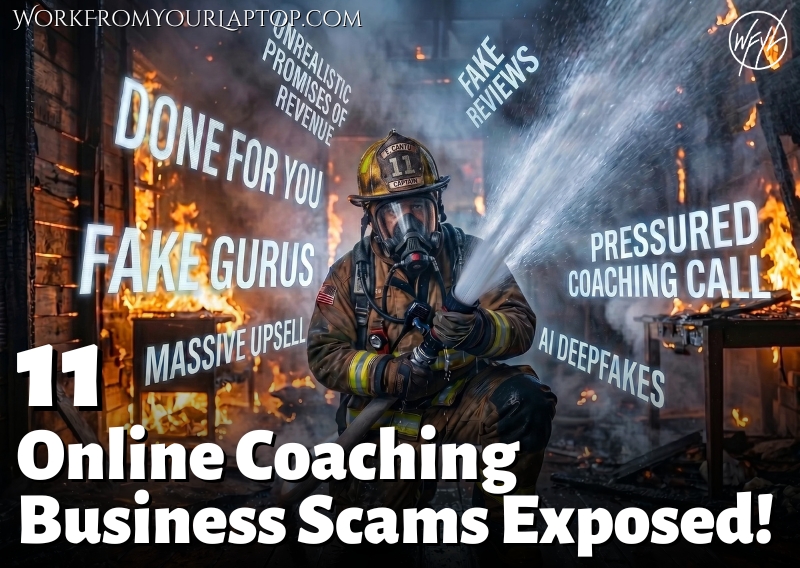
Maybe you’ve already been burned by a slick online “guru” who was more interested in slowly taking your money than actually teaching you anything. Or maybe you’re right on the edge, wallet in hand, wondering if the training course in front of you is a scam or legit.
I’ve been in this space long enough to spot the tricks a mile away, and today I’m handing you that same radar.
How Do I Avoid Online Business Coaching Scams?
To avoid online business coaching scams, watch for inflated “value stacks,” done-for-you promises, fake AI income claims, deepfake testimonials, and high-pressure sales calls. Real businesses take real work. If it guarantees fast money for little effort, walk away.
- If it promises fast money for little work, it’s a scam. Real online business is a slow build, not a lottery ticket.
- No system is truly “done for you.” Anything claiming 90% automation is bait for endless upsells.
- AI made fakery cheap. Income screenshots, testimonials, and even “guru” videos can now be 100% fabricated.
- A low buy-in is the hook, not the deal. That $7 or $99 intro almost always leads to a $5K–$30K pitch.
- Trust your gut and read the fine print. If you feel pressured or confused, that’s by design. Slow down.
What’s In This Article (Quick Jumps)
- Why Spotting Online Business Coaching Scams Matters Right Now
- My Experience With Online Business Coaching Scams
- 11 Online Business Marketing Tactics to Watch Out For in 2026
- Your Next Steps
- Final Thoughts
- Frequently Asked Questions
Why Spotting Online Business Coaching Scam Tactics Matters Right Now
Online fraud has become a global crisis, with financial fraud losses hitting an estimated $442 billion in 2025. INTERPOL warns that AI-enhanced fraud is now 4.5 times more profitable than traditional methods, fueling a new wave of polished coaching scams built on deepfake testimonials and fabricated income proof that are far harder to spot. INTERPOL Global Financial Fraud Threat Assessment
When I got my start in online business back in 2017, I was looking for a way to supplement my firefighting income. Back then, online scams were easier to spot. Now in 2026, with so much AI out there, the game for spotting online business scams has changed.
Today’s scammers use AI to fake everything. Fake student testimonials. Fake income dashboards. Even fake “guru” videos where the person talking might not be real at all. It’s becoming almost impossible to tell what’s real and what’s not.
That’s why I decided to update this article for 2026. The cost of getting this wrong is higher than ever. We’re not talking about losing $50 on a bad ebook. People are losing their savings, going into credit card debt, and worse, they walk away thinking online business itself is a lie.
In my experience I’ve seen so many people do this exact same thing and throw the baby out with the bathwater.
But here’s the silver lining. Once you learn how to read these red flags, it’s like a superpower. You stop wasting money on junk, your ears perk up when you see the slightest red flag signals, and you start focusing on real tools that actually help you to build a real business.
Understand that marketing tactics aren’t “scams” all by themselves. But when you’re familiar with the strategies used online to get to your wallet, you’re that much more prepared.
My Experience With Online Business Coaching Scams
When I got started with online business, specifically affiliate marketing, I was looking to find a way to create another stream of revenue so I could travel more. I saw so many people all over instagram sharing their travel photos, and I thought there had to be a way I could do this too.
Overtime shifts at the fire station would create more revenue, but they’d also mean more time at work. Online business seemed like the perfect solution.
For many people this mindset makes them an easy target. When you want something that bad, you can easily be persuaded. I sat through a webinar by a still popular online “guru” Keala Kanae and something just felt “off”.
Everyone in the webinar was talking about how great this “done for you” system was, but the more I listened the more I felt it was all just a lot of empty words and vague promises.
The deeper I dug, the more contradictions I found, and this started me on a journey to look for what’s real and what’s not in the online world. I started seeing and uncovering the same scam tactics over and over again in so many different online platforms.
Ultimately, this helped me find the training I owe all my online success to, and I made it my goal to expose as many online scams and bad business practices as I could.
I got my travel on, went to more countries than I thought possible, built a real online business I’m proud of, and created the full time revenue I was looking for.
11 Online Business Marketing Tactics to Watch For in 2026
Alright, let’s get into it. Here are 11 scams I want you to have on your radar. Seven are classics that never die. The other four are new 2026 monsters you need to know about now more than ever.
Remember, these scam tactics can be used in all kinds of combinations. Don’t think for a second that someone who’s after your money will only use one at a time.
1. High Ticket / Overvalued Price Point
Good training will always cost money. I don’t want you thinking that a high price point instantly means scam. But a huge price tag doesn’t magically make the training good either.
Here’s the trick they pull. You’ll see a program with a high price, and right next to it, a long list of “modules” each with its own made-up price. Module one: $2,000 value! Module two: $3,000 value!
It’s meant to make you feel like you’re getting a steal. Here’s a screenshot from a high ticket platform I recently reviewed called Mastermind.com that shows the overvalued price points in action (along with an ultra low buy-in tactic I’ll cover later in this list).
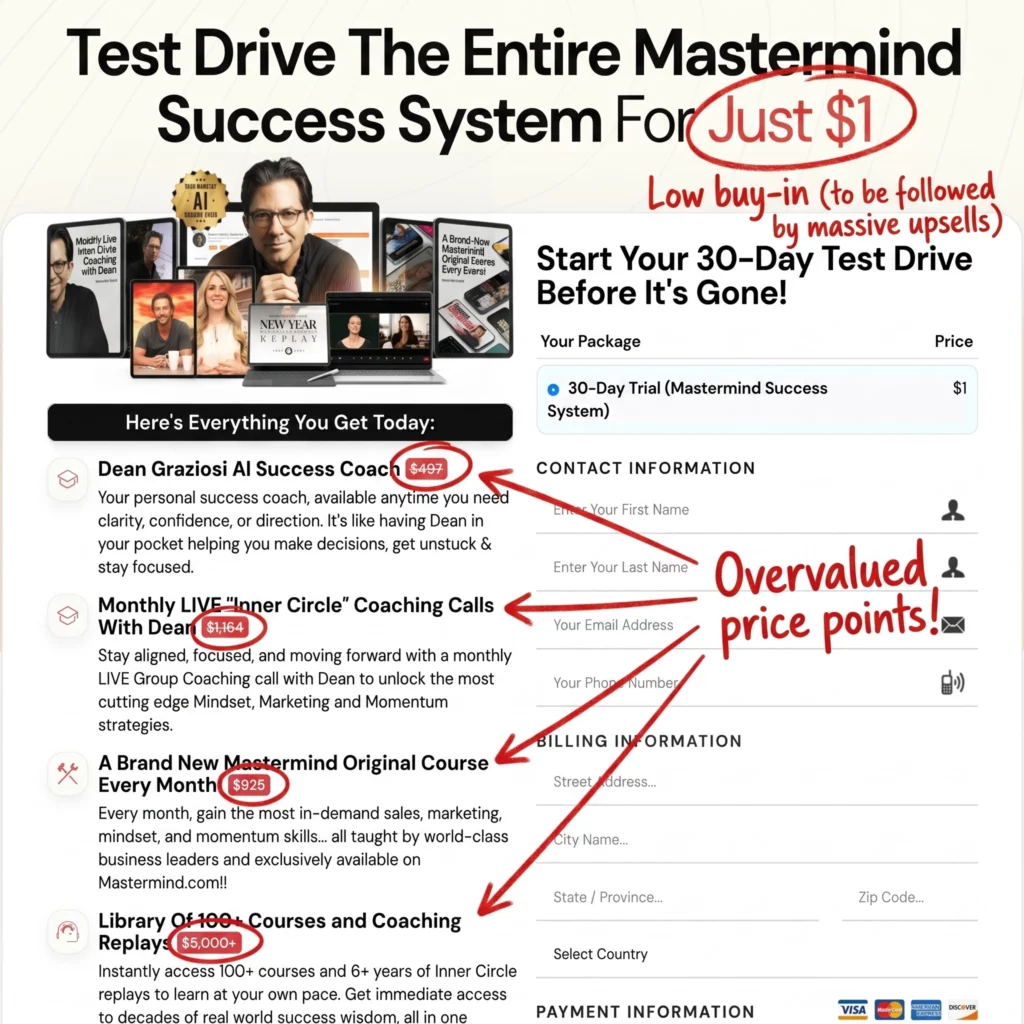
Spoiler alert: You’re not getting a deal here.
Nine times out of ten, none of those items are ever sold on their own. The price points are basically invented. It’s just a way to make an overpriced course feel like a bargain.
Pro Tip: Most people stare at the “total value” number. Ignore that completely. Instead, ask one thing: what’s the actual price I pay today, and what recurring costs come after? Those are the only number that matter.
2. “Done For You” Systems
Anytime you hear “Done For You,” do yourself a favor and run.
There is no such thing as a business that is done for you. There has never been a real business where you do 10% of the work, a “system” does the other 90%, and you get rich.
It doesn’t exist.
It can’t exist.
But this is a very popular marketing tactic you see everywhere.
A new platform I reviewed recently called 7 Figure Accelerator uses this strategy. They swear all you need is their “done for you” system. Then you sit back and collect money. It’s a fantasy, and it’s one of the most common scams out there.

Pro Tip: Real businesses are “done WITH you,” not “done FOR you.” Legit training teaches you to fish. A scam tells you the fish are already in your boat. Wake up!
3. The “AI Side Hustle” Money Pit (NEW for 2026)
This is the new “Done For You” scam wearing a shiny new AI costume, and it’s everywhere right now.
It goes like this. You see an ad screaming that some “AI system” or “AI bot” will run an entire business for you. You just pay a small fee, flip a switch, and the AI prints money while you sleep. “Pay $67 and watch the magic happen!”
Spoiler alert: There is no magic.
These programs slap the word “AI” on the same old empty promise because AI is the hot trend everyone’s chasing. The $67 gets you a flimsy intro, and then the upsells start rolling in.
First, you need the “premium AI license.” Then, you need the “done for you setup.” Oh by the way, you need the “scaling package.” Before you know it, you’re thousands deep into a tool that never made you a dime and never made sense in the first place.
Don’t mistake what I’m telling you here. AI tools are incredible and I use them every day in my own business. But AI is the tool, not the business. A hammer doesn’t build the house. You do.
Related article: Check out my full guide on Top AI Tools for Content Creation. These are the tools you need to get your hands on!
4. Unrealistic Promises of Revenue
This one preys on hope, and it makes me angry every time I see it.
You’ve heard the pitch. “I’ll give you the exact system I used to make $25,000 in 9 days, and you can have it running in the next 90 minutes!” Here’s a screenshot from one of Blake Nubar’s systems.
Your gut is telling you this isn’t possible.
Listen to it.
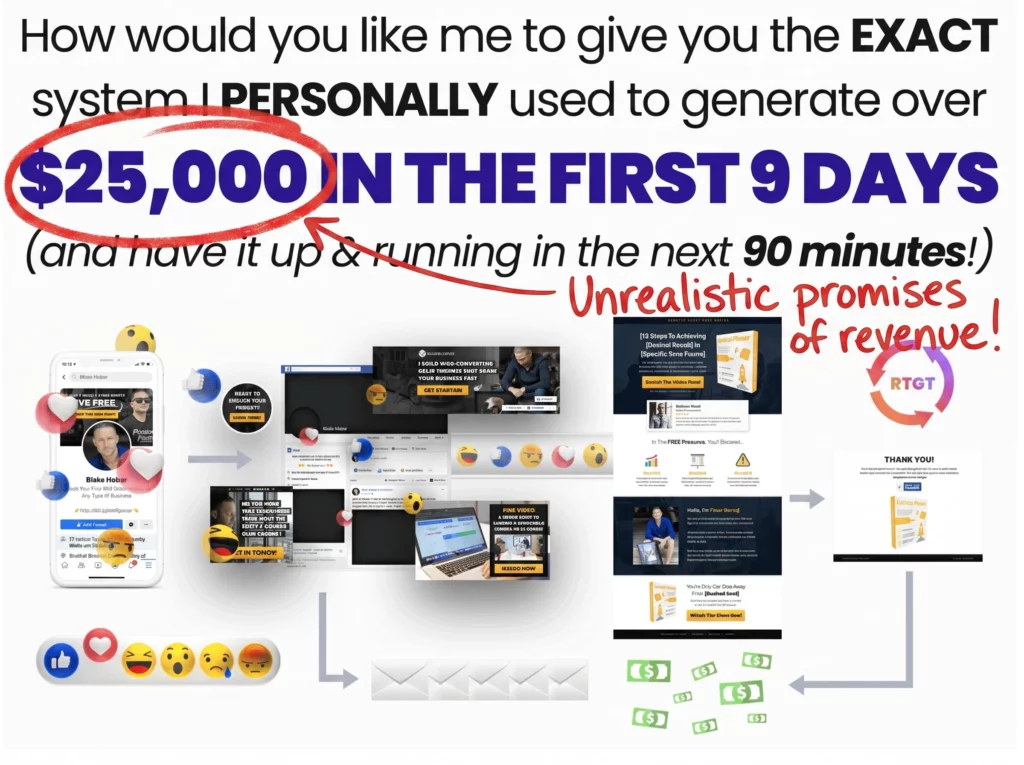
If making money online were that fast and that easy, literally everyone on earth would be doing it. These claims target people who’ve been grinding for years without results and are now more desperate than ever.
I recently reviewed Taylan Michael’s Viral Video Framework that uses this exact tactic and you also see it a lot with “get paid to watch videos” scams.
Pro Tip: Run the gut check. If a stranger promised you $25K in nine days in real life, you’d laugh in their face. The internet doesn’t change the math. When it seems too good to be true, it almost always is.
5. Major “Guru” Cliches
The mansion. The rented Lamborghini. The stacks of cash on the table. The private jet selfie.
Please don’t fall for this because it’s all one big distraction. The flashy lifestyle is designed to flip your brain into “I want THAT” mode so you stop paying attention to the actual content, which is usually thin or makes zero sense.
Platforms like any of Keala Kanae’s courses and AI Freedom Launchpad rely heavily on this “guru” appeal.
This was ultra popular when I got started in 2017. One webinar I sat in on literally had the “guru” sitting at a desk with a huge pile of cash sitting on it that he never once made reference to.
Ridiculous.

Now, in 2026, a lot of these “gurus” figured out the mansion act is played out. So now we’re seeing this switch to what I call “fake humility”, or worse, they fake the whole persona with AI (more on that in scam #11).
Pro Tip: Mute the video and watch it again with no sound. Strip away the lifestyle flexing and ask: is there any real teaching here? If all that’s left is vibes and vibes alone, you’ve got your answer.
6. The “Coaching Call” After a Webinar (And the DM Setup)
When a webinar ends and they offer you a free “coaching call,” it may harmless, but it’s not.
Make no mistake, this is a high-pressure sales call. The person on the phone is trained to keep you from saying no. They’ll hit you with lines like “How bad do you really want this?” and keep pushing more modules, more upgrades, more spending until you cave.
This was very true with Legendary Marketer, Attraction Marketing Formula, and Adam’s Method.
In 2026, this often starts in your DMs first. That friendly person sliding into your Instagram messages? In a lot of these operations, they’re a commission-only “setter” whose entire job is to book you onto a call with a “closer.” It feels personal. It’s a sales funnel.

Pro Tip: Decide your budget and your answer BEFORE the call, in writing. Then remember the most powerful move you have: you can hang up. They can’t force you to do anything. No call, text, or email obligates you to spend a cent.
7. Low Buy-In Followed by Massive Upsell
This is the classic bait and one of the most common scam tactics on this list. “Just pay $1 and jump in!” Or sometimes it’s a $7 eBook. The most common approach I’ve seen in my experience is the free webinar followed by the “if you want just a little more coaching like this” which leads to a MASSIVE upsell.
Alex Hormozi’s systems are notorious for beginning with very affordable or even free buy ins that balloon to anywhere from $25k-$50k to complete the training! Same exact thing is true for Adam Cherrington’s Affiliate Cashflow Code and Keala Kanae’s Power Code masterclass which leads to a $29K upsell.
Pro Tip: Before you buy ANY low-cost intro, search the program’s name plus the word “upsell” or “cost.” Find out the full price ladder before you take the first step. If they hide the real total, that’s your answer right there.
8. Convoluted Compensation Plan
This one shows up a lot with network marketing. When the pay plan is a tangled mess of “legs,” “tiers,” and arbitrary bonuses you can barely understand, that’s a huge red flag.
A pay structure that confusing usually means it’s not built to be sustainable. You might make a little quick money up front, but over time those bonuses get harder and harder to actually trigger. The complexity isn’t an accident. It hides how hard it really is to win.

This is a big reason I lean toward affiliate marketing instead. It’s simple: you recommend something, someone buys, you earn. No recruiting, no downline, no decoder ring required.
Pro Tip: If you can’t explain exactly how you get paid after reading it twice, don’t join. A legit business model fits on a napkin.
9. Sketchy Money-Back Guarantees
A money-back guarantee feels like a safety net. “If it doesn’t work, I’ll just get my money back, right?” That feeling is exactly what they’re counting on.
When you see a guarantee on a high-ticket program, read the fine print before you trust it. A lot of these guarantees have a tiny window of opportunity for you to claim the refund, or demand you “prove” you did a huge list of tasks first.
Pro Tip: Don’t just read that there’s a guarantee. Read HOW to actually trigger it. If the steps are vague, buried, or nearly impossible to meet, treat it like there’s no guarantee at all.
10. Fake “News” Reviews (NEW for 2026)
The more AI keeps advancing, the harder it is to tell what’s real.
Let’s say you’re doing your due diligence on a platform you’re considering buying. You make your Google search “Is [Platform Name] a scam?” and up pop a bunch of professional-looking articles on sites that look like real news, all praising the platform as legit.
A lot of those aren’t real reviews. They’re paid placements. Scammers hire PR agencies to publish “press releases” on big-name finance and business sites as sponsored content. It looks like independent journalism. But it’s an ad.
So how do you tell the difference? Look for the tiny “Sponsored” or “Brand Partner” tag at the top or bottom of the article. And check how it ends. If it wraps up with a giant “Join Now!” button linking to the course that’s a sales page in disguise.
Pro Tip: Real reviews point out flaws. If you read ten “reviews” of a program and not one mentions a single downside, you’re not reading reviews. You’re reading marketing.
11. Deepfake Testimonials & Fake Income (NEW for 2026)
This is a big one.
AI made it cheap and easy to fake the exact “proof” that used to make us trust a program. We’re talking fake student success videos, cloned voices, fabricated income dashboards, and even fully AI-generated “gurus” who don’t exist as real people.
Those glowing video testimonials? The faces might be stock photos or AI fakes. The voices might be cloned. The “$40,000 this month” screenshot? Anyone with a free tool can fake one in about thirty seconds.
So how do you verify these testimonials are real?.
Reverse image search the testimonials. Screenshot the “happy student” faces and run them through Google Lens. If the same face shows up on a stock photo site or some unrelated business in another country, you caught a fake.

Your Next Steps
Now that you have this list, what do you actually do with it?
Start with the program you’re eyeing right now. Run it through the 11 scams above like a checklist. Does it give you the vibe of ridiculous promises of revenue? Does it promise the system does all the work and is “done for you”?
With any program, course, or training platform you’re looking to attach yourself to you, make sure it has an actual focus on you learning, not just smoke and mirrors that your gut is telling you won’t work.
With a trained eye you’re going to be much quicker to spot these tells. After a while, they’ll be so obvious to you that you can’t believe everyone else doesn’t see them.
Every dollar you DON’T waste on a scam is a dollar you can put toward something real. Real businesses take real work to succeed. You can’t put shortcuts on success, but putting your focus on the work it takes to get there will allow you to reach your goals much faster.
Final Thoughts
The single most important move today is simple: before you spend a dime, slow down and verify. Trust your gut, research the program, and remember that real business is built with you, never magically done for you.
What do you think? Which of these 11 scams have you run into personally? Have you spotted an AI-faked testimonial or income screenshot in the wild yet? And is there a sneaky tactic I missed that you’d add to the list? Chime in below and drop it in the comments. I read and respond to every one.
Trying to make money online and still not seeing results? Create your FREE STARTER ACCOUNT with the same straightforward training I’ve used to create full time revenue online. No matter your experience, this step by step training delivers! Click here and get started NOW!
Frequently Asked Questions
What are the biggest red flags in online business coaching programs?
Watch for inflated “value stacks,” done-for-you promises, guaranteed income claims, high-pressure sales calls, and low-cost intros that lead to huge upsells. In 2026, also beware AI-faked testimonials and fake income screenshots.
Can AI really fake coaching testimonials and income proof?
Yes. AI now creates fake student videos, cloned voices, and fabricated income dashboards cheaply and quickly. Always reverse image search testimonials and treat any income screenshot as fake until you can verify it with a real, current student.
How can I check if a business coaching program is legit?
Search the program name with “scam,” “complaint,” and “upsell,” reverse image search testimonials, read reviews critically (look for mention of flaws), verify the coach has a real LinkedIn and business trail, and check the FTC website before buying.
Want More Affiliate Marketing Strategies?
Don’t stop your momentum now! Check out these articles for even more affiliate marketing strategies and get yourself on the fast track to full time revenue!
- 5 Smart Ways to Drive Traffic to Your Affiliate Links in 2026
- 4 Reasons Why Affiliate Marketing Isn’t a Pyramid Scheme

- Are Done For You Online Business Opportunities Legit? (2026 Update)

- 11 Online Business Coaching Scams Exposed & How to Avoid Them (2026 Update)
- Is Affiliate Marketing Still Worth It in 2026?

- Why You Need to Stop Obsessing Over Analytics!


In this day of “viral” TikToks leading to seemingly instant wealth, I can see where some people get fooled into thinking they can become millionaires overnight. I was wondering, though, what are the signs of a legitimate wealth-building program? I’ve seen a few that specifically did NOT promise “get-rich-quick” progress, so that’s certainly a start. But are there other signs to watch for?
Any platform that is free of these red flags is one you should definitely consider! Thanks for the comment! No such thing as get rich quick ????
Are webinar follow up sales calls handled by AI these days? I’m on a freelance platform and I’m constantly getting invites to answer questions for AI training. I never have (and won’t). I’m convinced it’s for training telesales systems or doing nefarious stuff with my voice.
As for which one I’ve run into personally, the “Low Buy-In Followed by Massive Upsell”… though I never stayed on the call long enough to find out the price – suspect if it’s worth a sales call to them, it’s a high price for me.
Any kind of “coaching call” should be read as a pressured sales call. It’s the only reason they do it, to sell you the next tier of coaching for the platform.
You’ve put your years of experience to good use. Your pro tip of “Mute the video and watch it again with no sound. Strip away the lifestyle flexing and ask: is there any real teaching here?…” is a great idea on one way to mute the hype and boil things down to their essence. The high-pressure sales pitch disguised as a free coaching call is not one I had thought of before. I’ve seen plenty of those offers but have yet to experience what was really happening.
Thanks for the comment!
I’m actually dealing with this right now on Facebook, some guy keeps jumping on my page spamming those scammy links. But instead of just deleting them, I flip it around in a fun way. I lead people to a blog where I explain exactly what he’s doing, and then (if he sticks around) I offer him some real help and drop a second link to legit training, all in the same comment. It’s been turning into some great engagement too!
Thanks again for laying this out so clearly. This is exactly the kind of info people need before diving into any online business coaching platform. Appreciate you sharing this!
Shawn
Nice! Keep up the good work! Thanks for the comment!
I’ve been looking at various “work from home” ideas shown on Facebook, and have encountered a fair number of scammers, normally in the “investment” type program of “invest 500 and you’ll have 4,500 in 6-9 hours, which seems just impossible.
This one was Glynn Woods Online Training and the site is posting many videos about how to work online but the direct messaging is about this “investment”.
Is this a common practice, entice people with ideas about working online and then switching them off to a scam investment?
That definitely falls under the “unrealistic revenue promises” red flag. Always trust your gut with these. It is 100% a scam to say “invest $500 and in hours you’ll have $4500”. I’ll definitely want to do a YouTube review on that to make sure others don’t fall for that kind of trap. Thanks so much for the comment!
Great article! My story relates very much to Amanda’s. After joining WA, I also found out about another platform promoted by Dean Holland, I bought his book for 7$ watched a few videos sent via email. I was pretty disappointed in the lack of good specific information and didn’t finish the videos and I’m not thrilled about going through the book either…
Finding good training can really be a struggle… What do you think about Dean Holland’s training platform?
I’m not familiar with it. What’s the name of his program. Sounds like a good one to do a review on.
https://www.internetprofitspartners.com/
His platform seems quite private and mostly accessible by social media ads funnel, videos and email lists once you buy the book.
I’ll have to look into it. Thank you 🙂
There are so many business coaching courses and scams out there. You must separate the good ones and the lousy ones. In my own case, I’ve fallen in the scams of business coaching that really served nothing for my goals and purpose. Fortunately, I’ve found teams that encouraged me and allowed me to start my business on my terms. You only have to study what they offer before making the right choice. Thanks!
Thanks for the comment!
It’s funny I came across this article. The second I read your contents section of a post it brought me right to the program I tried before finding Wealthy Affiliate. You hit the nail right on the head. Everything you said was exactly what the other program did. Luckily I only bought this initial thing which cost me $7. And scheduled the call after the webinar. But I didn’t go through with it. You hit everything that people need to watch out for when looking into money making programs. Good job!
There online business coaching schemes are so prevalent out there. Thanks for your perspective and I’m really glad you were able to listen to your gut and not get taken! Thanks for the comment!