• Skip to main content
  • Home
  • Sign Up
  • Blog & Search
  • Privacy Policy
  • Affiliate Disclosure

WORK FROM YOUR LAPTOP

  • Start Here
    • Watch the Video Tutorial
    • FAQs
    • Start Your FREE TRAINING!
  • Blog
  • Meet Eric

AI & Automation Tools

May 27 2026

AI Vs Human Writers: Who Writes Better Content?

AI Vs Human Writers: Who Writes Better Content?

At what point does AI just take over? It keeps getting better, and if you’re a content creator you may be wondering if including your voice in your own content even matters. The answer might surprise you.


TL;DR: Does AI or Human Writing Produce Better Content?

Neither AI nor human writers win on their own. Human-led content with real, first-hand experience outranks purely AI content on Google. The smartest strategy in 2026 is using both together.

  • Google’s March 2026 update made first-hand experience the #1 ranking factor – AI can’t fake that
  • Purely AI content without a human voice is losing ground fast in search results
  • The winning formula is AI for speed and structure + your voice and stories for trust and depth
  • E-E-A-T isn’t optional anymore – it’s the price of admission for ranking in 2026
  • Bloggers who master the human-AI combo are pulling ahead of everyone doing it one way or the other
🔍 Have ChatGPT Summarize This Article

What’s In This Article

  • Why AI vs. Human Writers Matters Right Now
  • My Experience with This Exact Debate
  • The Core Strategy: How to Use AI and Human Writing Together
  • Common Pitfalls & What to Avoid
  • Your Next Steps
  • Final Thoughts
  • Frequently Asked Questions

Why AI vs. Human Writers Matters Right Now

Google’s updates have made first-hand experience the top ranking signal, not just good writing. Sites using only AI content without real human experience are losing rankings fast. Bloggers who get this are building real authority. Those who don’t are watching their traffic dry up.

Ok, so we’re literally in the future. What used to be a hypothetical debate is now our reality. And if you’re a content creator, this debate could very well affect your business..

Google’s March 2026 core update shook things up in a big way. (Don’t they all?). It feels like every other year there’s a Google core update and every beginner blogger thinks the world is ending. This particular one dealt with AI vs human writing.

Sites that had real humans writing from real experience? They held their rankings or moved up. Sites that were pumping out AI content with no personal stories or original insight? A lot of them dropped hard.

So what does that mean for you?

If you’re publishing AI content with zero personal touch, you’re shooting yourself in the foot. But, on the flip side of this coin, if you’re refusing to use AI at all, then you’re working way too hard and falling way behind your competitors who aren’t.

The answer is a balance somewhere in the middle. And it’s simpler than you think.

Related article: I use AI every single day. Using it right will explode your productivity. Check out my full guide on the best AI Tools for Content Creation!


My Experience with This Exact Debate

My pet peeve as an expert trainer inside Wealthy Affiliate is when new members post to their WA blog (which should be like a progress journal where they share their wins, etc.) and just paste AI slop without batting an eye.

Suddenly, what used to be never ending shares of progress and questions has become a very weird area at times where some new members are not only pasting AI slop, but then commenting with AI too. it’s gotten better lately, but I feel like the angry old man telling AI to get off his lawn.

AI fatigue is a real thing. If your audience arrives at your content and senses immediately that it’s pasted AI, they’re going to hit the back button. As they make their exit, you’ve lost any chance of connecting with them.

I don’t mean to be the bearer of bad news here, but in the world of affiliate marketing, your connection with your audience is EVERYTHING. Lose that and you’re out of business.

It’s not about abandoning AI, it’s about having balance, allowing it to do all the heavy lifting, and then weaving your own voice into your content seamlessly. Period.

Do this right and your rankings will go up, your content production goes through the roof, and your traffic and revenue will explode.


The Core Strategy: How to Use AI and Human Writing Together

The best content strategy isn’t picking AI or human writing, it’s about balancing both. AI handles research, drafts, and structure. The human writer adds real experience, personality, and original insight. Together, they hit Google’s E-E-A-T standards and give readers something worth staying on the page for.

What AI Writers Actually Do Well

Let’s give credit where it’s due. AI is genuinely great at many things.

  • Speed – AI can write a solid 1,500-word draft in under a minute
  • Research – Ask AI to find the top questions people have about a topic and spits them out instantly
  • Consistency – It doesn’t get tired, doesn’t have off days, and doesn’t lose the plot (most of the time)
  • Structure – AI is really good at organizing information so it’s easy to read and scan

Use AI to build your outline, pull together your key questions, and write a first draft of each section. That’s your starting point, but not your final product.

Pro Tip: Most bloggers use AI to write the whole article and just clean it up a little. Don’t do that. Treat every AI draft like a rough sketch. The bones are there, but you have to put the meat on them. Add at least two personal stories or real examples. That one habit alone will make your content better than most of what’s out there.


What Human Writers Still Do Better

Here’s what the “AI is taking over” crowd keeps missing. There are things AI flat out cannot do very well just yet.

  • Real experience – You’ve actually done the thing you’re writing about. AI is pulling from stuff that was written in the past. Google can tell the difference (and so can your audience), and it rewards the real thing.
  • Human connection – People connect with people. A specific story, a moment of honesty, a little humor, those are human moves that AI just doesn’t land the same way.
  • Real opinions – AI tends to play it safe. It sits in the middle. You can take a clear stance, call something a waste of time, and actually help your reader make a decision.
  • Trust signals – Your author bio, your publishing history, your name tied to a topic over time, Google’s 2026 updates show this stuff now affects your rankings directly.

For every article you publish, include at least one specific first-person example (preferably 2-3) that proves you’ve actually done what you’re writing about. (Don’t have experience in the area? Then at the very least relate the experiences of others in a relatable way.)

Pro Tip: After Google’s March 2026 update, the sites that dropped the hardest were the ones that had cleaned out all their personal examples to make their content sound more “professional.” Don’t make that trade. The messy, real human story is what ranks.

Work From Your Laptop YouTube Subscribe

The 5-Step System I Use for Every Article

This is exactly how I put together every piece of content on this site.

Step 1 – Research and outline (AI) I give AI the topic and ask it to find the main questions people are asking, pull related keywords, and build an outline. Takes about five minutes instead of thirty. Inside Wealthy Affiliate, the Hubs feature starts you out with 100 topic ideas, keyword ready, all highly relevant to your niche right out of the box. AI is great for this!

Step 2 – First draft (AI) AI writes a first draft of based on the outline. It’s usually pretty accurate and easy to follow. But it’s also pretty generic and filled with AI tells. That’s ok for now.

Step 3 – The human layer (me) This is a very important step. I go through each section and ask myself: “What do I actually know about this from doing it?” and then I add that. A story. A result I got. A mistake I made. Something real.

Step 4 – Voice pass (me) Personally, this is the MOST important step. AI writes in a very AI tone. I go through and make every section sound like me. I add my voice and rewrite anything that doesn’t sound like me. Contractions. Short sentences. My actual opinion.

Step 5 – E-E-A-T check (me) Before I hit publish, I make sure the article shows real experience, explains the “why” behind every tip, and doesn’t make any claims I can’t back up. If I’ve done steps 1-4 right, then step 5 is basically done and it’s just a review. During this last step I add my CTAs, linking, etc.

Build this five-step system into your workflow. It takes a little practice, but once it clicks, both your speed and your quality go up at the same time.

Pro Tip: Most bloggers skip Step 3 and wonder why their AI content isn’t ranking. That human layer isn’t a bonus anymore, it’s literally where your ranking power comes from and the easiest part to do cuz, guess what, you’re human!


Common Pitfalls & What to Avoid

The biggest content mistakes come from two extremes, leaning too hard on AI with no human experience added, or avoiding AI altogether and burning out. Both hurt your rankings, your time, and your authority.

These common mistakes come straight from what I see bloggers asking about on Reddit and in blogging communities every single week.


Pitfall #1 – Hitting Publish on Raw AI Content

This is the most common one. You generate a draft, skim it, fix a couple sentences, and publish. It looks fine. But there are no real stories, no specific examples, no personality. Spoiler alert: Not only is Google getting really good at spotting that, but so is your human audience.

Workaround: Before you publish anything make sure you can point to 2-3 real, personal examples.

Related article: Check out my full review of Wordform AI here. It promises to use AI that is “undetectable”. See why I couldn’t promote it with a clear conscience after my research.


Pitfall #2 – Ignoring Your Author Page

Google now looks at who wrote the content, not just the content itself. If your author bio is vague, outdated, or doesn’t exist, you’re giving up ranking power. After the March 2026 update, your author page is basically part of your SEO infrastructure. Don’t overthink it, just make it your own.

Workaround: Build a real author page. List your actual experience, your credentials, and the topics you cover. Make sure your name is linked consistently on every article you publish.


Pitfall #3 – Using AI for Money or Health Topics Without Backing It Up

Topics like health, money, and legal advice are held to a higher standard by Google. AI-generated content on these topics with no verified expertise behind it is a problem.

Workaround: Write these sections yourself from real experience, or clearly state where your information is coming from. Your credibility is on the line here.


Pitfall #4 – Writing for Google Instead of People

Stuffing keywords, writing low value content that reads like a bulleted outline, answering “what” but never “why”, all this tanks your engagement. When people bounce fast, your rankings follow. This goes back to what I’m always telling my students inside Wealthy Affiliate. Stop writing AI book reports and start being relatable to your audience!

Workaround: Read your content out loud before you publish. If it sounds like a robot wrote it, rewrite it until it sounds like you’re talking to a friend. Would you ask AI to write a get well card to a loved one?


Pitfall #5 – Thinking AI Knows Your Topic Better Than You Do

I see new bloggers fall into this one all the time. They figure AI has read everything on the internet, so it must know more than them.Trust me, AI gets plenty of things wrong and will sound confident as ever when it writes it. If you don’t know enough to catch the mistakes, they’ll end up in your published article.

Workaround: Only write about things you know well enough to fact-check. Your knowledge is your edge. Don’t give it away.


Your Next Steps

The bloggers winning right now aren’t the ones who use AI the most. And they’re not the ones who refuse to touch it. They’re the ones who’ve figured out how to use both and make it look natural.

Here’s what I want you to do this week: Take your next article idea and run it through the five-step system I laid out above. Don’t aim for perfect. Just try it once. Write the AI draft, then sit down and ask yourself, “Where does my real experience live in this topic?” Add that in. See how the article feels when it has both structure and a real human voice behind it.

Keep this up and watch your numbers over the next couple months. I’d bet you’ll see people staying on your pages longer, leaving more comments, and coming back more often.

The two groups that are going to struggle going forward are the “AI does everything” crowd and the “I’ll never use AI” crowd. Both are leaving money and rankings on the table. You don’t have to pick a side. You just have to get good at working with both.

One more thing, don’t put off building your author presence. Your author page, your byline, your history of publishing on your topic over time, that’s part of your SEO now. It’s not about bragging. It’s about showing Google there’s a real, credible human behind your content.


Final Thoughts

The most important thing you can do today: go to your best article and add a section or two where you share something real from your own experience and in your own words. That one move tells Google a real human with real knowledge wrote this.

What do you think? Are you already mixing AI and human writing in your content or does the whole thing still feel a little overwhelming? Have you noticed your rankings shift lately and wondered if your content style had anything to do with it? Drop your thoughts in the comments. I read every single one and I always reply.
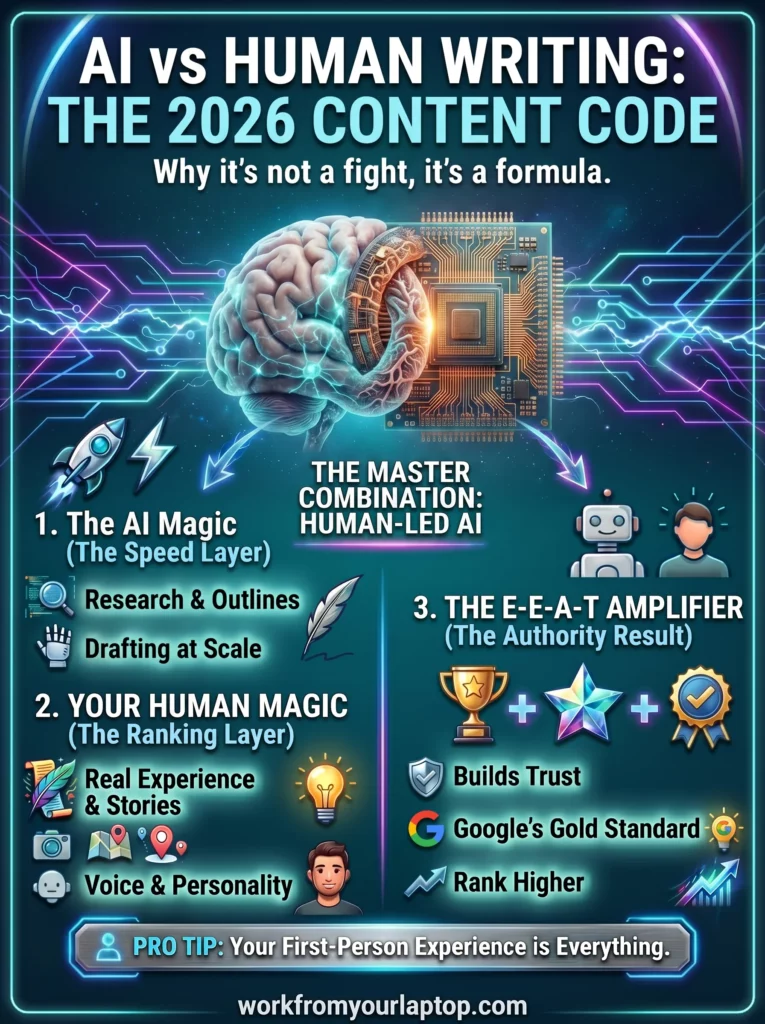
AI vs Human Writers Which is Better Infographic

Trying to make money online and still not seeing results? Create your FREE STARTER ACCOUNT with the same straightforward training I’ve used to create full time revenue online. No matter your experience, this step by step training delivers! Click here and get started NOW!


Frequently Asked Questions

Does Google penalize AI-written content? Google doesn’t go after AI content automatically. It goes after low-quality content that doesn’t help people, no matter how it was written. AI content with real experience and expert insight behind it can rank just fine.

Can readers tell when content was written by AI? Absolutely yes. When content has no personal stories, no specific details, and a flat tone, people feel it, even if they can’t name it. That disconnect hurts your time-on-page and your trust.

What’s the smartest way to use AI for blogging without hurting SEO? Use AI for outlines, first drafts, and pulling together research. Then add your personal experience, rewrite it in your own voice, and make sure your content proves you actually know what you’re talking about.


Want More on AI & Automation Tools?

Don’t stop your momentum now! AI tools are the tools that will make the most difference in building your business. Check out these articles and multiply your work by 10x!

  • AI Vs Human Writers: Who Writes Better Content?
    AI Vs Human Writers: Who Writes Better Content?
  • how to write the perfect chatGPT 5 Prompt
    How to Write the Perfect ChatGPT-5 Prompt

  • How I Use ChatGPT to Get More Traffic to My Blog
    How I Use ChatGPT to Get More Traffic From My Existing Blog Posts

  • Why I Replaced Google With ChatGPT and Why You Should Too
    Why I Replaced Google With ChatGPT (And You Should Too)
  • Top AI Tools for Content Creation
    Top 10 AI Content Creation Tools in 2025: Honest Reviews from Real Users

  • How I Use ChatGPT for Content Creation and SEO
    How I Use ChatGPT to Automate Content Creation, SEO, and Affiliate Marketing

Written by Eric Cantu · Categorized: AI & Automation Tools

Aug 19 2025

How to Write the Perfect ChatGPT-5 Prompt

how to write the perfect chatGPT 5 Prompt

Sometimes ChatGPT-5 can deliver absolute, pure gold, and other times it feels like you’re working with a stubborn teenager. The secret’s in the prompt. But don’t go thinking you *always need to craft a perfect 1000 word prompt to get the results you’re looking for.

Let me show you why.


TL;DR: How to Write a Perfect GPT-5 Prompt

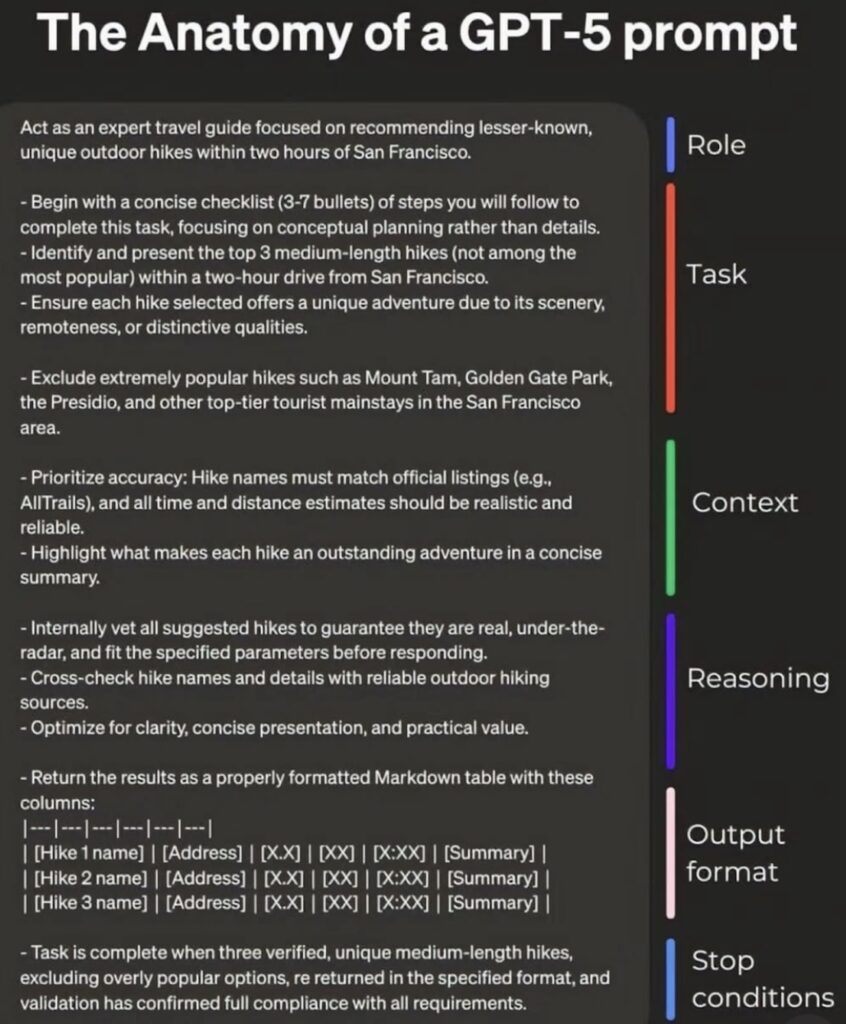
A strong GPT-5 prompt has six key parts: Role, Task, Context, Reasoning, Output Format, Stop Conditions. But you can get equally great results through a conversational approach with clarifying questions.

  • Set the role: Define who GPT-5 should act as to guide tone and expertise.
  • Clarify the task: State the exact action or output you want.
  • Give full context: Share relevant background, constraints, and examples.
  • Specify the format: Tell it exactly how the answer should be structured.
  • Consider conversation: Let GPT-5 ask clarifying questions instead of writing a massive prompt.
🔍 Have ChatGPT Summarize This Article

What’s In This Article? (Quick Jumps)

  • The Six Steps to a Perfect GPT-5 Prompt
  • How Conversational Prompting Works
  • How to Make ChatGPT-5 Ask You Clarifying Questions
  • The Step-by-Step Conversational Approach
  • When to Use Conversational Prompting vs Full Prompts
  • Final Thoughts
  • Frequently Asked Questions

The Six Steps to a Perfect GPT-5 Prompt

Prompt engineering has been a whole craze since ChatGPT came into existence. Here’s the step-by-step framework many advanced users swear by when they want consistent, high-quality results, with a little extra detail to help you nail each one.


1. Role

What it is: You tell GPT-5 who or what it should act as. This sets the tone, voice, and expertise level for the answer.
Why it matters: Without a role, GPT guesses how formal or casual to be, which can throw off the result.
Analogy: Like hiring someone for a job, you wouldn’t just say “do some work,” you’d hire a specific person with specific skills.
Example Prompt: “You are a senior travel consultant with 20 years of experience planning luxury European vacations.”
My take: GPT is an expert in all things. You don’t necessarily need to tell it “you are a website building expert” prior to asking it questions about WordPress, but this does help GPT refine its “mindset”.


2. Task

What it is: The exact action or output you want from GPT-5.
Why it matters: A vague task leaves too much room for GPT to go off-topic. The more precise you are, the more likely you’ll get exactly what you imagined.
Analogy: If you were ordering food and said, “Bring me something tasty”, this could mean anything from sushi to soup.
Example Prompt: “List five lesser-known Italian towns worth visiting, with a one-sentence cultural highlight for each.”
My take: The more specific you are, the better.


3. Context

What it is: The background information GPT needs to give you a relevant, useful answer.
Why it matters: GPT has no idea about your preferences or constraints unless you tell it. Without context, it might give generic or mismatched suggestions.
Analogy: Asking a tailor to make you a suit without telling them your measurements.
Example Prompt: “I’m planning a trip in late September. I want cool weather, fewer tourists, and day trips under two hours from Florence.”
My take: The great part about this is the more you work with GPT, it actually starts to learn your preferences. Like Arnold said, it’s a “learning computah”


4. Reasoning

What it is: Instructing GPT-5 to think through its answer before delivering it, sometimes called “chain-of-thought prompting.”
Why it matters: This reduces mistakes and helps GPT explain its logic, so you can spot errors before they cause bigger issues.
Analogy: Like showing your math work in school, the answer matters, but the process proves it’s correct.
Example Prompt: “First, share your reasoning with me for choosing these towns, then give me the final list.”
My take: This can save boatloads of headaches. When GPT explains to me how it’s going to complete a task I ask of it, I can reel it in before it goes off the rails.


5. Output Format

What it is: The exact way you want the answer presented. Maybe you want a bullet list, a table, numbered steps, a narrative, etc.
Why it matters: Saves you time reformatting and makes sure the content is ready to use right away.
Analogy: When ordering coffee, you don’t just say “coffee,” you tell the barista if you want it hot or iced, in a tall or grande cup, with almond milk or whipped cream. Same drink, but the presentation changes everything
Example Prompt: “Show the results in a table. Have columns for Town, Highlight, and Travel Time from Florence.”
My take: Again, a major time-saver saving yourself steps down the line.


6. Stop Conditions

What it is: Boundaries on how much GPT-5 should output or when it should stop.
Why it matters: Prevents overly long, rambling responses and keeps the focus on exactly what you need.
Analogy: Asking a storyteller to keep the tale to five minutes so you’re not still listening an hour later.
Example Prompt: “Stop after listing three towns and keep the total word count under 150.”
My take: Stop conditions are a must, even in regular conversations with GPT, I’ve told it many times to eliminate the fluff and just get straight to the point.


Related article: ChatGPT can absolutely level up your online business. Check out “How I Use ChatGPT for Content Creation, SEO, and Affiliate Marketing”

Now, if we plug these six steps together, your “perfect” GPT-5 prompt might look like this:

“You are a senior travel consultant with 20 years of experience planning luxury European vacations. List five lesser-known Italian towns worth visiting, with one cultural highlight for each. I’m traveling in late September, prefer cool weather, fewer tourists, and day trips under two hours from Florence. First, explain your reasoning, then give me the list in a Markdown table with columns for Town, Highlight, and Travel Time from Florence. Stop after five towns.”

Again, in my opinion, setting the role is optional. I feel it will give just as good of an answer here without that role defined, but I do think this also helps us as the user with organizing our thoughts and creating specificity with our prompt.


How Conversational Prompting Works & Why I Prefer It Over Long Prompt Engineering

Now we get to the more natural way of getting everything you want out of ChatGPT-5: conversational prompting.

Conversational prompting is exactly what it sounds like. Instead of crafting one big, perfectly structured prompt with every detail burned in, you start with a rough idea and let GPT-5 ask you the questions it needs to fill in the gaps.

Why This Works Like a Charm

GPT-5 is built to understand context and adjust its answer based on your replies. If you let it guide its own process, you still end up with the same precision as a “perfect prompt,” but you don’t have to think of every detail at the start.

This is true collaboration, which as humans we’re much more used to. You’re not just instructing the AI, you’re co-creating the final request together.

Related Article: ChatGPT is a genius assistant in so many ways. Are you using it to its fullest? Check out my full guide to using ChatGPT to get more traffic to your website.


How to Make GPT-5 Ask You Clarifying Questions

If you want GPT-5 to excel at conversational prompting, you can prime it to always clarify vague prompts before answering.

Quick Ways to Do This:

  1. In ChatGPT, go to Settings > Personalization > Custom Instructions, and add this: “Whenever I give you a vague request, ask clarifying questions before generating a response. If after generating a response you have follow up suggestions or next steps to take I’d appreciate those ideas as well.”
  2. If you don’t want it to always ask questions, just make it Step 1 to any task you’re creating: “First, ask me two clarifying questions. Then, proceed.”
  3. If it skips clarification and makes wrong assumptions, restart the chat and explicitly request clarification first.

The Step-by-Step Conversational Approach

  1. Start broad, but relevant
    • Example: “Help me plan a vacation.”
    • Don’t overcomplicate the first prompt, just make sure GPT knows the general topic.
  2. Let GPT-5 ask questions
    • It might say: “Where are you going, how long will you be there, and what’s your budget?”
    • This is where missing context gets uncovered naturally.
  3. Answer specifically
    • The clearer your answers, the better the AI can refine its follow-up questions.
  4. Watch for assumptions
    • If GPT guesses details you didn’t provide, correct them right away so the final answer stays accurate.
  5. Confirm before execution
    • Ask GPT to repeat the full clarified request back to you.
    • Example: “Okay, so you want a 7-day Italy itinerary in September, with a focus on food and culture, avoiding tourist-heavy spots?”

Example Conversation Flow

You: “Help me plan a vacation.”
GPT-5: “Where are you going, how long will you be there, and what’s your budget?”
You: “Italy, 10 days, mid-range budget.”
GPT-5: “Do you want a mix of famous sights and hidden gems, or focus on lesser-known areas?”
You: “Lesser-known.”
GPT-5: “Got it. Do you prefer city stays or small towns?”
You: “Small towns.”
GPT-5: “Perfect. Here’s a 10-day itinerary for small, lesser-known Italian towns, each with a cultural highlight and realistic travel times.”

That final result will be just as good as if you had written a fully detailed 6-step prompt, but you got there through a natural back-and-forth.


When to Use Conversational Prompting vs Full Prompts

ScenarioBest MethodWhy
You know exactly what you want, including formatFull promptFastest, most direct path to a precise answer
You’re exploring ideas or don’t have all details yetConversational promptingGPT fills in the gaps by asking targeted questions
You want speed but some flexibilityHybridStart broad, let GPT ask a few clarifying questions, then give final format
You’re teaching someone prompt craftingBothShow the structured method, then how conversation achieves the same clarity

Related article: I use AI tools every single day. Check out my full guide on Top AI Tools for Content Creation.


Final Thoughts

Six-part prompts give you precision and control. Conversational prompting gives you flexibility and speed. With ChatGPT-5, you can swap between them depending on your goal, and sometimes the best results come from blending both.

In short: Use the perfect prompt when you have all the details. Go conversational when you want to explore or collaborate.

What do you think?
Do you prefer structured prompts or free-flowing conversation with GPT-5? Share your prompting style below — and if you’ve found a hybrid that works even better, tell us about it.

Trying to make money online and still not seeing results? Create your FREE STARTER ACCOUNT with the same straightforward training I’ve used to create full time revenue online. No matter your experience, this step by step training delivers! Click here and get started NOW!


Frequently Asked Questions

1. Can conversational prompting really match a perfect prompt?
Yes — as long as GPT-5 asks targeted clarifying questions, you can guide the answer to be just as precise as a full-spec prompt.

2. How do I make GPT-5 ask clarifying questions?
Add it directly to your prompt or include it in your custom instructions so it becomes part of the model’s default behavior.

3. What if GPT-5 doesn’t ask enough questions?
Nudge it with: “Before answering, ask me three questions to make sure you understand exactly what I want.”


Want More From the World of AI and Automation Tools?


  • AI Vs Human Writers: Who Writes Better Content?
    AI Vs Human Writers: Who Writes Better Content?
  • how to write the perfect chatGPT 5 Prompt
    How to Write the Perfect ChatGPT-5 Prompt
  • How I Use ChatGPT to Get More Traffic to My Blog
    How I Use ChatGPT to Get More Traffic From My Existing Blog Posts
  • Why I Replaced Google With ChatGPT and Why You Should Too
    Why I Replaced Google With ChatGPT (And You Should Too)
  • Top AI Tools for Content Creation
    Top 10 AI Content Creation Tools in 2025: Honest Reviews from Real Users
  • How I Use ChatGPT for Content Creation and SEO
    How I Use ChatGPT to Automate Content Creation, SEO, and Affiliate Marketing
Written by Eric Cantu · Categorized: AI & Automation Tools

Jul 24 2025

How I Use ChatGPT to Get More Traffic From My Existing Blog Posts

How I Use ChatGPT to Get More Traffic to My Blog

Most creators are stuck in the same loop: constantly publishing new content, blindly updating old posts, and hoping something sticks. I was there too. I’d look at a post I wrote a year ago and think, “Maybe this just needs new keywords? Or a better intro?” 

Everything changed when I started using ChatGPT like an actual strategist.

TL;DR: Can ChatGPT Help You Get More Traffic?

Yes, by analyzing your existing content with real search data, ChatGPT shows you exactly what to improve or remove so you can get more traffic without creating anything new.

  • It helps you fix what’s underperforming. ChatGPT identifies blog posts with high impressions but low CTR so you can update them and start pulling in more clicks.
  • It shows you what’s not worth saving. By analyzing low-traffic, low-value posts, it helps you confidently delete content that’s dragging your site down.
  • It helps combine overlapping posts for stronger results. Merging similar content improves topical authority and helps you rank higher for competitive keywords.
  • It eliminates the guesswork. You stop wasting time updating posts that won’t move the needle and focus only on what’s proven to get results.
  • It works with the content you already have. No new writing required — just smarter decisions that drive more traffic using what’s already published.
🔍 Have ChatGPT Summarize This Article

What’s In This Article? Quick Jumps

  • How I Use ChatGPT to Get More Traffic (Full Website Audit Tutorial)
  • The Problem With Guessing What to Fix
  • What I Ask ChatGPT (And Why It Works So Well)
  • How I Use the Data to Make Smart Content Decisions
  • How to Build the Spreadsheet (Even If You Hate Spreadsheets)
  • Why This Audit Method Leads to Real Traffic Growth
  • Final Thoughts
  • Frequently Asked Questions

How I Use ChatGPT to Get More Traffic (Full Website Audit Tutorial)

Video Chapters & Quick Jump Guide (Click to Expand)
  • 0:00 Intro
  • 0:42 Initial ChatGPT Prompt for Starting Your Website Audit
  • 1:04 Understanding the Metrics from Google Search Console You’ll Track
  • 2:22 Understanding How to Use these Metrics to Take an Audit Action
  • 3:47 How to Make and Download a Google Sheets Spreadsheet for Your Audit
  • 5:20 Final Thoughts, Conclusion

The Problem With Guessing What to Fix

Before I had this system, I didn’t know which blog posts needed just a quick update and which ones I should do away with altogether. I didn’t have a real system in place based on actual analytics.

Here’s the thing: Google Search Console holds the answers, but it’s not always obvious what to do with the data. And most of us don’t have time (or desire) to spend hours sorting it out manually.

I’m not a huge analytics person, but here’s where GPT changed the game for me.

Related article: Are you optimizing your content for AI search? Check out “Generative Engine Optimization: How to Optimize for AI Search” and get a massive leg up on the competition.


What I Ask ChatGPT (And Why It Works So Well)

When it comes to getting what you want out of ChatGPT, the magic is always in the prompt:

“I want to audit my website using Google Search Console data to decide which blog posts to update, merge, or delete. Can you build a spreadsheet for this?”

What I get back is a full spreadsheet structure, usually with columns like:

  • Post URL
  • Target keyword
  • Clicks (last 3 months)
  • Impressions (last 3 months)
  • CTR %
  • Average position
  • Word count
  • Internal links
  • Backlinks
  • Last updated date

And it doesn’t stop there — GPT explains why it chose each column.

For example:

“Include word count to help identify thin content and compare top performers.”

That kind of logic is what makes GPT more than just a writing assistant. It starts thinking like a strategist for you.


How I Use the Data to Make Smart Content Decisions

Once the spreadsheet is built, this is where the real magic happens.

Sure I can fill in the spreadsheet boxes with the values taken from Google Search Console. But then what? What does an article with low CTR but decent impressions mean for my next action?

Once again, ChatGPT to the rescue. ChatGPT gives me a content audit decision guide based on the data. This was key for me.

  • Update:
    Moderate to high impressions, but a low CTR (under 1%)
    → This means people are searching, but your post isn’t pulling them in. Might need better titles, visuals, or updated info.
  • Merge:
    Low clicks, and there’s another post on the site with the same intent
    → Combine them into one stronger post to boost authority.
  • Delete:
    0–5 clicks, low impressions, irrelevant topic, or no backlinks
    → This is thin content and can be dragging your site down.

And if you have a question about a specific article’s data and whether those numbers should be considered “low” or “high”, just ask! “Hey GPT, this article has x number of impressions, y number of clicks, and z average position in search. What should I do with it?”


How to Build the Spreadsheet (Even If You Hate Spreadsheets)

I’m not a spreadsheet person. At all.

But when I asked ChatGPT, “Can you create that spreadsheet for me?” it generated a downloadable CSV that I could open in Google Sheets. From there, I followed simple instructions like:

  1. Go to Google Sheets and open a new spreadsheet
  2. Click File > Import
  3. Upload the CSV GPT gave me
  4. Format the columns if needed — done

💡 Pro tip: You can even ask GPT to help color-code cells using conditional formatting. For example:

  • CTR below 1% = red
  • Clicks over 500 = green

This helps you visually spot the winners and underperformers.


Why This Audit Method Leads to Real Traffic Growth

The best part? This method gets you focused on impact.

Instead of posting more and more content hoping for a win, I’m refining what I’ve already created. That’s where the compound results happen.

By using this audit strategy regularly, I’ve been able to:

  • Eliminate dead weight posts that weren’t helping
  • Boost rankings on content that just needed minor updates
  • Combine posts that were competing with each other
  • Spend way less time guessing what’s worth working on

And all of this leads to what we really want: more traffic, less stress.


Final Thoughts

ChatGPT isn’t just a content tool. It’s a strategist that helps you turn what you’ve already created into real traffic. When you stop guessing and start acting on data, everything changes.

This ChatGPT audit strategy has become one of my most valuable tools, and it’s now baked into how I run my entire content business. It’s fast, it’s repeatable, and best of all, it helps you stop guessing.

What do you think? Have you ever used ChatGPT to analyze your own content? Do you rely on Google Search Console for your content decisions, or are you still making updates based on gut instinct? Drop a comment and let me know how you’re using AI in your workflow. I always reply.

Trying to make money online and still not seeing results? Create your FREE STARTER ACCOUNT with the same straightforward training I’ve used to create full time revenue online. No matter your experience, this step by step training delivers! Click here and get started NOW!


Frequently Asked Questions

How do I get Google Search Console data into ChatGPT?
Export your performance data from GSC as a CSV, then either paste sections of it into GPT or describe the patterns you’re seeing and ask GPT for next steps.

What’s the best way to decide if a post should be deleted?
If it’s off-topic, has 0–5 clicks, no backlinks, and hasn’t moved in rankings in months — it’s probably safe to delete.

Do I need to be good with spreadsheets for this to work?
Nope. ChatGPT handles the structure, and Google Sheets is drag-and-drop simple. You can even ask GPT to walk you through each step as you go.


Want More Like This?

  • AI Vs Human Writers: Who Writes Better Content?
    AI Vs Human Writers: Who Writes Better Content?
  • how to write the perfect chatGPT 5 Prompt
    How to Write the Perfect ChatGPT-5 Prompt
  • How I Use ChatGPT to Get More Traffic to My Blog
    How I Use ChatGPT to Get More Traffic From My Existing Blog Posts
  • Why I Replaced Google With ChatGPT and Why You Should Too
    Why I Replaced Google With ChatGPT (And You Should Too)
  • Top AI Tools for Content Creation
    Top 10 AI Content Creation Tools in 2025: Honest Reviews from Real Users
  • How I Use ChatGPT for Content Creation and SEO
    How I Use ChatGPT to Automate Content Creation, SEO, and Affiliate Marketing
Written by Eric Cantu · Categorized: AI & Automation Tools

Jun 27 2025

Why I Replaced Google With ChatGPT (And You Should Too)

Why I Replaced Google With ChatGPT and Why You Should Too

Most people still use Google by default. It’s familiar, it’s fast, and we’ve all been trained to just type in a question and skim through the results. But here’s the thing. Google gives you links, ChatGPT gives you answers.

Not just any answers either. Your answers. Answers that match the way you think, work, and create. Once I realized that, there was no going back.

This article dives into how I actually use ChatGPT daily to run my content business. and how it’s become way more than a shortcut. It’s become my assistant, my strategist, and my creative sounding board all in one.

TL;DR: Who Wins in ChatGPT vs Google?

For content creators, ChatGPT isn’t just better than Google: it’s smarter. It learns how you work, remembers your style, and gives full, personalized workflows instead of scattered search results.

  • ChatGPT adapts to how I work, Google doesn’t. ChatGPT tailors its responses to my style, tone, and content flow so I’m not starting from scratch every time.
  • ChatGPT remembers what matters. From my brand colors to my workflow structure, it holds onto the details that make my process faster.
  • ChatGPT saves hours every week. I get full blog outlines, video scripts, and tweet threads in my voice, no piecing together search results.
  • ChatGPT helps me build momentum. Instead of scattered research, I get personalized systems that compound with every piece of content I create.
  • ChatGPT collaborates like a team member. This isn’t just a tool, it thinks with me, helps me improve, and grows alongside my business.
🔍 Have ChatGPT Summarize This Article

What’s In This Article (Quick Jumps)

  • How I Use ChatGPT to Replace Google in My Workflow
  • It Doesn’t Just Respond: It Remembers
  • How ChatGPT Became the Backbone of My Content Workflow
  • Final Thoughts
  • Frequently Asked Questions


How I Use ChatGPT to Replace Google in My Workflow

Google is great at handing you a list of links. But if you’re trying to create something. a blog post, a YouTube script, a tweet thread, a full-on funnel. that list of links still requires you to piece everything together. You’re still the one doing the thinking, comparing, organizing, translating.

ChatGPT doesn’t work like that. I type in a prompt and get something that already sounds like me. And that’s just the start.

I’ve asked it things like:

  • “What are my two brand colors again?” It answered with my exact hex codes, and told me what I typically use each one for.
  • “What’s my next step after publishing a blog post?” and it didn’t just give me some generic checklist. it walked me through my own system: Quick Read, video script, YouTube post, tweet thread, carousel idea, internal links, and so on.

But I’ve gone even further with it.

These days, I’ll say:

  • “Build a rough content calendar for next week based on the topics I’ve already published.”
  • “What topics haven’t I covered yet that would complement my last three posts?”
  • “Write an intro hook that matches my tone and references my fire shift.”
  • “Give me 3 Instagram carousel ideas using my latest Quick Read article.”

It’s not about replacing creativity. I still choose the direction. But ChatGPT helps me get there in half the time without sacrificing my voice.

Related article:Check out my full guide on how to create the perfect prompt for GPT-5!


It Doesn’t Just Respond, It Remembers

“Wait. it remembers you?” Yep.

ChatGPT knows I’m a firefighter on a 24/48 shift. It remembers I recently promoted to Captain. It remembers my mostly pescatarian diet. It remembers my dog’s names. This is a whole new ballpark compared to Google.

And when I ask it for help, it doesn’t ask me to reintroduce myself every time. it picks up right where we left off. The more I interact with it, the better it gets at helping me think through what I’m building. That’s the difference.

When I’m scripting a video, it’ll automatically apply the same tone, sentence rhythm, and CTA style I use without me prompting it. When I ask it to help with a tweet thread, it suggests angles based on what I’ve already said in the video.

It’s like having that perfect assistant who actually listens, remembers your quirks, and makes helpful suggestions without stepping on your toes.

I’ve also had it:

  • Rework older scripts into updated, tighter formats that match how I speak now
  • Help brainstorm ideas for new toolkits and bonuses for my high-converting lead magnets
  • Remind me about posts I should link to or topics I should revisit

From content prompts to publishing workflows, I’ve built out full systems using GPT. Wanna learn how to do that? I broke it all down in detail right here.

And see, Google can’t do that. Google can’t learn you.

Related article: Check out my review of a platform that promises to help you build an AI business that runs on autopilot. Is this legit?


How ChatGPT Became the Backbone of My Content Workflow

This is where things get really exciting. Because once you realize ChatGPT isn’t just for answering questions but for helping you build your system, everything clicks.

Here’s what I mean:

  • I start with a rough idea (from a video, an article, or even a tweet)
  • ChatGPT helps me shape it into a blog outline, a YouTube script, or both
  • From there, it creates the Quick Read summary and teaser tweets (I sure am mentioning Quick Reads a lot for something I’m about to ditch right?)
  • Then I generate a pinned comment, YouTube description, and CTA language
  • It even tracks what articles I’ve internally linked to recently so I’m not repeating the same few again and again

And this is all just with a few prompts. It remembers my format: video first, article second. It knows my structure: answer paragraph, TOC, embedded video, full H2 breakdown, TL;DR before Final Thoughts.

And when you start combining it with top AI tools for content creation, it’s like having a full production crew behind you.

I’m not having to make new decisions every time. We’re building momentum.

And now, when I’m planning out a week’s worth of content, I’m not working from scratch. I’m doubling down on what already works with a helper that doesn’t forget what I said last week.

It’s part of a bigger shift happening in how creators work, and this deep dive into how generative AI is transforming creative work shows exactly why that matters.

Related article: Are you optimizing your content for AI search? If you’re not already, it’s time to get with the times. Check out “Generative Engine Optimization: How to Optimize for AI Search”.

Trying to make money online and still not seeing results? Create your FREE STARTER ACCOUNT with the same straightforward training I’ve used to create full time revenue online. No matter your experience, this step by step training delivers! Click here and get started NOW!


Final Thoughts

For content creation, for workflow, for strategy. ChatGPT gets me. Google never did. When I’m working, I don’t want to search. I want to build. And this thing helps me build faster, cleaner, and more aligned with how I work. Once you get a taste of that, it’s tough to go back.


Frequently Asked Questions

Is ChatGPT better than Google for content creators?
Yes. Especially if you’re building systems, creating content at scale, or want tools that actually adapt to you instead of giving you scattered results.

Can ChatGPT remember past prompts and preferences?
Yes, if you’ve enabled memory. It remembers tone, structure, workflows, and even things like content formats and branding preferences.

What can I use ChatGPT for in my content business?
Everything from idea generation to full content calendars. I use it for blog posts, YouTube scripts, tweets, affiliate structure planning, toolkits, Quick Reads. and more every week.


Want More From AI & Automation?


  • AI Vs Human Writers: Who Writes Better Content?
    AI Vs Human Writers: Who Writes Better Content?
  • how to write the perfect chatGPT 5 Prompt
    How to Write the Perfect ChatGPT-5 Prompt
  • How I Use ChatGPT to Get More Traffic to My Blog
    How I Use ChatGPT to Get More Traffic From My Existing Blog Posts
  • Why I Replaced Google With ChatGPT and Why You Should Too
    Why I Replaced Google With ChatGPT (And You Should Too)
  • Top AI Tools for Content Creation
    Top 10 AI Content Creation Tools in 2025: Honest Reviews from Real Users
  • How I Use ChatGPT for Content Creation and SEO
    How I Use ChatGPT to Automate Content Creation, SEO, and Affiliate Marketing

Written by Eric Cantu · Categorized: AI & Automation Tools

May 19 2025

Top 10 AI Content Creation Tools in 2025: Honest Reviews from Real Users

Top AI Tools for Content Creation

AI tools for content creation are evolving so fast it’s hard to keep up. But not every tool is created equal. I spent the last few weeks diving deep into the most talked-about platforms, reading through Reddit threads, Quora questions, YouTube comments, and user forums to find out what real people actually think about these tools.

This is my ultimate guide to you based on actual feedback. Whether you’re a blogger, YouTuber, freelance writer, or social media manager, this list will help you figure out which AI tools are worth your time in 2025.

One AI tool I left on this list that I use every single day is ChatGPT. That’s because I consider it like it’s a PART OF ME. Seriously. If you’re not using GPT, you’re nuts. Here’s a great article on how I’ve completely replaced Google with it.

Now, on to the rest of the list.

TL;DR: What Are the Best AI Tools for Content Creation in 2025?

In 2025, content creators lean on tools like Descript, Jasper, Grammarly, Canva AI, and Surfer SEO to streamline their workflow, sharpen output, and stay competitive. Each has a standout strength, but they’re not the only players worth exploring.

  • Other solid AI tools include Pictory, Lumen5, Synthesia, Copy.ai, and Writesonic, each built for a specific purpose—whether it’s turning blog posts into videos or cranking out ad copy fast.
  • Pictory makes repurposing content easy, converting text into video with AI voiceovers, though timing often needs a manual touch.
  • Lumen5 automates blog-to-video creation smoothly, but its customization features are limited unless you’re on a premium plan.
  • Synthesia lets you generate avatar-led videos without filming, ideal for demos or training, though the avatars still feel a bit robotic.
  • Writesonic and Copy.ai are great for short-form content, but both require editing when used for long-form or technical topics.
🔍 Have ChatGPT Summarize This Article

What’s In This Article? (Quick Jumps)

  • Descript
  • Jasper AI
  • copy.ai
  • Grammarly
  • Canva
  • Surfer SEO
  • Pictory
  • Lumen5
  • Synthesia
  • Writesonic
  • Final Thoughts
  • Frequently Asked Questions

Descript: The Podcaster’s Dream, the Editor’s Quirky Cousin


descript logo

Website: descript.com
Check out my full Descript review here

Features

  • Audio and video transcription
  • Text-based editing
  • Multitrack audio/video editing
  • Screen recording
  • Overdub (AI voice cloning)
  • Filler word and silence removal

Descript is a versatile content creation tool built around the idea that editing video and audio should be as easy as editing a document. You upload your file, and it auto-generates a transcript that’s directly tied to the video timeline. Delete a sentence from the transcript, and it’s gone from the video. Want to clean up the “ums” and awkward pauses? Descript’s AI takes care of it in one click.

Overdub is one of the most powerful tools: it lets you clone your voice using a short training script. You can then generate synthetic voice recordings in your own voice just by typing, which is a huge time-saver for corrections and edits.

It also supports multitrack editing for podcast or video teams, and its screen recording feature makes it great for tutorials.

Best for: Podcasters, video editors, solo creators, and content marketers who want fast, text-based editing without traditional timelines

Pricing

  • Free: 1 hour transcription/month, watermark on exports
  • Hobbyist: $12/month (billed annually)
  • Creator: $24/month (billed annually)
  • Pro & Enterprise: Custom pricing for teams needing more seats and branding support

Pros & Cons

“We’ve used Descript for a year now and pay $20/mo, which is great for what it does.” — u/DeadlinePending

The speed and ease of editing are major wins. It’s built for podcasters, YouTubers, and solo creators who want to get professional results without a steep learning curve.

“Descript feels more like a prototype than a polished tool. Basic features are buggy.” — Reddit

That said, users have called out bugs, especially in larger or more complex editing projects. Export quality is another common complaint, with noticeable compression in some video outputs.


Jasper AI: Speedy But Pricey Copywriter


jasper logo

Website: jasper.ai

Features

  • Long-form content generation
  • Brand voice integration
  • AI-assisted workflows for teams
  • Templates for ads, emails, blogs, and website content
  • SEO mode and multilingual support

Jasper AI is a powerhouse when it comes to content at scale. It’s built for marketers and businesses that need consistent, on-brand copy. Users can train the AI with their brand voice to generate marketing content that stays true to tone and style. The platform includes dozens of templates—from social media captions to blog intros—and even supports multiple languages.

Its SEO mode helps you craft content that aligns with your keyword strategy, and the long-form assistant can be used to draft articles or sales pages quickly with minimal prompting.

Best for: Marketing teams, freelancers, brand copywriters

Pricing

  • Creator Plan: $49/month — includes 1 brand voice, 1 user seat, and access to 50+ templates
  • Teams Plan: $125/month — includes 3 brand voices, collaboration tools, SEO mode, and priority support
  • Business Plan: Custom pricing for advanced needs and additional users

Pros & Cons

“It’s helped me pump out content way faster. Looks human-written too.” — u/lexus250beast

Jasper is excellent for content teams who need speed and consistency. The brand voice feature is a standout, allowing you to maintain a consistent tone across all outputs.

“Biggest con is the price. And the interface? A bit much.” — Reddit

The pricing can be a hurdle for freelancers or solopreneurs, and the dashboard’s feature-rich layout might feel overwhelming to first-time users.


Copy.ai: Fast, Focused Short-Form Generator


copy ai logo

Website: copy.ai

Features

  • AI-powered copywriting templates for ads, emails, headlines, and social posts
  • Blog post wizard and long-form content support
  • Built-in brand voice and tone customization
  • Project folders and collaboration tools

Copy.ai is all about fast, focused content. It shines when you need snappy headlines, ad copy, email intros, or social captions. The platform features dozens of templates that can generate content with just a few inputs. You can fine-tune the tone and voice to match your brand, and its intuitive dashboard makes it accessible even to beginners.

For longer content like blog posts, Copy.ai includes a guided workflow, but the output often requires heavy editing to get it reader-ready. It’s great for short-form use cases but not as strong when you’re aiming for depth or storytelling.

Best for: Ecommerce stores, solo marketers, small agencies

Pricing

  • Free Plan: 2,000 words/month, limited templates and tools
  • Pro Plan: $49/month (or $36/month billed annually), unlimited words and all features
  • Enterprise: Custom pricing with team collaboration and dedicated support

Pros & Cons

“They work well for short copy. I use them all the time for social posts at work.” — Reddit

Copy.ai is a quick-win tool for marketers who need simple content fast. The templates save time, and the copy feels surprisingly human with minimal input.

“They start to make little sense and the writing doesn’t flow.” — Reddit

That said, the platform struggles with long-form coherence. Articles can read robotic without a lot of post-editing, which makes it less ideal for in-depth blogging.


Grammarly: The Undefeated Editor


Grammarly logo

Website: grammarly.com

Features

  • Real-time grammar and spell checking
  • Tone and clarity suggestions
  • Plagiarism detection
  • AI writing assistant (beta)
  • Integrated browser extension and desktop apps

Grammarly remains the gold standard for polishing writing. It provides real-time feedback on grammar, punctuation, and clarity, along with AI-driven tone suggestions that help make your writing more natural and engaging. Its interface is clean and easy to use, whether you’re writing inside Google Docs, Outlook, or Grammarly’s own editor.

The AI writing assistant can now help rephrase sentences and generate variations, adding light generative AI capabilities to an already robust toolset. It’s not built for creating content from scratch, but it’s one of the best at cleaning things up.

Best for: Writers, students, editors, professionals

Pricing

  • Free Plan: Grammar and spelling checks, conciseness suggestions
  • Premium: $12/month (billed annually) or $30/month (billed monthly) — includes tone adjustments, full-sentence rewrites, and plagiarism detection
  • Business: $15/user/month — includes team management, analytics, and style guides

Pros & Cons

“So much better than built-in spellcheckers. Catches way more.” — Reddit

Grammarly is an essential tool for writers who want to ensure clarity and correctness. The tone detector and rewrite suggestions are helpful for improving flow.

“Most of the suggestions were very robotic.” — Reddit

However, tone suggestions don’t always hit the mark, and advanced grammar edits can occasionally feel unnatural or overly formal.

Related article: Check out my review on a platform that promises to help you use AI tools and build a business on autopilot. Is this really legit?


Canva AI: Design + AI Writing in One Tool


Canva logo

Website: canva.com

Features

  • Magic Write (AI text generation)
  • Magic Design and Magic Edit tools
  • Drag-and-drop visual content creation
  • Brand kits, templates, and stock asset library
  • Team collaboration and scheduling tools

Canva has grown beyond being just a design tool. With Magic Write, you can now generate marketing copy, blog intros, product descriptions, and more. Magic Design lets users input a prompt or upload an image, and Canva instantly builds an entire design layout around it.

Magic Edit allows you to alter visual elements inside images using prompts (think remove an object or change colors). It’s become a one-stop shop for creators who want fast, branded content without hiring a designer or copywriter.

Best for: Content creators, brand designers, social media managers

Pricing

  • Free Plan: Access to basic templates, Magic Write (limited uses), and 5GB cloud storage
  • Pro Plan: $12.99/month for individuals — includes Magic tools, brand kits, premium templates, and 100GB storage
  • Teams Plan: $14.99/month for up to 5 users — includes workflows, approval systems, and shared team folders

Pros & Cons

“I use the background remover often. Magic Expand is great when it works.” — Reddit

Canva is perfect for creators who want to streamline both design and copy. It’s intuitive, and the AI tools are surprisingly effective for quick tasks.

“Magic Write tends to stray away from original content.” — Reddit

The AI outputs can sometimes feel generic, especially in long-form content, and Magic Edit occasionally misinterprets prompts. Still, for visuals + copy all in one place, Canva AI is hard to beat.

Work From Your Laptop YouTube Subscribe

Surfer SEO: Optimization for Content Pros


Surfer SEO logo

Website: surferseo.com
Check out my full Surfer SEO review here.

Features

  • Real-time on-page SEO recommendations
  • NLP keyword integration
  • Content score grading system
  • SERP analyzer and audit tool
  • AI-driven content briefs

Surfer SEO is a tool that brings SEO strategy into the writing process. As you create content, it grades your writing in real time based on keyword usage, word count, headings, and more. The content score helps you track optimization while writing, so you’re not just guessing what Google wants.

Its NLP keyword tool pulls data from top-ranking pages and suggests semantically related terms to use naturally throughout your article. Surfer also includes a SERP analyzer and audit tool, allowing you to reverse engineer competitors’ content and see what’s helping them rank.

Best for: SEO agencies, niche site builders, content ops teams

Related article: When it comes to SEO strategies, does GEO replace SEO? Check out my article on how to optimize for AI search!

Pricing

  • Essential Plan: $89–$99/month — Includes content editor, keyword research, and SERP analysis
  • Scale Plan: $219/month — Includes more content editor credits and AI tools
  • Enterprise: Custom pricing — For large teams needing content at scale and custom integrations

Pros & Cons

“Game-changer for content optimization.” — Reddit

Surfer is a powerhouse for SEO content writers. It simplifies technical optimization and helps your content compete from day one.

“It’s astrology for SEOs.” — Reddit

Some writers feel Surfer encourages keyword stuffing or prioritizing score-chasing over genuine writing. There’s a balance to strike, and it may not be for every writing style.


Pictory: Turn Text into Video


pictory logo

Website: pictory.ai

Features

  • Text-to-video transformation from blog posts, scripts, or articles
  • AI voiceover generation
  • Captioning and auto-highlighting key points
  • Stock footage and audio library
  • Video summarization and clipping

Pictory is designed for creators who want to turn long-form content into short-form video without editing software or on-camera work. Simply paste in a script or article URL, and Pictory auto-generates a video outline with visuals, voiceovers, and captions. You can select from a library of stock footage or upload your own clips, making it flexible for various styles.

It’s especially useful for repurposing blog posts into YouTube Shorts, LinkedIn clips, or Instagram Reels. The platform even allows you to extract highlight reels from longer videos for sharing across social platforms.

Best for: Content marketers, bloggers, repurposing pros

Pricing

  • Starter: $19/month — up to 30 videos/month, 10-minute limit per video
  • Professional: $39/month — up to 60 videos/month, 20-minute video limit, branding and custom templates
  • Teams: $99/month — team collaboration tools, shared workspaces, priority support

Pros & Cons

“It’s just amazing compared to Fliki and Invideo.” — Reddit

Pictory is perfect for content marketers who want to scale video output quickly. The interface is beginner-friendly and the auto-captioning feature is a big time saver.

“Do AI-created videos get penalized by YouTube?” — Reddit

However, the AI voiceovers still have that synthetic tone, and you may need to manually tweak visual timing for a polished result.

Read my full PIctory review here for a full breakdown on everything it offers.


Lumen5: Slide-In, Slide-Out Video Creation


lumen5 logo

Website: lumen5.com

Features

  • Text-to-video transformation using blog posts or scripts
  • Drag-and-drop video editor
  • AI-generated B-roll, animations, and music
  • Branded templates and themes
  • Captioning and social media aspect ratio support

Lumen5 turns blog posts and written content into animated videos in just a few clicks. The AI highlights key sentences and builds a storyboard using licensed visuals, animations, and audio tracks. You can drag and drop elements to tweak the final look or let the AI handle layout and timing automatically.

It’s especially useful for repurposing blog content into explainer-style videos for YouTube, Instagram, or LinkedIn. Lumen5 also offers brand kits and templates, so your videos stay visually consistent across platforms.

Best for: Educators, content teams, bloggers

Pricing

  • Basic Plan: $19/month — 720p videos, limited features and templates
  • Starter: $59/month — 1080p exports, custom colors and fonts, 1 user seat
  • Professional & Business: $149/month and up — includes branding tools, collaboration, premium media, and more user seats

Pros & Cons

“Great for repurposing blog posts into shorts.” — Reddit

Lumen5 excels at simplicity. It’s intuitive and saves tons of time, especially if you’re turning written content into video regularly.

“Needs work on customization and quality.” — Reddit

Customization is limited in the lower tiers, and advanced users may find the editing tools too basic. The automation can also be hit or miss depending on the input format.

Related article: Want to read about an AI writing tool I was directly asked to include on this list but I couldn’t do it with a clear conscience after my research? Check out my full guide on Wordform AI here!


Synthesia: The Avatar Factory


Synthesia logo

Website: synthesia.io

Features

  • AI-generated video from text scripts
  • Customizable avatars and multilingual support
  • Screen and slide integration
  • Template library for training and explainer videos
  • Audio editing, subtitles, and automatic scene generation

Synthesia is built for those who want to produce professional-quality videos without being on camera. You simply input your script, choose an AI avatar, and the platform generates a video where the avatar presents your message. It’s especially useful for training videos, onboarding materials, and explainer content.

You can upload your own backgrounds or slides, edit subtitles, and generate multilingual versions with native-sounding AI voices. While not perfect in tone and inflection, the avatars are steadily improving and now support dozens of languages.

Best for: Course creators, HR teams, SaaS explainers

Pricing

  • Starter Plan: $22/month — includes 10 video credits/month, access to avatars, subtitle editing, and custom backgrounds
  • Creator Plan: $67/month — includes 30+ avatars, branding tools, multiple scenes, and extended video lengths
  • Enterprise Plan: Custom pricing — for teams needing custom avatars, analytics, and bulk production

Pros & Cons

“Pretty solid, even if the avatars feel robotic.” — Reddit

Synthesia is great for professionals who need consistent, branded video content without the cost of filming. It cuts production time to hours instead of days.

“The avatars can feel a bit robotic sometimes.” — Reddit

Despite ongoing improvements, the synthetic nature of the voices and facial movements can still feel uncanny at times, especially for emotionally expressive content.


Writesonic: Budget-Friendly Jasper Alternative


writesonic logo

Website: writesonic.com

Features

  • AI content generation for blogs, ads, emails, and product descriptions
  • Chatsonic (ChatGPT-like AI assistant)
  • Landing page and website copy tools
  • AI article writer and paraphrasing tools
  • Multilingual support and API access

Writesonic is a flexible writing assistant built for creators who want quick, functional content without breaking the bank. Its dashboard includes tools for blog posts, Google ads, landing pages, and email sequences. Chatsonic acts like an AI chatbot you can prompt conversationally, and it integrates with Google search for up-to-date results.

The AI article writer can produce long-form content in just a few steps. While it’s not as nuanced or polished as Jasper, it’s plenty good for product reviews, blog intros, and quick-turnaround SEO articles. There’s also a paraphrasing tool and sentence expander to help rewrite or refine drafts.

Best for: Bloggers, affiliate marketers, budget-conscious creators

Pricing

  • Free Trial: Limited credits and features for testing
  • Basic Plan: $15/month — includes short-form content generation, AI chat, and access to templates
  • Professional Plan: $45/month — adds long-form writing, advanced AI quality, and bulk generation
  • Enterprise Plan: Custom pricing — team collaboration, white-labeling, and API usage

Pros & Cons

“Produces content 10x faster than a pro writer.” — AmbitiousInvestor.com

Writesonic is perfect for creators looking to produce lots of content without a heavy budget. It covers a wide range of content types and is very beginner-friendly.

“They’re all shit. Especially for technical writing.” — Reddit

While fast and versatile, it falls short in highly technical or specialized content. You’ll need to do a fair bit of editing to make it sound natural in those cases.

Trying to make money online and still not seeing results? Create your FREE STARTER ACCOUNT with the same straightforward training I’ve used to create full time revenue online. No matter your experience, this step by step training delivers! Click here and get started NOW!


Final Thoughts

In 2025, the smartest content creators aren’t asking which AI tool to use—they’re building workflows with the right mix. Test what works, tweak what doesn’t, and let AI do the heavy lifting.

What do you think? Which AI content creation tools do you use? Which have left you wanting more? Let me know in the comments section below! I’m always eager to hear your perspective and I always replay back!

Trying to make money online and still not seeing results? Create your FREE STARTER ACCOUNT with the same straightforward training I’ve used to create full time revenue online. No matter your experience, this step by step training delivers! Click here and get started NOW!


Frequently Asked Questions

What is the best AI content creation tool for beginners in 2025?
For beginners, Copy.ai and Canva AI are excellent starting points in 2025. Both offer user-friendly interfaces, quick content generation, and low-cost or free plans, making them ideal for creators just starting out.

Are AI content creation tools like Jasper or Writesonic worth the subscription cost?
Jasper and Writesonic are worth the investment if you’re producing content at scale. Jasper offers powerful long-form capabilities and brand voice control, while Writesonic provides affordable versatility, especially for bloggers and affiliate marketers.

How do AI tools like Surfer SEO and Grammarly improve content quality?
Surfer SEO enhances your content’s search engine optimization by suggesting relevant keywords and structure in real time. Grammarly polishes grammar, tone, and clarity, ensuring your writing is both professional and readable.


Want More Honest Reviews?

  • Wordform AI review
    Wordform AI Review: What They Don’t Tell You About the $67 Price
  • Cash Tracking System Scam Review
    7 Red Flags That Prove Cash Tracking System Is a Scam
  • Keala Kanae Power Code Masterclass review scam
    Keala Kanae’s Power Code Masterclass Review: The Free Bait Before the $29K Hook
  • Genesis by Inspirean Keala Kanae Scam or Legit Review
    7 Reasons Why Keala Kanae’s Genesis by Inspirean Is a Bad Idea – Honest Review
  • 7 figure accelerator review
    7 Figure Accelerator Review
  • Mastermind.com Review
    Mastermind.com Review: Scam or the Ultimate Knowledge Business Tool?

Written by Eric Cantu · Categorized: Essential Reads, AI & Automation Tools

  • Page 1
  • Page 2
  • Go to Next Page »
  • Home
  • Sign Up
  • Blog & Search
  • Privacy Policy
  • Affiliate Disclosure

Copyright © 2026 · Work From Your Laptop · Eric J. Cantu · All Rights Reserved