• Skip to main content
  • Home
  • Sign Up
  • Blog & Search
  • Privacy Policy
  • Affiliate Disclosure

WORK FROM YOUR LAPTOP

  • Start Here
    • Watch the Video Tutorial
    • FAQs
    • Start Your FREE TRAINING!
  • Blog
  • Meet Eric

Email & List Building

Oct 15 2025

How to Set Up an Email Automation Sequence That Actually Converts

email automation sequence that converts

You’ve got a killer lead magnet, the traffic’s trickling in, and your email list is finally growing. But now what? If you’re just collecting emails and letting them sit there cold, you’re leaving a ton of opportunity on the table. This is where an email automation sequence steps in to do the heavy lifting.

TL;DR: How Does a Good Email Automation Sequence Work?

An email automation sequence is a series of pre-written emails sent automatically to new subscribers. A solid 7-day sequence should welcome your audience, build trust with valuable content, and end with a clear call to action.

  • Start with a strong lead magnet: Offer something genuinely helpful like a niche list or quick-win guide to get people on your list.
  • Use a 7-day structure: Send one email per day to guide your subscriber from “just browsing” to “interested buyer.”
  • Write like a human: Use storytelling, stay personal, and make each email feel like a natural conversation.
  • Include value before the pitch: Educate, entertain, or inspire before asking for the sale.
  • Pick the right email tool: Platforms like AWeber, MailerLite, and ConvertKit make automation easy, even if you’re just starting out.
🔍 Have ChatGPT Summarize This Article

What’s In This Article? (Quick Jumps)

  • Why Email Sequences Matter
  • The Foundation: Your Lead Magnet
  • The 7-Day Email Sequence Blueprint
  • Writing Tips to Keep Emails Engaging
  • Email Platforms to Use: AWeber, MailerLite, ConvertKit
  • Common Email Automation Mistakes to Avoid
  • Final Thoughts
  • FAQs

Why Email Sequences Matter

Building a successful email list can literally bring you thousands in revenue. So think about just how important your email sequences are.

Think of your email sequence like a friendly hello. Outside of your normal content, this is your first real introduction and chance to say, “Hi! Thanks for joining! Here’s something cool for you.”

That first message is important. It shows new people who you are and helps them decide if they want to hear more from you. When you do it right, it makes them trust you, want to learn more, and maybe even buy something later on based on your recommendation.

And the best part is that once you set it up, your emails go out automatically to every new subscriber who joins. That means you don’t have to send each one yourself. The system does it for you. It saves you time, helps more people get to know you, and keeps your business growing without a lot of extra work.


The Foundation: Your Lead Magnet

If you don’t have a high converting lead magnet you won’t be getting email signups. It’s that simple. If you don’t give people a good reason to join your list, they won’t.

You need to offer something that delivers real value and is helpful. As an example, I’m getting ready to create a lead magnet in the form of a free PDF with 25 profitable niches to build an online business around.

Why is this a good fit for me and my audience? Because it directly solves a problem that my specific target audience has, which is figuring out which where to start when it comes to building their own online business.

On top of that, with any good lead magnet you want it:

  • quick to read (don’t give them some massive novel they’ll never even open)
  • easy to understand (never use technical jargon)
  • delivering a ton of value (deliver actionable easy steps your audience can take to get to their solution)

That’s what makes it a great lead magnet. People like to get something helpful right away, and that builds trust.

But you can’t just throw the offer anywhere on your site. You have to make it easy to find and nice to look at. Put your opt-in form where people will see it, like at the top of your page or in a pop-up. Use a headline that says exactly what they’ll get and why it matters. You can also show a picture of the PDF to make it more real.

Also, remember that a ton of people are on your site via their smartphones or tablets. This means your form needs to work well on mobile devices. Check that it looks good and loads fast both on desktop and mobile.

When someone signs up, your email tool (called an email service provider or ESP) automatically takes over. It should send the free PDF automatically. This part is really important. If people don’t get what you promised, they might think you’re not reliable. So always test your form and your email before going live to make sure everything works right.


The 7-Day Email Sequence Blueprint

Email marketing isn’t hard. The K.I.S.S. principle definitely applies here. Here’s a simple framework you can follow. to build out your own email sequence. It’s exactly what I use. Each email builds on the one before it, moving your audience from curious to committed.

Day 1: The Welcome Email

  • Subject: Welcome + Here’s Your Free Gift!
  • This is the email that goes out immediately after they give you their email address.
  • Thank them for signing up
  • Deliver the PDF link (I use PDFs for lead magnets, but it can be whatever you like)
  • Give a short intro about who you are and what to expect
  • Keep it warm, friendly, and brief! Don’t scare them off!

Day 2: The Origin Story

  • Subject: Why I Do What I Do
  • Share a short story of how you got started or discovered something helpful
  • Tie it into the niche guide or problem your audience is facing
  • Build relatability. This is where they start realizing you’re cool.

Day 3: The Quick Win

  • Subject: A Tip That Could Make You $$$ This Week
  • Share one actionable tip related to your lead magnet. This should directly help them and further confirm that you’re in the business of delivering value and solving their problems.
  • Let them feel that small win fast
  • Ask them to reply and share their takeaway. Someone who engages and replies is someone who’s not only feeling comfortable with you, but ready to take action.

Day 4: The Value Bomb

  • Subject: This Strategy Changed Everything
  • Dive deeper into a tactic or mindset shift that made a big difference for you
  • You can link to a blog post or video here
  • This delivers even more authority and delivers even more value

Day 5: The Social Proof

  • Subject: Real People, Real Results
  • Share testimonials or case studies if you have them
  • Highlight how others have benefited from what you teach
  • Reinforce that this isn’t just theory
  • Don’t ask them to take action just yet. This is simply laying the foundation

Day 6: The Soft Pitch

  • Subject: Ready to Take It Further?
  • Introduce your product, service, or affiliate offer
  • Explain the benefit and value it delivers, not just the features
  • Use a light CTA (call to action), like “Check it out here if you’re curious”, but don’t be pushy about it
  • You can also take this opportunity to give another quick win, maybe a solid tip or strategy

Day 7: The Hard Pitch

  • Subject: Don’t Miss Out
  • This is where you go in with a clear offer
  • Add urgency or scarcity if it’s genuine (limited-time bonus, etc.)
  • Strong CTA: Tell them exactly what to do next
  • FOMO is a real thing. You’ve delivered value, so they know you’re not bluffing. This is where they almost can’t resist the value behind the offer.
  • This won’t be your last email to them. But your next one won’t talk about this offer.

Writing Tips to Keep Emails Engaging

Before you hit send on any email, think about how it’s going to land in someone’s inbox. You want your messages to feel personal, friendly, and worth reading. You don’t want them feeling like just another generic promo they’ll delete without opening.

Here are a few writing tips to help your emails connect and convert:

  • Write like you talk: No corporate speak. No technical jargon. Be casual. Use contractions, ask questions, keep it light.
  • Use short paragraphs: Easier to read on mobile.
  • Don’t be shy with bullet points and lists: As you can see, I use them all the time. They’re easy on the eyes and people love scanning lists.
  • Add personalized touches: First names, references to why they signed up, etc.
  • Tell stories: People remember stories more than facts. Storytelling can have your subscribers anxious to open the next email and see where the story’s going.
  • Include a P.S.: It’s often the most-read part of your email. Right now you’re thinking about all the email messages you’ve received and their sneaky p.s’s that got your attention aren’t you…
Work From Your Laptop YouTube Subscribe

Email Platforms to Use: AWeber, MailerLite, ConvertKit

There are several ESPs out there to choose from. Choose any that fit your style. I’ve narrowed it down to three. Any one of these tools will let you build your 7-day sequence with ease.

Here’s a quick peek at how beginner-friendly these platforms are:

AWeber

  • Drag-and-drop automation builder
  • Great email templates to save time
  • Super beginner-friendly for new users
  • Free plan includes basic automation tools
  • Excellent customer support and onboarding
  • Detailed reporting to track email performance
  • Easy integration with landing pages and sign-up forms

Related article: Check out my full AWeber review here.

MailerLite

  • Clean, simple interface that’s easy to navigate
  • Automation builder is very user-friendly
  • Strong email deliverability rates
  • Affordable pricing (free up to 1,000 subs)
  • Offers A/B testing for subject lines
  • Drag-and-drop editor for beautiful emails
  • Useful landing page builder included

ConvertKit

  • Specifically built for creators and solopreneurs
  • Visual automation builder is smooth and simple
  • Powerful tagging and segmentation features
  • Slightly pricier, but very effective
  • Easy integration with tools like WordPress and Shopify
  • Excellent for selling digital products and courses
  • Great for setting up subscriber funnels and opt-ins

Common Email Automation Mistakes to Avoid

Before you jump in and start building out your email sequence, it’s good to know where people usually trip up. Even the best intentions can fall flat if you’re not careful with how you structure and send your emails.

These are the most common issues that come up again and again. Thankfully, once you’re aware of them, they’re super easy to fix:

  • Too much, too soon: Don’t overload subscribers with info on Day 1. It’s tempting to show off everything you know right away, but giving too much too fast can overwhelm your readers. Start simple and build up the value over several emails. You want to leave room for curiosity and create a sense of progression.
  • Skipping the value: Always give before you ask. Subscribers join your list to get help or learn something, not to be sold to right away. Focus your first few emails on providing tips, insights, or resources that are genuinely helpful. Once you’ve earned trust, then it’s okay to introduce an offer.
  • Forgetting the CTA: Every email should guide the reader toward something. Whether it’s replying to a question, clicking a link, or checking out your latest blog post, your emails need purpose. A clear CTA (call to action) gives each message direction and gets your audience used to taking action.
  • Not testing links: Broken links kill trust fast. Always test your emails before sending them to your full list. Click every link to make sure it works, check the formatting, and send a test to your own inbox. It might seem small, but these details show you’re professional and trustworthy.
  • Ghosting after the sequence: After your 7-day automation ends, don’t go silent! Create a plan to continue engaging your list, whether it’s weekly updates, monthly tips, or new offers. Consistency keeps your audience warm and interested in what you’re doing.

Final Thoughts

Setting up a great email automation sequence doesn’t have to be complicated. With the right lead magnet, a thoughtful 7-day plan, and a solid email platform, you can start turning curious clicks into loyal customers on autopilot.

What do you think? Have you already created an email automation sequence, or are you just getting started? Share your experiences, what’s worked (or flopped), and feel free to ask questions in the comments. Let’s figure it out together.

Trying to make money online and still not seeing results? Create your FREE STARTER ACCOUNT with the same straightforward training I’ve used to create full time revenue online. No matter your experience, this step by step training delivers! Click here and get started NOW!


Frequently Asked Questions

What’s the best email automation tool for beginners?
MailerLite and AWeber are both great for beginners. They offer free plans, easy drag-and-drop builders, and plenty of templates to get started quickly.

How many emails should be in an automation sequence?
A 7-day sequence is a solid start. It keeps you top of mind without overwhelming your subscribers and gives you room to build trust before pitching.

When should I pitch my product or service?
Start softly on Day 6 by introducing the offer. Go harder on Day 7 with a clear, focused call to action. Always lead with value before the pitch.


Want More From the World of Email Marketing?


  • email automation sequence that converts
    How to Set Up an Email Automation Sequence That Actually Converts
  • How to start a newsletter that works
    How to Start a Newsletter That Works: Easy Tips for Beginners
  • email segmentation 101
    Email Segmentation 101 – Avoid Spam and Boost Conversions
  • creating high converting lead magnets
    Creating High-Converting Lead Magnets
  • Building your first email list
    Build Your First Email List from Zero, Step-by-Step
  • How hard is email marketing as a side hustle
    How Hard is Email Marketing as a Side Hustle?
Written by Eric Cantu · Categorized: Email & List Building

Sep 17 2025

How to Start a Newsletter That Works: Easy Tips for Beginners

How to start a newsletter that works

Starting an email newsletter that really works is way more than just writing something nice and clicking “send.” You need to pick the right tools, get people to sign up, keep things consistent, and track what works. This guide will help you do all that, step by step. Let’s dive in!

TL;DR: How Do You Start a Newsletter That Works?

Pick a platform that fits your needs, make your sign-up forms and freebies helpful, plan your email schedule so people stay interested, write in a friendly and clear way, and check how your emails are doing.

  • Pick the right platform that fits your goals and budget.
  • Make your sign-up form and freebie (lead magnet) simple and helpful.
  • Plan when and what you’ll send so people stay engaged.
  • Write emails that are easy to read with a warm greeting, one main idea, and a clear next step.
  • Watch your email stats to see what’s working and what needs to change. to see what’s working and what needs to change.
🔍 Have ChatGPT Summarize This Article

What’s in This Article?

  • Why Do I Need to Add an Email Newsletter to my Website?
  • Choosing the Right Newsletter Platform
  • Setting Up Sign-Up Forms and Freebies
  • What Should You Say in Your Emails?
  • Planning Your Email Schedule
  • Checking Your Results
  • Final Thoughts
  • FAQs

Why Do I Need to Add an Email Newsletter to my Website?

If you have a website, adding a newsletter is a really smart move and it opens you up to the lucrative world of email marketing. It’ll help you keep in touch with the people who already like what you do and it’s a great way to boost your conversions consistently.

Newsletters help people trust you more over time. You can send helpful tips, stories, special deals, or anything useful. People who join your list already want to hear from you, so it’s easier to build a strong connection and maybe even turn them into customers.

Unlike social media, where posts might get missed, emails go straight to someone’s inbox. It’s more direct and dependable. Plus, the list of people who sign up is yours, so you don’t have to worry if a social media site changes the rules or disappears.

Related article: Check out my full guide on building your email list from zero to hero!


Choosing the Right Newsletter Platform

Before you start sending emails, you need a platform that helps you do it easily.

Look for a platform that has a free plan to start. Make sure your emails won’t end up in spam folders. If you don’t like tech stuff, choose one that’s easy to use with drag-and-drop tools or ready-made designs.

Here are a few options to check out:

  • Beehiiv – good if you want to grow fast or earn money.
  • MailerLite – easy to use and budget-friendly.
  • Substack – great if you like writing and want something simple.
  • Mailchimp – powerful, but may feel a bit complicated for beginners.
  • AWeber – reliable and beginner-friendly with solid customer support and helpful features like drag-and-drop editors. Check out my full AWeber review here.
  • Systeme.io – a great all-in-one option if you want email, landing pages, and course tools together in one place. It’s especially helpful for people who are also selling products or services online. Check out my Systeme.io review here.

Start with something simple and easy. You can switch later when your list gets bigger or you need more tools.


Setting Up Sign-Up Forms and Freebies

Example Plugin: WPForms

If you’re using WordPress, a great way to collect emails is with WPForms. It’s one of the most popular and easy-to-use form plugins out there. You can:

  • Drag and drop fields to build your form with no coding.
  • Use pre-made templates made just for newsletter sign-ups.
  • Connect it with services like Mailchimp, AWeber, and others.
  • Start for free, then upgrade if you need more features.

Now, it’s time to get people to sign up. You need to give them a reason to share their email with you.

This is done by offering them something useful in return. This is called a lead magnet. It could be a checklist, a free guide, a small course, or a simple template. Make sure it matches what your newsletter is about. If you send tips about social media, give them a few ready-made posts they can use.

Keep your sign-up form short and easy. Just ask for their name and email. Put the form in places where people will see it, like:

  • On your blog or website. Some will have an inline CTA in the middle of their posts, or possibly in a sidebar
  • At the top or bottom of your pages
  • As a pop-up (but don’t make it annoying)
  • On a special sign-up page you can link to from social media

Tell people what they’ll get and how often. For example: “Get weekly tips and tools to grow your audience.” Let them know it’s safe to sign up, with lines like “No spam, unsubscribe anytime.” If others already follow you, you can say that too. It helps build trust.


What Should You Say in Your Emails?

Now that you’re planning to send newsletters, you might wonder, “Okay, but what do I actually write?” You’re not alone. A lot of people get stuck here. But don’t worry, writing your emails can be fun and simple if you follow a few easy steps.

Start with a friendly greeting, like you’re talking to someone you know. Say hi by name if you can, and remind them who you are, especially in your first email. For example, you might say, “Hi! I’m Sam, and I help people grow their small businesses with simple marketing tips.”

Make sure your first email welcomes them. Thank them for signing up, let them know what kind of content to expect, and how often you’ll be in touch. This helps set expectations and builds trust right away.

Keep your emails short and clear. People are busy, and most of them read emails on their phones. One main idea per email is usually enough. Don’t try to cram everything in at once. If you have lots to say, break it up over a few emails.

Write like a real person. Use everyday words, keep your tone friendly, and try to sound like yourself. If you’re funny, be funny. If you’re calm and thoughtful, write that way. That’s what keeps people reading.

Also, always include a call to action (CTA). That could be something small like “Hit reply and tell me your biggest challenge,” or something bigger like “Click here to check out this free tool.” Give your reader one clear next step.

And don’t forget to end with a thank you. Even something simple like “Thanks for reading!” can go a long way in making people feel appreciated.

Related article: Want to see my own personal 7-day automation sequence template? Check out my full guide on building an email automation sequence that converts!


Planning Your Email Schedule

If you send emails randomly, people might forget about you. Or they might get annoyed if you send too many. That’s why it’s good to stick to a schedule.

Weekly emails are great if you have lots to share. Bi-weekly (every other week) gives you more time to plan and write. Monthly emails are good for deep thoughts or big updates.

Think about what works best for your topic. If things change fast (like news or tech), weekly might work. If you’re sharing personal stories or tips, maybe every two weeks or monthly is better.

If you’re guiding your new subscriber on a step by step journey showing them how to do something, then an email a day could be perfect. In fact, most of the time when you’re offering a lead magnet to gain a subscriber it’s common to offer some sort of how-to / step by step guidance to accomplish something related to your niche.

Even after your how-to is completed, that doesn’t end the conversation. You can still deliver value in ay number of ways. Plan your topics ahead of time. You can use a calendar or a list to keep track. Try mixing things up with different types of emails, like:

  • Quick how-to tips
  • Personal stories
  • Cool stuff you found online
  • Free tools or downloads
  • Questions for your readers

Stick to a simple format to make writing easier. For example: start with a greeting, share your main message, and end with a helpful link or next step.


Checking Your Results

Once you’ve sent a few emails, check how they’re doing. Most platforms will show you some helpful numbers:

  • Open rate – how many people opened your email
  • Click rate – how many clicked a link
  • Unsubscribes – how many people left your list

If not many people open your emails, try different subject lines or send them on a new day. If they’re opening but not clicking, your content might need a clearer link or stronger message.

Also look at how your list is growing. Are more people signing up than leaving? Are your freebies helping? Some platforms even let you see how long people stay active after signing up.

Test different ideas. Try different subject lines, email formats, or send times. Look at what works best and do more of that.


Final Thoughts

Creating a newsletter that really works takes time and planning. Choose the right tools, offer helpful freebies, stay on schedule, and keep an eye on what’s working. Little changes over time can make a big difference.

What do you think? Have you started a newsletter yet? Or are you planning to? What’s been the hardest part so far? Share your story! I’d love to hear it!

Trying to make money online and still not seeing results? Create your FREE STARTER ACCOUNT with the same straightforward training I’ve used to create full time revenue online. No matter your experience, this step by step training delivers! Click here and get started NOW!


Frequently Asked Questions

What’s a good open rate?
Most small newsletters see open rates around 20 to 25%. If yours is lower, try changing your subject lines or send time.

How big should my freebie be?
Keep it short and useful. A one-page checklist or a quick download usually works better than a big, long ebook.

How soon will I see results?
It takes time. Most people see growth after a few months of sending good content and promoting their sign-up form.


Want More Email Marketing Tips?

  • email automation sequence that converts
    How to Set Up an Email Automation Sequence That Actually Converts
  • How to start a newsletter that works
    How to Start a Newsletter That Works: Easy Tips for Beginners
  • email segmentation 101
    Email Segmentation 101 – Avoid Spam and Boost Conversions
  • creating high converting lead magnets
    Creating High-Converting Lead Magnets
  • Building your first email list
    Build Your First Email List from Zero, Step-by-Step
  • How hard is email marketing as a side hustle
    How Hard is Email Marketing as a Side Hustle?
Written by Eric Cantu · Categorized: Email & List Building

Aug 29 2025

Email Segmentation 101 – Avoid Spam and Boost Conversions

email segmentation 101

Sick of emails that feel like they’re disappearing into the void? You need to start delivering value based on your reader’s specific interests! That’s where segmentation comes in. It helps your message land like it was written just for them. Genius!

TL;DR: How Does Segmenting Emails Boost Conversions?

Segmentation divides your list into meaningful groups, by who they are or how they act, so your emails feel personal, timely, and actually worth reading, leading to more clicks, sales, and brand love.

  • Behavior → Better Timing: Send based on actions (like clicks or past buys) for tailored timing and content.
  • Demographics → Better Fit: Align messaging with who they are (age, job, location) so it resonates.
  • Higher Engagement: Relevant emails get opened, not ignored or trashed.
  • Stronger Deliverability: Active, happy readers boost your sender reputation.
  • Niche Examples: From fashion to fitness to B2B software, segmentation keeps emails from being generic.
🔍 Have ChatGPT Summarize This Article

What’s in this article? (Quick Jumps)

  • Why email segmentation matters
  • Top email segmentation types that work
  • Behavior vs Demographics, What makes each so potent
  • Segmenting by niche: Real examples
  • Advanced moves to try
  • Final Thoughts
  • Frequently Asked Questions

Why Email Segmentation Matters

Sending the same email to everyone is lazy. Sounds a bit harsh, but when you have tools that make delivering tailored, hyper relevant content possible, well, it’s the truth.

Your audience will convert like crazy when the email newsletter they’re a part of feels like it’s tailored for them, not some random message sent to a huge list. That’s where email segmentation comes in. It helps you group people based on who they are or what they do, so your message fits better.

Whether you’re just starting your email list, or have an email list of thousands of people, segmentation makes each message feel more personal. Sorting your audience by things like age, job, or past behavior helps your emails do way better.

Plus, email platforms like Gmail are more likely to send your emails to the inbox (not the spam folder) if people are actually clicking and reading them.


Top Email Segmentation Types That Work

These are the most common ways to break up your email list to make sure they get opened, read, and clicked. Whether you’re sending emails to busy parents, tech experts, or people who haven’t heard from you in a while, choosing the right way to group them can help your email do a lot better.

  • Demographic Segmentation: Split by traits, like age, gender, job, location. Example: sending diaper deals to new parents versus home décor to professionals.
  • Behavioral Segmentation: Based on what people do, think clicks, opens, site visits, purchases, etc. Powerful for triggered campaigns and follow-ups.
  • Progress / Lifecycle Stage: Beginner vs advanced in your niche, helping you understand whether to send tutorials or expert strategies accordingly.
  • Purchase History: Bought once? Remind them. Bought often? Reward them.
  • Engagement Level: Separate the openers from the radio silencers, and tweak your message. Straight-talk for active, re‑engagement for the inactive.

Behavior vs Demographics: What Makes Each So Potent

When you’re deciding how to group your audience, two big strategies stand out: what people do and who they are. Let’s look at both up close.

Behavior = Hyper‑Relevance

Think about what someone does before they buy something. If they click on a product or visit a page, they might be interested. So sending an email right after they do that, like a “Still interested?” reminder or a coupon can make them more likely to buy. It’s about showing up at just the right time when they’re thinking about it.

Demographics = Personal Tone

This is about who the person is. Knowing things like their age, where they live, or what they do for work helps you write emails that feel more personal. For example, a message for a teen might sound very different from one for a mom with kids. When the email matches who they are, it feels more real and builds trust.

Combined Power

Now imagine using both together. If someone owns a cat (demographic) and recently clicked on cat toys (behavior), you can send them fun cat content that is hyper-specific to them. Trust me when I say they’ll react and connect with that.

Mixing what people do with who they are helps you dramatically boost conversions. It’s not just about getting in the inbox, it’s about sending something people care about so they take action.

For those evaluating email automation tools, I’ve also published a full review of how ClickFunnels 2.0 manages segmentation and workflows

Work From Your Laptop YouTube Subscribe

Segmenting by Niche: Real Examples

To really bring segmentation to life, it helps to see how it plays out across different industries. Here are some real-world examples of how businesses can segment their audience.

E‑commerce Fashion

  • Behavioral: If someone leaves something in their cart, send a reminder like, “Don’t forget your jacket!” You can also show them more items like the ones they looked at.
  • Demographic: Send different clothing ideas based on someone’s age or gender. Younger shoppers might like trendy styles, while older shoppers may prefer more classic looks.
  • Advanced: Use smart tools to guess what a shopper might want next. Then send them outfits or fashion tips based on what they liked before.

B2B Software / SaaS

  • Behavioral: If someone downloads a guide or joins a webinar, follow up with more tools or an invite to try your product.
  • Demographic: Group people by their job or company size. Send big-picture content to managers and step-by-step help to everyday users.
  • Advanced: Track who’s most active and send them special offers or early access to new features.

Content Creators / Bloggers

  • Behavioral: Watch what posts, freebies, or videos someone clicks on. Then send them more of that kind of content.
  • Demographic: Group readers by age or topic they like, like crafts, tech, or wellness, and send content that matches their style.
  • Advanced: Use tools that tag people based on their activity and send newsletters based on what they enjoy most.

Travel & Tourism

  • Behavioral: See what types of vacations people look at. Are they into relaxing beach vacations or adrenaline rushed adventure trips? Send deals accordingly.
  • Demographic: Group people by age, budget, or who they travel with. Then send tips or trips that match what they’d enjoy.
  • Advanced: Use where someone lives and the time of year to send travel ideas that fit their location and season.

Healthcare / Wellness

  • Behavioral: Notice what health info someone reads, like workouts or stress tips, and send more helpful advice on that topic.
  • Demographic: Group people by age, gender, or health goals, then send tips and plans that match what they need.
  • Advanced: Watch how often someone interacts with your site or app, and send reminders or personalized health tips to keep them going.

Online Coaches and Creators

  • Behavioral: See who watches your free videos or clicks on your coaching offers. Then invite them to sign up for your full program.
  • Demographic: Group your audience by what they do, like new freelancers, creators, or business owners, and send resources to help them grow.
  • Advanced: Recommend courses or VIP options based on what they’ve already signed up for or shown interest in.

Related articles: Check out my reviews of AWeber and Systeme.io and see which email automation service is a better fit for your email marketing needs!


Advanced Moves to Try

Ready to go beyond the basics?

  • Predictive Segmentation: This means using smart technology to guess what someone might want to buy next, kind of like when a streaming app suggests the next show you’ll love. You can also use what they’ve looked at before to make even better guesses.
  • Micro‑profiling (Progressive Profiling): Instead of asking for a bunch of information all at once, you collect small bits over time. It’s like getting to know a new friend slowly, so you don’t scare them off.
  • Lifecycle Stage + Behavior: People are at different points in their journey with your brand. New subscribers, regular customers, and people who haven’t visited in a while all need different kinds of emails. Paying attention to what they click helps you send better stuff.
  • Interest-Based Tagging: Let people choose what they like, or watch what they click on to figure it out. Then you can group them by hobbies, goals, or what they might want to buy.
  • Geotargeting: Use where someone lives to send better emails, like a special deal for a nearby store or info about an event in their city. It’s super useful if your business has real locations or sells worldwide.

Related article: Ready to start sending quality emails to your list? Check out my full guide on building an email automation sequence that converts!


Final Thoughts

In short, segmentation makes emails more personal and effective. It helps you send the right message at the right time to the right people, and that means much better conversions and less time spent in the spam folder.

What do you think? Have you tried segmenting your emails yet? What worked (or flopped) most recently for you? Tell me your favorite niche story! I’d love to hear it!

Trying to make money online and still not seeing results? Create your FREE STARTER ACCOUNT with the same straightforward training I’ve used to create full time revenue online. No matter your experience, this step by step training delivers! Click here and get started NOW!


Frequently Asked Questions

1. What’s easiest segmentation for a solo blogger to start with?
Start with interest-based plus progress-level. Ask readers about their favorite topics and skill level in your welcome email.

2. How do I reduce unsubscribe rates with better segmentation?
Send fewer, more relevant emails to each group. Irrelevant content is the top reason people click “unsubscribe,” so segmentation helps put the brakes on that.

3. Can segmentation improve email deliverability?
Absolutely. When emails are opened and engaged with, ISPs see you as trustworthy and less likely to send your emails to spam.


Want More Email Marketing Strategies?

  • email automation sequence that converts
    How to Set Up an Email Automation Sequence That Actually Converts
  • How to start a newsletter that works
    How to Start a Newsletter That Works: Easy Tips for Beginners
  • email segmentation 101
    Email Segmentation 101 – Avoid Spam and Boost Conversions
  • creating high converting lead magnets
    Creating High-Converting Lead Magnets
  • Building your first email list
    Build Your First Email List from Zero, Step-by-Step
  • How hard is email marketing as a side hustle
    How Hard is Email Marketing as a Side Hustle?

Written by Eric Cantu · Categorized: Email & List Building

Aug 23 2025

Creating High-Converting Lead Magnets

creating high converting lead magnets

The internet is drowning in freebies. From “Get my all new PDF!” to the weirdly specific spreadsheet, everyone’s offering something in exchange for your email. So how do you stand out and actually get people to hit “subscribe” instead of just bouncing off your page?

That’s where smart, strategic high-converting lead magnets come in.

TL;DR: What Makes a Lead Magnet Convert Like Crazy?

A high-converting lead magnet offers quick, clear value that solves a real problem for a specific audience. The best ones are actionable, easy to consume, and match the subscriber’s intent.

  • Solve a specific problem: Don’t try to be everything to everyone. One pain point, one solution.
  • Make it instantly useful: People should get value within five minutes of opening it.
  • Keep it digestible: Bite-sized is better. A one-page checklist often beats a 30-page ebook.
  • Use intentional design: Good visuals and layout matter. Make it skimmable and attractive.
  • Pair with solid follow-up: Link it to your email funnel for max results.
🔍 Have ChatGPT Summarize This Article

What’s In This Article? (Quick Jumps)

  • Why Well Crafted Lead Magnets Still Work
  • Why Ebooks Are Such a Popular Lead Magnet
  • Checklists and PDFs: Easy One Page Wonders
  • Get Connected and Get Conversions with Webinars
  • Go Interactive with a Quiz
  • Pro Tips for More Opt-ins
  • Final Thoughts
  • Frequently Asked Questions

Why Well Crafted Lead Magnets Still Work

You might think free stuff online doesn’t work anymore, but it still does if you do it right. Email newsletters convert like crazy and the make or break point is the lead magnet.

The secret is to give it real value. If your lead magnet solves a problem people are dealing with right now, they’ll absolutely want it and will have no problem exchanging their email for it. Now

No one wants more junk in their inbox. So if you give them something useful that saves time or actually solves a problem, you’re showing that you respect their time.

That’s the kicker. You need to be helpful and show that you understand what they need. When people see you really get them, this is where they start to trust you. And trust is what leads to them reading your emails, clicking your affiliate links, and maybe even buying what you’re offering.

You deliver value, they give their email, they join your list, and now they’re a part of your equally value driven funnel using platforms like AWeber, Systeme.io, or ClickFunnels.


Why Ebooks Are Such a Popular Lead Magnet

Who even came up with ebooks? They’re not exactly books (they’re usually only a few pages long with not much text on any one page), but they are such a popular choice because they feel more complete and show that you know what you’re talking about.

Done right, they deliver real authority. They help people trust you, and they can even be reused later in a course or other project. They also look more serious than a small checklist, which means people feel like they’re getting something really valuable, and all they had to do was give you their email.

A good ebook gets to the point quickly and gives readers something helpful right away. Do not think you’re delivering great value with an 80 page ebook! No one really wants that!

You want your reader to actually read the whole thing, not just download it and forget about it. So try to keep it short and focused. A 5 or 10-page ebook can be amazing if it teaches something useful and is easy to understand.

How to Craft a High-Converting Ebook

  • Pick one narrow topic: “Instagram Growth for Artists” beats “All About Social Media.”
  • Keep it short: 5–10 pages is totally fine. Include actionable steps, not just theory.
  • Design matters: Use tools like Canva or hire a freelancer to make it look polished.
  • Add a call-to-action: Don’t forget to direct them to your next step. Use it to lead into a course, free trial, or consultation. You’ll double down on this with your email marketing which is the whole reason you snagged that email.

Related article: If you’re building a website, a blog, or a YouTube following, building your email list is an easy natural step. Check out my full guide on building your first email list from zero, step by step.


Checklists and PDFs: Easy One-Page Wonders

Checklists are awesome little tools. In the form of a quick, downloadable PDF, they’re quick, easy to use, and actually really helpful. When someone feels stressed or doesn’t know where to start, a checklist can make things feel simple.

Heck, you may even have your audience printing yours out to have as a hands on helper. Having a step-by-step guide on hand that tells you exactly what to do can be a godsend.

Their real power: they don’t take a lot of time to make, and people love using them. You don’t have to read a bunch of stuff to get the info you need, you just follow the list.

They also help people feel more confident. When you can see what you’ve done and what’s left, it’s easier to stay focused. Whether someone’s starting a blog, getting ready for a big project, or just trying to stay organized, a checklist makes everything feel easier.

Checklist Tips:

  • Make it scannable: Use bullets, boxes, and bold text.
  • Focus on outcomes: “Pre-Launch Checklist” is better than “Tasks to Do.”
  • Pair it with something deeper: Link to a guide, ebook, or email sequence that expands on the checklist.

Get Connected and Get Conversions with Webinars

If you want to display true authority, nothing beats literally being the teacher. Webinars are like online classes where you talk to your audience. You can do them live, which would be some extra work, but most are prerecorded, so it’s not that different than anything you’ve done for your YouTube channel.

People watching your webinar can see how things work (and how you work) and start connecting your face with authority. If your product is yourself, say you’re looking to be an online coach, webinars help your future students feel more comfortable and ready to take the next step.

Just don’t insult your audience’s intelligence and “pretend” it’s live when it’s obviously not, or go way, way over the top with them. I watched this one webinar where the “guru” literally stepped out of a helicopter and had assistants running up to him with a mic as he passed by models in swimsuits at the pool and sat down at a table COVERED WITH PILES OF CASH for his “fake-live” webinar.

Totally cringe.

Why Good Webinars Work:

  • They feel personal: Even a 20-minute mini-webinar builds way more connection than a PDF.
  • You can pitch: Soft or hard, you get a natural moment to make an offer.
  • Great for evergreen funnels: Host it once, automate the rest.

Just remember: value first. Make sure your attendees walk away with something actionable before you pitch anything.


Go Interactive with a Quiz

Quizzes are way more popular than you think. They’re fun to take, they feel personal, and they can help you learn something cool about who you are. When someone takes a quiz that feels like it was made just for them, it grabs their attention and makes them want to stick around.

What’s cool with quizzes is you don’t need to actually send them anything. With a quiz plugin they can be done right there on your website. Quizzes make people stay on your site longer because they’re not just reading, they’re doing something. That makes the experience way more fun.

Plus, the quiz results can give helpful tips or even suggest a product or service based on the answers. So while it seems like just a fun game, it’s all marketing, and that’s where timely emails seal the deal.

How to Make a Quiz That Converts:

  • Start with a hook: “What Type of Freelancer Are You?” or “Is Your Website Costing You Clients?”
  • Keep it short and fun: 5–7 questions is a sweet spot.
  • Give a result that teaches something: Make it genuinely helpful, not just entertaining.
  • Use quiz logic to tag leads: With tools like Systeme.io, you can sort subscribers based on their answers and send tailored follow-ups.

Pro Tips for More Opt-ins

  • Test different formats: Some audiences love webinars, others prefer checklists. Try a few.
  • Promote it like a product: A lead magnet isn’t just “free content”, it’s a conversion tool. Treat it like it matters.
  • Use strong CTAs: “Download Now” is okay. “Steal My Free Client-Getting Checklist” is better.
  • Link it to a funnel: Once they’re in, nurture the relationship. Make your emails solid, value driven, and don’t be salesy.
  • Mention it often: On blog posts, in your bio, even on your homepage.

Related article: Want to see my own personal 7-day email automation sequence template? Check out my full guide on building an email automation sequence that converts!


Final Thoughts

The best lead magnets don’t just get downloads, they start relationships. Whether you go with an ebook, checklist, webinar, or quiz, focus on solving one real problem really well.

What do you think? Have you created a lead magnet before? Did it flop or fly? Got a favorite format that always works for your audience? Drop your experiences, wins, and even flops in the comments. Let’s swap ideas.

Trying to make money online and still not seeing results? Create your FREE STARTER ACCOUNT with the same straightforward training I’ve used to create full time revenue online. No matter your experience, this step by step training delivers! Click here and get started NOW!


Frequently Asked Questions

What’s the best type of lead magnet for email list building?
It depends on your audience, but checklists and quizzes often perform the best due to their simplicity and engagement factor. Test different formats to see what sticks.

How long should a lead magnet be?
Shorter is usually better. Aim for quick wins—ebooks under 10 pages, checklists one page, webinars under 30 minutes, and quizzes with 5–7 questions.

Can I use Systeme.io or AWeber to deliver lead magnets automatically?
Yes! Both Systeme.io and AWeber let you set up automations that deliver your lead magnet immediately after someone opts in, and then continue nurturing them through email sequences.


Want More From the World of Email & List Building?


  • email automation sequence that converts
    How to Set Up an Email Automation Sequence That Actually Converts
  • How to start a newsletter that works
    How to Start a Newsletter That Works: Easy Tips for Beginners
  • email segmentation 101
    Email Segmentation 101 – Avoid Spam and Boost Conversions
  • creating high converting lead magnets
    Creating High-Converting Lead Magnets
  • Building your first email list
    Build Your First Email List from Zero, Step-by-Step
  • How hard is email marketing as a side hustle
    How Hard is Email Marketing as a Side Hustle?

Written by Eric Cantu · Categorized: Email & List Building

Aug 11 2025

Build Your First Email List from Zero, Step-by-Step

Building your first email list

Email lists are one of the most reliable ways to connect directly with your audience and have them stick with you long past the honeymoon phase of finding your website. If you’re still relying only on social media or search traffic to connect, you’re leaving money and relationships on the table.


TL;DR: How To Build an Email List Step by Step

To build an email list, pick an ESP (email service provider), offer a high-converting lead magnet, collect sign-ups with landing pages and opt-in forms, then automate, segment, and follow compliance rules.

  • Pick the right ESP – Choose an email platform with automation, integrations, and a price that works as your list grows.
  • Create a strong lead magnet – Offer a resource so valuable your audience wants it immediately.
  • Use landing pages and opt-ins – Keep them simple and clear so it’s easy to subscribe.
  • Automate your welcome sequence – Pre-written emails that build trust and guide new subscribers.
  • Segment and stay compliant – Send relevant content to the right people and follow GDPR/FTC guidelines.
🔍 Have ChatGPT Summarize This Article

What’s In This Article? (Quick Jumps)

  • Step 1 – Choose Your Email Service Provider
  • Step 2 – Create a Lead Magnet
  • Step 3 – Build Your Landing Page
  • Step 4 – Add Opt-In Forms to Your Blog
  • Step 5 – Set Up Email Automation Sequences
  • Step 6 – Segment Your Email List
  • Step 7 – Stay GDPR & FTC Compliant
  • Final Thoughts
  • Frequently Asked Questions

Step 1 – Choose Your Email Service Provider

Your ESP is where your subscribers live, how you send emails, and where you control automations. For beginners, good options are Mailerlite, ConvertKit, and AWeber. They’re beginner-friendly, integrate with blogging platforms, and have enough automation to grow with you.

Pick one, set it up, and move forward. You can always switch later if you outgrow it.

Related article: Check out my AWeber review here. It’s my first ESP and has a free option that’s great for beginners getting started.


Step 2 – Create a Lead Magnet

The key to any successful email newsletter is the lead magnet.

This is the offer that gets people to hand over their email. Most bloggers will say something like “Check out my free PDF checklist on how to create a successful blog!” or something to that affect and have the reader enter their email to get it emailed to them.

This allows you to add that user to your email list and you’ll be able to deliver value to them (and offers) via an email sequence that drips out to them. Keep the lead magnet small enough to use quickly but valuable enough to feel like a win.

Examples:

  • PDF checklist
  • Mini email course
  • Exclusive discount
  • Template or swipe file

Match your lead magnet to the topic of your blog so you’re attracting the right people from the start.


Step 3 – Build Your Landing Page

Your landing page is your conversion machine. This is not just a place to “sign up”, it’s the page that convinces someone to say yes.

What makes a landing page convert:

  1. A benefit-driven headline – Lead with the biggest transformation your lead magnet delivers. Instead of “Free PDF Guide,” go with “Get Your Free 7-Day Meal Plan to Save Time and Eat Healthier.”
  2. A visual element – Even if your freebie is digital, use a mock up or a clean eBook or worksheet cover. People connect better to something they can picture.
  3. Short, persuasive copy – Keep it tight. Think short, right to the point paragraphs, explaining what the lead magnet is, who it’s for, and why it’s valuable.
  4. A single, clear call-to-action – Your page should have one job: collect an email. No extra menu links, no “read my latest posts” distractions.

Pro tip: If you can add a testimonial or quick stat (“Over 1,000 people have downloaded this”), it instantly boosts credibility.


Step 4 – Add Opt-In Forms to Your Blog

Your landing page does the heavy lifting, but opt-in forms placed throughout your site help you catch people in the moment.

Best placements:

  • Sidebar widget – Good for desktop readers who are scrolling slowly.
  • End of blog posts – Perfect for catching readers who just finished your content and want more.
  • In-line forms – Small forms embedded in the middle of relevant posts.
  • Exit-intent pop-ups – Triggered when a reader is about to leave your site.

Step 5 – Set Up Email Automation Sequences

Email automation sequences are where your email list starts building real value for you. They work while you sleep, and they ensure every new subscriber gets the same polished experience.

Your starter welcome sequence might look like this:

  • Email 1 (Instant) – Deliver the lead magnet, thank them for signing up, and set the tone for your emails.
  • Email 2 (Day 2 or 3) – Share your story or mission. People like knowing who they’re hearing from.
  • Email 3 (Day 5) – Offer a quick tip or resource that solves a small, specific problem.
  • Email 4 (Day 7) – Introduce a relevant product or service. Keep it natural — you’re offering something that fits their needs, not hard selling.

Why this works:
It builds trust before you ever make an offer, and it keeps your name in their inbox while you’re still fresh in their mind.


Step 6 – Segment Your Email List

Email segmentation lets you talk to the right people with the right message. Instead of blasting one generic email to everyone, you create smaller groups based on their interests and actions.

Ways to segment:

  • Lead magnet – The topic they signed up for tells you what they care about most.
  • Click activity – If they clicked on an affiliate link for “Beginner Photography Gear,” you know they’re interested in that product type.
  • Engagement level – Send re-engagement emails to people who haven’t opened in 60 days, and VIP offers to those who click everything.

Segmenting improves open rates, click-through rates, and even your deliverability, because engaged subscribers help your sender reputation.


Step 7 – Stay GDPR & FTC Compliant

Compliance might not be exciting, but it protects you and builds trust.

  • GDPR – For EU subscribers, you must get explicit consent, allow easy unsubscribes, and collect only the data you need (usually just name and email). What is GDPR?
  • FTC – If you promote affiliate products, disclose it in your emails. A short line like “This email contains affiliate links. If you buy, I may earn a commission at no extra cost to you” is usually all you need.

Never buy email lists. Not only is it against the law in many places, it damages your sender reputation and gets you marked as spam fast.


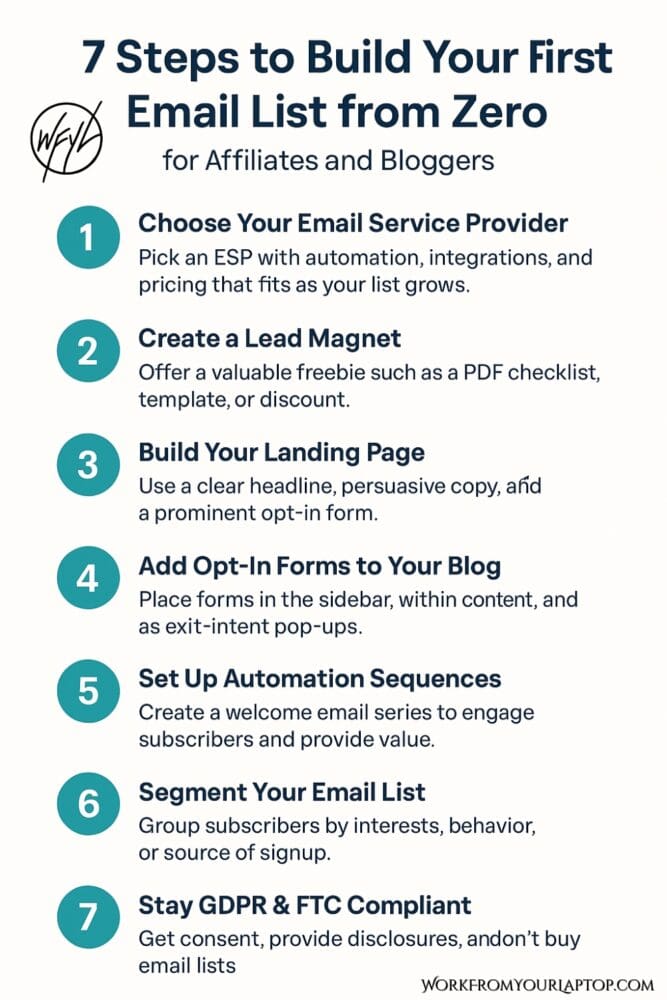
Save this graphic so you’ve got a quick reference anytime you’re working on your email list. Keep it handy and you’ll always know your next step.

how to build an email list step by step graphic

Final Thoughts

Building an email list from scratch means picking the right platform, offering a strong lead magnet, creating focused sign-up points, automating a welcome sequence, segmenting for relevance, and staying compliant from the start.

What do you think? Are you just getting started or looking to grow what you already have? Share your biggest email list challenge below! Your insight might help another reader, and I’m always looking to hear from you and your perspective!

Trying to make money online and still not seeing results? Create your FREE STARTER ACCOUNT with the same straightforward training I’ve used to create full time revenue online. No matter your experience, this step by step training delivers! Click here and get started NOW!


Frequently Asked Questions

How often should I send emails to my list?
Once a week is a good starting point. It keeps you present without overwhelming your subscribers.

What’s the best lead magnet for affiliates and bloggers?
Short, actionable resources like checklists, templates, and mini-courses. They’re quick to consume and deliver an immediate benefit.

How can I increase my email list conversion rates?
Use lead magnets that solve a pressing problem, place opt-ins strategically throughout your site, and test different headlines and calls-to-action to see what converts best.

Want to Deep Dive Further Into Email & List Building?

  • email automation sequence that converts
    How to Set Up an Email Automation Sequence That Actually Converts
  • How to start a newsletter that works
    How to Start a Newsletter That Works: Easy Tips for Beginners
  • email segmentation 101
    Email Segmentation 101 – Avoid Spam and Boost Conversions
  • creating high converting lead magnets
    Creating High-Converting Lead Magnets
  • Building your first email list
    Build Your First Email List from Zero, Step-by-Step
  • How hard is email marketing as a side hustle
    How Hard is Email Marketing as a Side Hustle?

Written by Eric Cantu · Categorized: Essential Reads, Email & List Building

  • Page 1
  • Page 2
  • Go to Next Page »
  • Home
  • Sign Up
  • Blog & Search
  • Privacy Policy
  • Affiliate Disclosure

Copyright © 2026 · Work From Your Laptop · Eric J. Cantu · All Rights Reserved