Last updated on April 14, 2026 · Comprehensive breakdown, <10 min read
You just spent your entire weekend (or week) perfect you latest post. You smash that “publish” button with high hopes. And then… crickets.. How frustrating is that?! All that hard work and you’re buried on page ten of the search results? Not on my watch. Let’s pull back the curtain on how search actually works in today’s changing climate and how you can stop guessing and start ranking.
TL;DR: How Can I Rank My Blog Posts at the Top of Google Consistently?
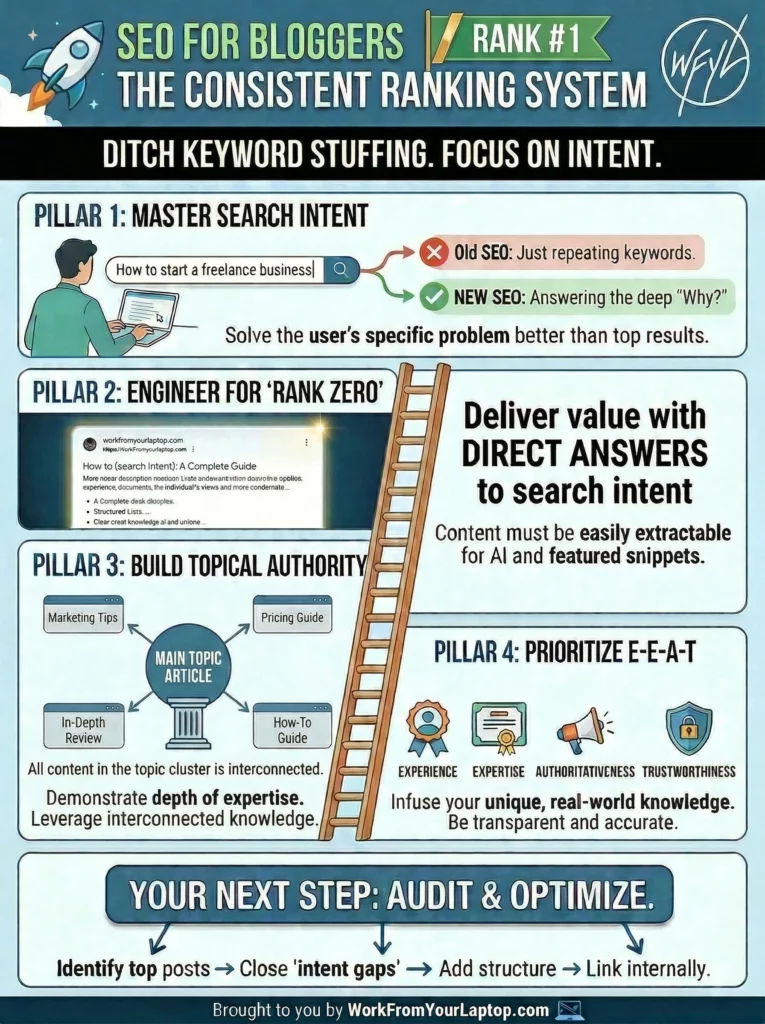
To rank consistently, align your content with user intent, build topical authority through interlinked clusters, and optimize for both human readability and AI-driven search engines. Focus on providing unique, experience-based insights that add value beyond existing top-ranking search results.
Golden Rules of Ranking:
- Target Search Intent: Write to solve the user’s specific problem, not just to rank for a keyword.
- Prioritize Topical Authority: Build clusters of related articles to prove your expertise to search algorithms.
- Optimize for AI & Humans: Use clear headings, direct answers, and structured lists for both search crawlers and readers.
- E-E-A-T is Everything: Infuse your content with personal experience, credentials, and transparent, factual accuracy.
What’s In This Article? (Quick Jumps)
- Why SEO Still Matters Right Now
- My Experience With Ever-Changing SEO
- Step-by-Step Breakdown: The Core Strategy
- Common Pitfalls & What To Avoid
- Your Next Step
- Final Thoughts
- Frequently Asked Questions
Why SEO Still Matters Right Now
SEO has evolved from simple keyword optimization into a holistic system of signals. Google’s algorithms now evaluate your site’s overall quality and trustworthiness. Ignoring SEO means your best content remains invisible, while mastering it ensures a steady stream of targeted traffic that compounds over time.
I’ve heard plenty of bloggers argue that SEO is dead. In my opinion, this is a really, really bad take. I believe now more than ever it’s hyper essential for driving organic traffic and building your brand.
One of the more common misconceptions about SEO is that it’s a one-time effort. For SEO to even begin to work there needs to be consistent effort and a long-term strategy in place. With the rise of new technologies SEO is as important as ever.
We’re living in a time where AI-powered search engines can summarize the internet in seconds. So don’t kid yourself into thinking you’re only competing with other bloggers. You are 100% competing with AI for the “featured” slot in AI overviews.
Let me make this crystal clear from personal experience: SEO is not dead. It’s simply time to adapt. Results don’t come overnight. We’re playing the long game here.
My Personal Experience with Ever-Changing SEO
If you follow me, then you know I’m a Captain in the Fire Department and I run this blog as a serious operation alongside my career. It’s allowed me to travel this world more than I ever thought possible. So I know what I’m talking about when it comes to using Google as the absolute powerhouse tool it is to reach your audience.
Just like in the fire department, you have to apply a logical, step-by-step system that you’re consistent with to get the results you’re looking for with SEO.
Back in 2017 you could arrange the words in your title in a certain way and suddenly shoot to the top of the SERPS. That’s not even close to a thing now.
I’ve moved away from focusing on keyword order because that doesn’t align with how search works anymore. The focus now is entirely on overall intent. When I write, I prioritize what I feel is my reader’s actual goal. I write so that the article is the most direct and accurate answer they can find online.
I want my article to be talking to the reader directly. That’s how you snag the “Rank Zero” position: by being the best source for the information that the reader has “a-ha” moments for.
I don’t rely on guessing or hacks or shortcuts. There’s no such thing. I try to build pages that are simultaneously easy to follow but also structured and easy for AI engines to scan and extract from. You can’t focus on one and not the other.
When you make your focus being the most reliable, accurate source for your topic, your results start being way more consistent. And don’t worry, I’m about to lay down the straightforward approach I use so you can to.
Ready? Let’s break this down.
Step-by-Step Breakdown: The Core Strategy
A consistent ranking strategy requires a shift from keyword volume to topical depth. Start by selecting one primary niche, identifying the specific questions your target audience asks, and creating comprehensive, interconnected content that satisfies their intent better than anything else currently available in search results.
Step 1: The Niche “Deep Dive”
You don’t have to rank for every single aspect of every single pain point your audience has. Choose one specific problem you solve for a specific person. Choose something you have actual experience with. Remember, you’ve picked your niche based on passion, right? Use tools like Google Search Console or just do like I do and dive into Google itself to find low-competition, long-tail questions.
Pro Tip: Most people target broad terms. Instead, target specific long-tail questions that address the precise “how-to” questions your audience is asking.
Step 2: Content That Answers Better
When you write, look at the top 3 results for your target topic. Ask yourself: “What’s missing here?” If they have a text-heavy guide, add a comparison table, a checklist, or a personal case study. (Image Studio by Wealthy Affiliate is spectacular for this.) Your goal is to provide a “one-stop shop” answer so the reader doesn’t even think about going anywhere else.
It’s a complete myth that your audience is only interested in the “quick” answer. Understand this: Google and YouTube have a stranglehold on search. Yes, AI is here and people will go to ChatGPT or Gemini for quick answers, but then they go right into Google and YouTube to find the “whole” answer.
Pro Tip: AI is your friend. Use it to brainstorm structures, but always rewrite the content in your own voice. Google’s algorithm is incredibly good at identifying generic, AI-written filler. Be honest, when you read this article, can’t you hear me talking? Do the same for yours.
Related article: Think that PPC kills SEO? Check out my full guide on SEO vs PPC and see why PPC has it’s place, but you can never quit SEO!
Step 3: Link Your Content Like a Web
Search engines want your site to be this interlocking, connected entity. If you write an article, make sure it links to at least two other relevant posts on your site, and have at least two existing posts link back to it. This creates a “cluster” that signals to Google you are an expert on that topic. It’s also great for the user experience of your reader.
Pro Tip: Do your best to avoid “orphan pages.” Never publish an article without at least one internal link pointing to it from your high-traffic pages. If it doesn’t connect to your other content, then it’s probably not a good fit for your site.
Common Pitfalls & What to Avoid
Beginners often fail by chasing “vanity metrics” or outdated tactics. To succeed, prioritize E-E-A-T signals: Experience, Expertise, Authoritativeness, and Trustworthiness. Do this by demonstrating real-world knowledge and maintaining technical hygiene on your site.
- Keyword Cannibalization: Stop targeting the same intent on multiple pages. Workaround: Audit your site and consolidate those pages into one “pillar” page.
- Ignoring Mobile Users: Remember that over 50% of your traffic is on mobile. Workaround: Use a mobile-responsive theme and test your site layout on your phone regularly.
- Thin Content: Stop posting less than 300 word articles that offer no value. Workaround: Aim for comprehensive guides that solve the reader’s intent completely.
- Buying Backlinks: Never do this. This is a quick way to get penalized and dropped to the bottom of Google. Workaround: Earn real backlinks by creating genuinely helpful resources, original research, or data-backed insights.
- Neglecting Site Speed: A slow site kills your rankings. Workaround: Use a fast host, compress your images before uploading, and don’t stuff your content with noise or overdo plugins.

Your Next Step
Stop thinking about your blog as a collection of random posts and start seeing it as a library of assets. Whether you’re just starting or you’ve been grinding away for years, the work doesn’t stop when you hit “publish.”
To actually rank, you need to apply what we’ve covered to your existing practices:
- For the New Blogger: Stop hunting for “perfect” keywords. Pick one core problem you’re going to solve, outline the five most common questions your audience asks about it, and write the answer to each one. Focus on getting these first five pieces live and linked together. This is your foundation for building early topical authority.
- For the Seasoned Veteran: Stop churning out new content just to stay “active.” Audit your existing articles and find your top-performing pieces (AI is great for this kind of stuff). Now look for “intent gaps” and places where you haven’t fully answered the user’s follow-up questions. Update these posts and snag that Rank Zero position away from the competition who hasn’t updated their content in years.
Take a look at your Google Search Console data to see what queries you’re already getting impressions for, even if you aren’t ranking well. That’s your low-hanging fruit. Take the highest-potential post, strip out the noise, sharpen the answer, and create a cluster around it.
Need some tips on the visuals of your blog to make it easy on the eyes while still delivering value? Check out my guide on building a visually perfect blog post and get that leg up on the competition.
Final Thoughts
SEO isn’t a “get rich quick” scheme; it’s a long-term asset-building strategy. Do the work today by answering one user question perfectly, and you’ll reap the traffic rewards for years to come.
What do you think?
- What’s the biggest roadblock you face when trying to rank your blog posts?
- Have you ever tried to update an old post with better information, and did you see a traffic shift?
What other questions do you have for me? I absolutely love hearing your perspective so don’t be shy! Drop your comments and questions down below!
Ready to stop chasing advice and build something that works?
I owe all my success to this training. Trust me, it’s worth taking a look.
🎯 Click here to check out my full review.
Frequently Asked Questions
Does AI-generated content hurt my SEO rankings?
Not necessarily. Google focuses on the “helpfulness” of content, not the tool used to write it. If your content provides unique value, experience, and accuracy, it will perform well. If it’s generic, repetitive, or inaccurate, it will fail regardless of whether a human or AI wrote it.
How often should I update my old blog posts?
You should review and update your content whenever the information becomes stale, or at least every 6–12 months. Updating old posts with fresh data, new insights, and broken link fixes is often faster than writing new content and signals to Google that your site remains current.
What is the fastest way to build topical authority?
Focus on “content clusters.” Choose a core pillar topic and create a comprehensive main page for it. Then, write 5–10 supporting articles that answer specific sub-questions and link them all back to the pillar page. This structure tells search engines exactly what your site specializes in.
Want More Search Engine Optimization Strategies?
SEO is the key to building traffic! Don’t stop your momentum now! Dive into these guides and turn that traffic into revenue!
- SEO for Bloggers: How To Get to the Top of Search Rankings Consistently

- Generative Engine Optimization (GEO): How to Optimize for AI‑Driven Search
- SEO vs PPC: Which is More Effective in 2024? Numbers Don’t Lie!
- How the 2024 Google HCU Has Impacted SEO – Strategies for Recovery
- Why is my bounce rate over 100?





Hi there, Eric, you know me. I’m reading your excellent post about search engine optimization. I compliment you, you practice what you preach. I’m enjoying this post, and I’m bookmarking it in my browser to come back and read it again. I think you truly follow your own Golden Rules of Ranking. BTW, I had to look up what E-E-A-T meant. And yes, my AI told me that this meant “Experience/Expertise/Authoritativeness/Trustworthiness” and that it helps build trust. Yes, I remember reading that before within Wealthy Affiliate – probably from one of your posts. I’ll keep working on the other 3 bullet points in your Golden Rules. I’m going to start doing Step 2 and researching the top 3 search results. Good information, lots of it. And yes, I’ll check out the linked articles too, because I know they will be great. Have a great Day – Shirley
Keep up all the great work, Shirley! When you inject your experiences (and even if you feel you don’t have “experience” in a subject, add your personal perspective) that is what allows you to connect with your audience. Glad you enjoyed this!
This is such a comprehensive guide to SEO for bloggers! One question: For someone just starting out, would you recommend focusing on one or two SEO tactics first (like keyword optimization and internal linking) before tackling everything at once? Also, how soon can new bloggers typically expect to see results from these efforts?
SEO is something you incorporate as a whole to your content. You don’t take just one or two aspects and then leave others out when you know better. With time, it all becomes routine. Keep up the good habits! Thanks for the comment!
I have enjoyed this article, and I have two questions for you.
First, what’s the biggest challenge you face when shifting from keyword-first SEO to an intent-first approach, beyond the obvious people looking for specifics?
And second, have you noticed better rankings or engagement since focusing on search intent rather than just keyword placement?
Thanks, and have a great day!
It’s not so much a challenge as it is a shift in how you approach your work. You have to be aware that there’s been a shift to make that shift. And when you do, yes, you see increased traffic because now you’re playing by the search engine’s rules. ???????? Thanks for the comment!
I have been trying to get my head around the complexities of SEO, and your details here were both practical and seem easy enough to put in place. I have started applying a few of your tips, especially around keyword research and optimizing content, and I am already seeing some improvements (all be it small) in my rankings.
Do you have any advice on balancing SEO efforts while at the same time keeping a natural, engaging writing style for readers?
That’s what the article is all about 🙂 Remember your SEO keys but deliver value and don’t keyword stuff. Thanks for the comment!
Hi Eric,
You mentioned that keywords are king so getting it right is critical. I had never used the Google Keywords Planner, so I tried it after reading your post, but it didn’t seem intuitive to me. It suggested only two items to me from my input. Any tips on how to get the best out of the tool?
Google keyword planner is just one example of the many keyword research tools out there. I personally use Jaaxy or go directly to Google itself to find low competition keywords. Thanks for the comment!